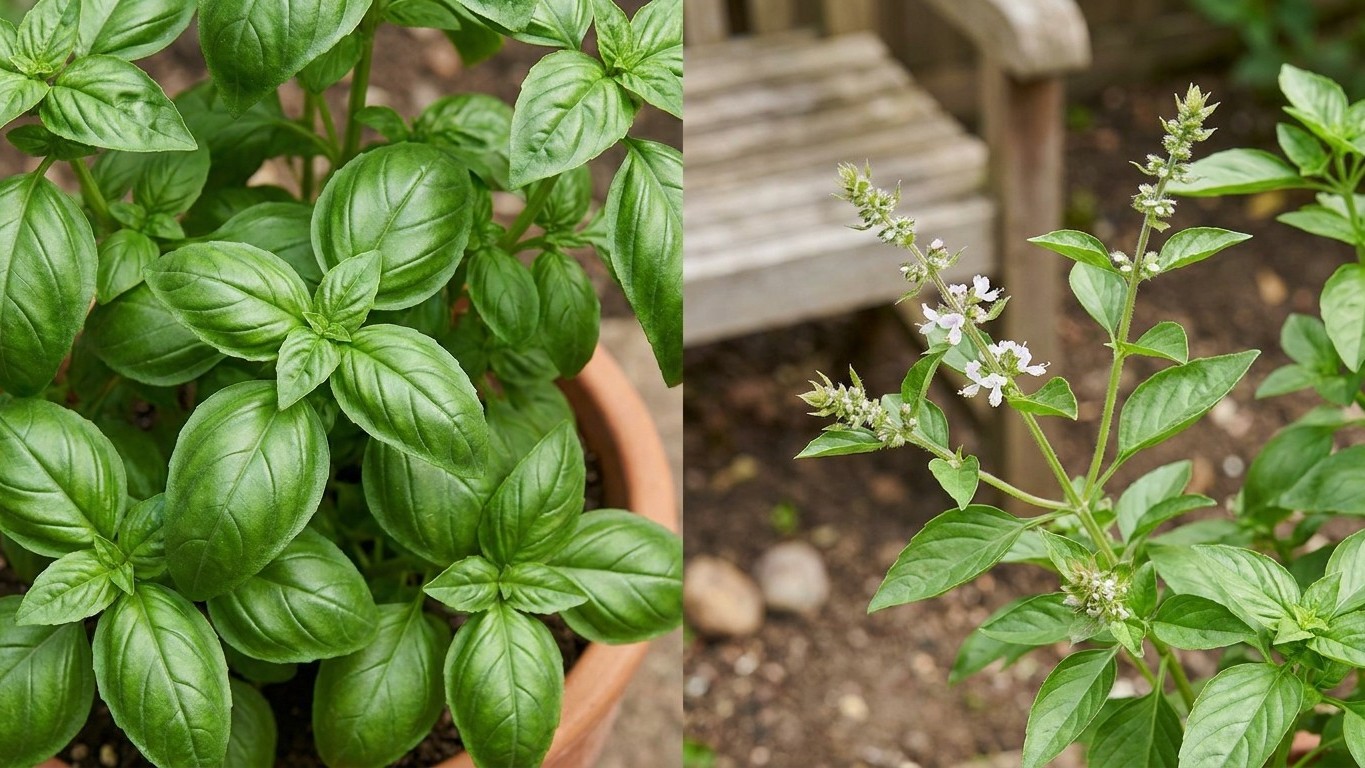

No, pinching basil flowers does not give you more leaves. According to Utah State University Extension, pinching flowers off once they’ve formed “does NOT stimulate new foliage” and instead “encourages flowers to form in the axils of the leaves,” which actually reduces how much basil you get. The leaf boost everyone talks about comes from a different move, made at a different time, before any bloom shows up.
The short answer
Utah State University Extension, in its guide Basil in the Garden, draws a hard line between two actions gardeners tend to lump together. Removing leaves regularly, done before the plant ever tries to flower, forces basil to branch out and produce more foliage. That’s the mechanism most people think they’re using when they “pinch” a basil plant. But once a flower bud has already formed, pinching it off is a different action entirely, and it doesn’t reset the plant back to leaf-production mode. Instead, the extension found that removing an open or forming flower pushes the plant to throw out more flowers from the leaf axils, the little joints where each leaf meets the stem. More flower sites means less energy going into leaf tissue. The yield drops.
This is worth sitting with, because it contradicts a piece of advice that’s been repeated in gardening circles for decades: “pinch the flowers so it makes more leaves.” That instruction isn’t wrong because pinching is bad. It’s wrong because it names the wrong target and the wrong timing. The plant needs its leaves removed on a schedule, continuously, long before flowering starts. Waiting until a flower bud appears and pinching that bud is closing the barn door after the horse has already decided to leave.
The practical upshot: if you’ve been letting basil grow tall and bushy, ignoring it for a couple weeks, then panicking and snapping off flower spikes when they show up, you’ve been managing the plant backward. The leaves should have been coming off the whole time. Once you see a flower, in a Utah State University Extension sense, you’re already behind, and the pinch you reach for won’t buy back what’s lost. Get basil in the ground after your last frost date, since it has zero cold tolerance, and start the leaf-removal habit from the first real growth spurt, not after trouble shows up at the top of the stem.
What actually decides it

Two different gestures, two different outcomes
The confusion comes from treating “pinching” as one universal technique. Utah State University Extension separates it cleanly: regular leaf removal before flowers form is what drives branching and higher foliage output. Pinching flowers after they’ve formed does the opposite, encouraging more blooms rather than more leaves. These aren’t two names for the same habit. They’re two different interventions that happen to look similar with your fingers, and only one of them helps your harvest.
What actually triggers the flip to flowering
Basil doesn’t flower on a whim. Utah State University Extension identifies the trigger directly: high summer Temperature and water stress cause basil to flower and set seed. Once that switch flips, off flavors develop and the plant stops producing leaves the way it did before. This means flowering isn’t really a growth stage you manage with scissors. It’s a stress response. The plant is bolting toward seed production because conditions told it survival, not leaf mass, is now the priority. Pinching a flower off a stressed plant doesn’t remove the stress. The plant just tries again.
Nitrogen is part of the equation, not an afterthought
Anyone coming to basil after growing beans or peas needs to reset expectations here. Legumes fix Their Own Nitrogen through root bacteria and generally do fine, or even worse, with added nitrogen fertilizer. Basil doesn’t have that trick. It’s a heavy leaf producer, and leaf production runs on nitrogen. A basil plant that’s short on nitrogen is a basil plant under stress, and stress is exactly what pushes it toward flowering early. Feeding basil consistently isn’t optional if you want sustained foliage; it’s part of preventing the very problem this whole article is about.
How to do it
- Plant after your last frost date. Basil has no frost tolerance, so timing is set by your local frost calendar, not a fixed date on the page. Cold-stressed transplants start life already behind, which sets up early flowering later.
- Start regular leaf removal as soon as the plant is established and growing, well before any flower bud appears. This is the leaf removal Utah State University Extension credits with forcing more branches and more foliage. Waiting until the plant “needs” it is waiting too long.
- Cut stems back to a point just above a healthy pair of leaves, rather than plucking single leaves from the top. This is what drives the plant to branch outward instead of just growing taller with fewer, higher leaves.
- Feed with nitrogen on a regular schedule. Because basil lacks the nitrogen-fixing ability of legumes, ongoing fertility is part of keeping the plant out of the stress zone that triggers flowering.
- Water consistently and avoid letting the plant dry out between waterings. Water stress, alongside high summer heat, is one of the two named triggers for premature flowering and seed set.
- Sow a new round of basil every other week through the growing season. This is the preventive step Utah State University Extension specifically recommends to keep plants from flowering too quickly, since younger plants further from bolting can carry you through when older ones start to decline.
- If a flower bud does appear despite all this, don’t pinch just the bud. Cut the entire flowering stem back down to the nearest strong leaf node below the bloom. You’re sacrificing that section’s growth, but you’re removing the flower structure entirely rather than triggering more blooms in the leaf axils below it.
What Goes Wrong
- Pinching the flower bud itself instead of removing the whole stem. This is the mistake at the center of the confusion. A quick pinch of just the bud leaves the leaf axils primed, and the plant responds by forming more flowers there, not more leaves. The fix is cutting back to a leaf node well below the bloom, removing the flowering structure rather than trimming its tip.
- Letting the plant coast through a hot, dry stretch without extra attention. Heat and water stress are the named triggers for flowering and seed set, and once that starts, flavor drops along with leaf production. The remedy is steady watering and, in punishing heat, some afternoon shade to take the edge off.
- Treating basil like a legume and skipping fertilizer. Beans and peas can lean on nitrogen-fixing bacteria in their roots; basil can’t. Underfeeding a leafy crop like basil creates the kind of stress that pushes it toward early flowering. Fertilize on a regular schedule instead of assuming the soil will carry it.
- Planting once at the start of the season and expecting it to produce all summer. A single planting ages, gets stressed, and bolts on its own timeline, often all at once. Succession sowing basil every other week keeps younger, more productive plants coming behind the ones that start to decline.
- Freezing fresh basil leaves plain, expecting them to hold up like other herbs. Plain frozen basil leaves turn black and mushy on thawing because of their high water content and delicate cell structure. The workaround gardeners rely on is freezing basil already processed, blended with a little oil into a paste or pesto base, which protects the texture and color far better than freezing whole leaves loose in a bag.
Common questions
Should I remove basil flowers at all once they appear?
You can, but understand what it does and doesn’t do. Removing the whole flowering stem, cut back to a leaf node below the bloom, stops that stem from setting seed and keeps off flavors from spreading further. It won’t restore the leaf production you’d have had if flowering had never started, since Utah State University Extension notes the plant tends to flower again from the leaf axils rather than resume leafy growth.
Why does my basil flower so fast in summer?
Utah State University Extension points to high summer temperature combined with water stress as the direct trigger. It’s not simply the plant’s age or a calendar date; it’s a response to heat and dryness pushing the plant to prioritize seed production over leaf growth.
Does basil need fertilizer the way vegetables do, or can I treat it like beans?
Basil needs regular nitrogen. Unlike beans or peas, which fix nitrogen through root bacteria, basil has no built-in nitrogen source and depends on what’s fed to it or already present in the soil. Skipping fertilizer puts the plant under the kind of stress that speeds up flowering.
Is there a basil variety that resists flowering or produces more leaves regardless?
Utah State University Extension lists many basil varieties without ranking most of them on this point, but it does single out two: ‘Genoa Green’ as a top foliage producer, and ‘Purple Ruffles’ as a low foliage producer. Beyond that distinction, the extension attaches no other specific claims to individual variety names.