
Apple maggot flies in Manitoba typically start emerging from the soil in early-to-mid July and stay active into September, a window shaped by the province’s shorter, cooler growing season compared to Ontario or the Maritimes. Stopping them comes down to three moves done in the right order: hang sticky traps before the flies show up, clean up dropped fruit fast, and treat only after a trap tells you it’s time, not on a fixed calendar date.
What Apple Maggot Damage Actually Looks Like

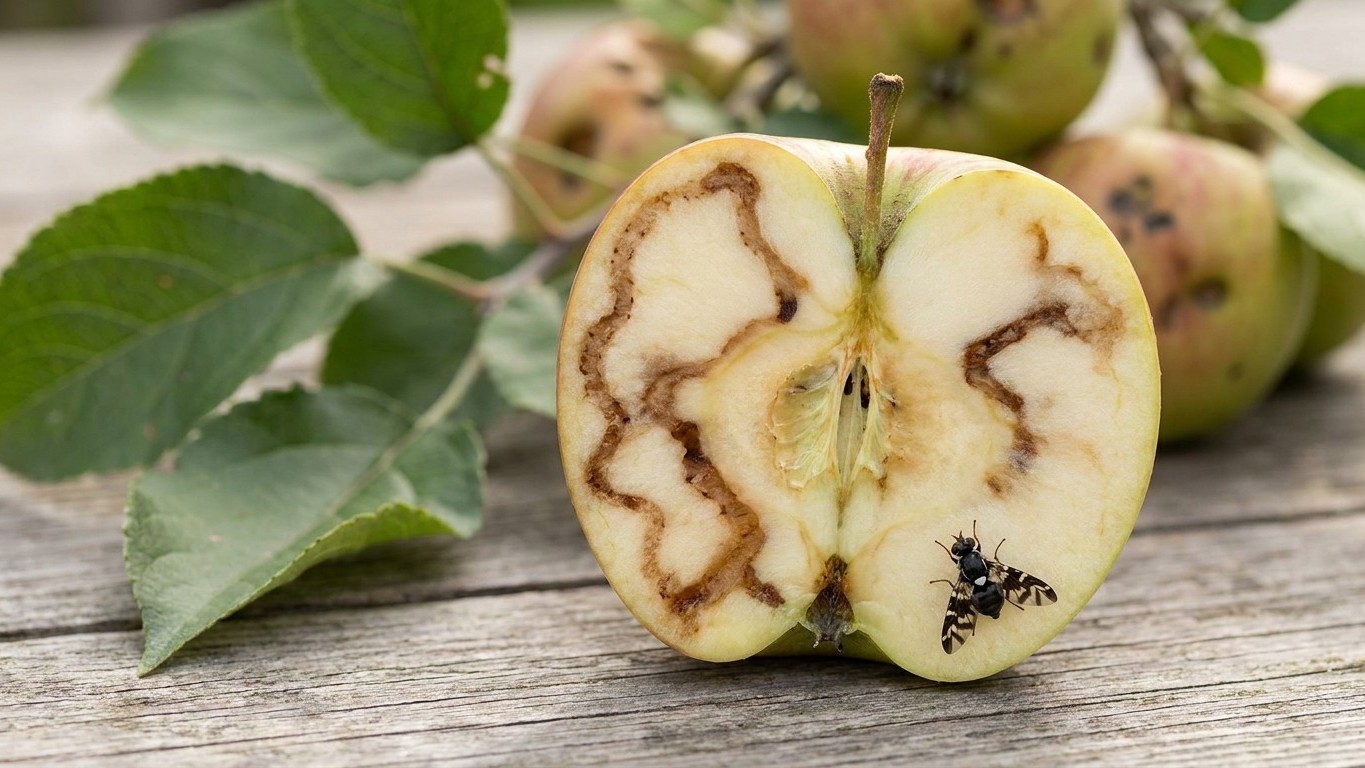
The adult fly is about the size of a housefly, with a shiny black body, white markings on the thorax, and distinctive dark bands zigzagging across clear wings. That banded wing pattern is the giveaway if you catch one in a trap and want to confirm it’s not just a random insect. Females use a sharp, saw-like ovipositor to puncture apple skin and lay eggs just under the surface, and that’s where the real trouble starts.
Inside the fruit, larvae tunnel through the flesh in winding paths that growers describe as railroad-track scarring, a pattern that browns and softens the tissue around each tunnel. Fruit often drops early, sometimes weeks before it would normally ripen, and apples that stay on the tree turn lumpy and dimpled where the tunnels run close to the skin. Crabapples and hawthorn get hit too, which matters a lot in Manitoba yards since ornamental crabapples are everywhere in Winnipeg neighborhoods and act as a year-round reservoir for the pest even when nobody’s growing apples for eating.
When Apple Maggot Shows Up in Manitoba
The insect overwinters as a pupa buried one to five inches deep in the soil beneath host trees, and adults don’t emerge until the ground warms enough and holds that warmth for a stretch of weeks. Manitoba’s slower spring push and shorter frost-free stretch mean that warm-up happens later than it does further south and east, which is why local emergence tends to land in early-to-mid July rather than June.
Peak flight activity generally follows four to six weeks after that first emergence, putting the busiest egg-laying window somewhere in late July through August for most of southern Manitoba. Most populations run a single generation per year here, though a warm, extended fall can occasionally push a partial second wave. That single-generation pattern is actually good news for backyard growers: miss the window once and you’re not fighting a fresh batch every few weeks the way you might with some other orchard pests.
One wrinkle worth knowing: because crabapples and hawthorn host the same fly, a neglected ornamental tree a few yards over can keep reseeding a population even in a season where you’ve done everything right on your own apple tree. Flies aren’t picky about property lines.
What Stops It: Monitoring and Control That Works
Trapping tells you when to act
Red sticky spheres, roughly baseball-sized and coated in tanglefoot-type adhesive, mimic a ripening apple and pull flies in when baited with an ammonium-based lure. Hang two or three per tree at eye level on the sunnier, south-facing side of the canopy starting in mid-June, before you expect any activity, and check them weekly. Yellow sticky panel traps work as a lower-cost alternative and catch a broader range of flies, which makes them useful for a first warning but less precise for confirming apple maggot specifically.
The point of trapping isn’t to eliminate flies through the trap itself. A handful of traps on a mature tree won’t catch enough insects to matter. What they do is tell you the exact week local flies became active, so any spray or barrier treatment goes on when it can actually intercept egg-laying adults instead of being wasted on a tree with no flies around yet or applied too late after eggs are already inside the fruit.
Sanitation removes next year’s problem
Larvae finish feeding inside a dropped apple and then exit into the soil to pupate, so every windfall left on the ground for more than a few days is a chance for the cycle to complete itself right under the tree. Picking up dropped and obviously infested fruit every two to three days during the active season, and disposing of it away from the root zone (bagged in the trash, not the compost pile), cuts off a meaningful share of next year’s population before it ever gets started.
Extending that cleanup to nearby abandoned crabapples, unmanaged hawthorn hedges, or a forgotten apple tree at the property line does more for long-term control than most people expect. A single untended host tree can supply flies to every managed tree within a few hundred feet, which is roughly the distance an adult apple maggot fly will travel searching for fruit.
Treatment options for home orchards
Once trap counts cross the threshold of a couple flies per trap in a week, home growers generally reach for one of three approaches. Kaolin clay, sprayed as a particle film that coats the fruit surface, makes apples less recognizable and less attractive for egg-laying without relying on a toxic active ingredient. Spinosad-based organic insecticides target adult flies on contact and break down relatively quickly, which suits smaller plantings where reapplication after rain is manageable. Broader-spectrum synthetic insecticides remain an option for larger plantings with heavier pressure, applied on a schedule tied to trap activity rather than a set date.
Timing matters more than which product gets used. Every one of these treatments only works on adult flies before they lay eggs. Once a larva is tunneling inside an apple, nothing sprayed on the outside reaches it, which is exactly why the trap-first approach beats guessing at a spray calendar.
Why It Matters Beyond the Backyard Tree
Some Canadian provinces enforce restrictions on moving apple maggot host fruit or nursery stock out of infested areas and into regions still trying to stay pest-free, since introducing the fly to a new area can be far harder to reverse than managing it where it’s already established. Manitoba sits within the established range of the pest, so a home grower here isn’t typically dealing with the same quarantine paperwork someone shipping fruit into a pest-free zone would face. That said, anyone moving homegrown apples, seedlings, or even soil from around a host tree to another region should check current provincial rules first, since those restrictions can shift year to year based on where new detections turn up.
A single infested apple can carry several larvae feeding at once without showing much on the outside until the fruit starts to soften, which is why a tree that looks fine from the driveway can still be worth cutting open a sample or two before assuming you’re in the clear.