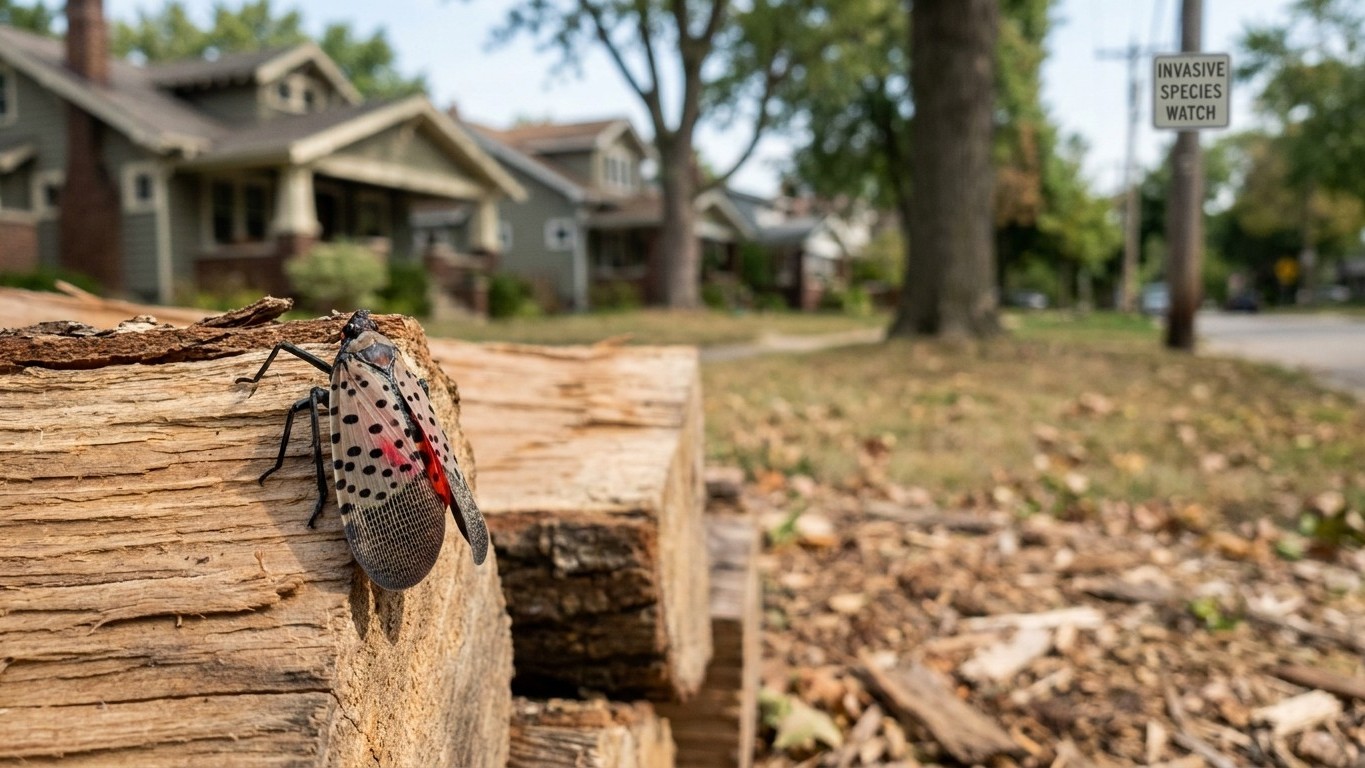

Spotted lanternfly has landed in Illinois, and the state’s confirmed detections are concentrated in the Chicago metro area, particularly Cook County, where the insect was first verified by state agriculture officials in 2023. It hasn’t spread statewide the way it has in Pennsylvania or New Jersey, but Illinois Department of Agriculture inspectors keep expanding their monitoring grid every season because the bug hitchhikes on vehicles, firewood, and outdoor furniture far faster than it flies on its own.
Spotted Lanternfly Status and Spread Across Illinois

The insect (Lycorma delicatula) is a planthopper native to parts of Asia. It showed up in the United States for the first time in Berks County, Pennsylvania, back in 2014, riding in on a shipment of stone. Since then it has crept west and south, county by county, mostly by clinging to cars, trailers, and shipping pallets rather than by flying long distances on its own wings.
Illinois sits on the edge of that spread. The confirmed population in the Chicago region, anchored around Cook County, represents an isolated introduction rather than a slow crawl from Pennsylvania or Ohio, which tells inspectors the bug likely arrived on freight or a moving truck. Downstate Illinois, including farm-heavy counties near the Mississippi River, hasn’t reported an established population as of this writing, though isolated hitchhiker sightings get logged almost every year in truck stops and rail yards.
What makes Illinois a state worth watching isn’t just the Chicago find. The state’s agricultural output, especially grapes grown for the small but growing Illinois wine industry, and its hardwood lumber trade, give the insect plenty to feed on if it establishes further. Vineyards in states like Pennsylvania have already reported yield losses tied directly to lanternfly infestations, and that’s the economic nightmare Illinois growers are trying to avoid.
The Lanternfly’s Calendar: When to Expect It in Illinois
Timing matters more than most homeowners realize. Spotted lanternfly runs through four life stages in a single year, and each one looks completely different, which is part of why so many people miss it until the adults show up in late summer.
Eggs survive the Illinois winter glued to tree bark, fence posts, rocks, or the underside of outdoor grills, coated in a gray, mud-like film that dries to look almost like a smear of dried mortar. Nymphs start hatching in May, appearing first as tiny black insects with white spots, no bigger than a tick. By July they molt into a bright red stage with black and white markings, still wingless, still crawling rather than flying.
Adults emerge around late July through August, roughly one inch long, gray-winged with black spots and a hidden flash of red underwing that shows when they jump. This is the stage most Illinois residents actually notice, usually clustered on tree trunks at dusk or swarming porch lights in September. Females start laying next year’s eggs in September and keep at it into November, sometimes as late as the first hard frost, which in most of Illinois lands somewhere between mid-October and early November depending on the year.
That fall window is the single most important stretch for homeowners to check their property. An egg mass laid in October on a firewood stack or a patio chair can travel hundreds of miles if that item gets moved before spring.
Tree of Heaven: The Plant That Feeds the Invasion
Spotted lanternfly has a strong preference for Tree of Heaven (Ailanthus altissima), a fast-growing invasive tree already common along Illinois highways, rail lines, and vacant lots. It’s not the only host. Nymphs and adults also feed on grapevines, maples, black walnut, river birch, and willow, but Tree of Heaven acts almost like a magnet, concentrating populations where it grows in clusters.
Identifying and removing Tree of Heaven on a property, or at minimum reporting dense stands to local extension offices, is one of the more effective long-term moves a homeowner can make. The tree spreads through both seed and root sprouts, so cutting it down without treating the stump often makes the problem worse by triggering a burst of new shoots.
What Actually Stops It: Control Methods That Work
No single tactic wipes out a spotted lanternfly population. Every state that has dealt with an infestation longer than Illinois has learned that control means stacking several methods together, consistently, across an entire season.
Scraping egg masses off hard surfaces between October and April remains the cheapest and most direct method available to any homeowner. A plastic card or putty knife works fine. Scrape the mass into a bag or container filled with rubbing alcohol or hand sanitizer, which kills the eggs on contact, then seal and dispose of it. Simply scraping eggs onto the ground without destroying them does almost nothing, since a surprising number survive being knocked loose.
Sticky bands wrapped around tree trunks catch nymphs as they crawl up and down during the spring and early summer. These bands need a wire mesh cover, though, because birds, squirrels, and other wildlife get stuck on exposed sticky tape and die needlessly. That’s a real problem that’s been documented in states further east, and Illinois wildlife officials have flagged it as an avoidable mistake.
Systemic insecticides applied to high-value trees, particularly grapevines and ornamental maples, offer another layer of protection, but timing and product selection matter enough that most homeowners are better off consulting a licensed arborist or their county extension office rather than guessing. Contact insecticides work on adults and nymphs directly but need repeat applications since new insects keep migrating in from untreated areas nearby.
Removing or treating Tree of Heaven stands, as mentioned above, cuts off the insect’s preferred food source and breeding ground. In areas with heavy infestations elsewhere in the country, targeted removal of these trees has measurably reduced local lanternfly density within a season or two.
- Scrape and destroy egg masses every fall and winter you find them
- Wrap sticky bands with wire mesh covers, never bare tape
- Identify and manage Tree of Heaven on and near your property
- Inspect vehicles, firewood, and outdoor gear before moving them, especially between September and April
What to Do If You Spot One in Illinois
The Illinois Department of Agriculture asks residents to report suspected sightings rather than assume someone else already flagged it. A photo, even a blurry one from a phone camera, helps inspectors confirm identification and map where new populations might be spreading. Crushing a confirmed adult or nymph on sight, when it’s safe to do so, is also encouraged since every insect removed is one less female laying dozens of eggs in the fall.
Quarantine rules matter here too. States with established infestations, including Pennsylvania and Ohio, have put compliance checklists in place for anyone moving firewood, mulch, nursery stock, or outdoor equipment out of infested zones. Illinois hasn’t issued a statewide quarantine given the limited confirmed area, but that could change quickly if the Chicago population expands, so checking current guidance before hauling yard waste or firewood across county lines is worth the five minutes it takes.
One detail that surprises a lot of people: spotted lanternfly doesn’t bite or sting, and it poses no direct health risk to people or pets. The real damage is agricultural and cosmetic. Large populations excrete a sugary substance called honeydew that coats decks, cars, and patio furniture, which then grows a black sooty mold. Homeowners in heavily infested parts of Pennsylvania have described entire backyards turning sticky and gray by late summer, a problem that pressure washing fixes temporarily but doesn’t solve until the underlying population drops.