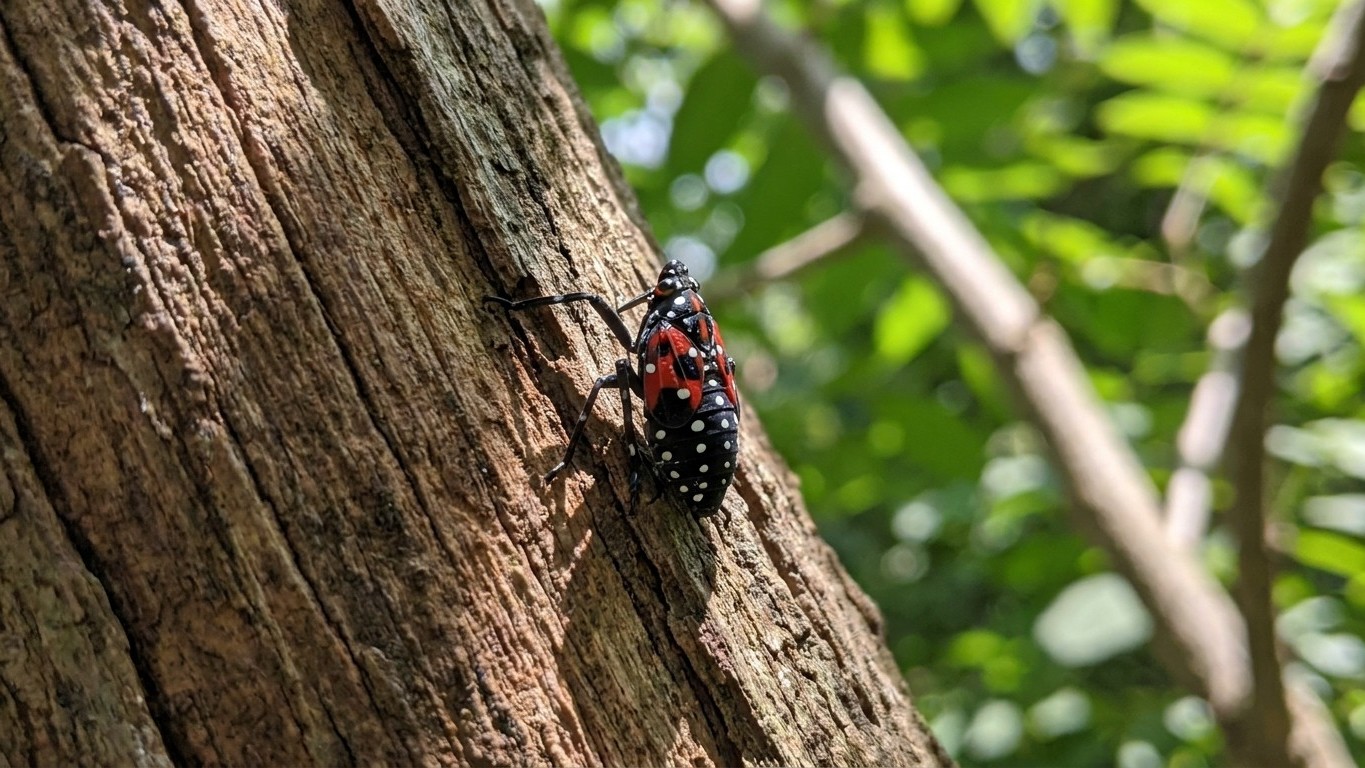

Spotted lanternfly activity in Maryland follows a predictable calendar: egg masses hatch in late April through May, nymphs feed through summer, adults emerge by mid-July, and egg-laying runs from September until the first hard frost kills the adults off, usually in November. The insect is already established across much of central and northern Maryland, with Cecil, Harford, Baltimore, and Frederick counties among the hardest-hit areas. Nothing eradicates it once it settles in, but scraping egg masses, banding host trees, and removing or treating Tree of Heaven can knock populations down enough to protect vineyards, orchards, and backyard trees.
How the Spotted Lanternfly Timeline Plays Out in Maryland

Maryland’s climate mirrors Pennsylvania’s closely enough that the insect’s life cycle here tracks almost exactly with the original Berks County outbreak first confirmed back in 2014. Eggs laid the previous fall survive Maryland winters just fine, tucked under bark, on outdoor furniture, or on the underside of stones and cars. That’s part of why the insect moved south so fast, it hitchhikes on almost any flat surface.
Nymphs start hatching in late April, often coinciding with when Maryland dogwoods finish blooming. The first two nymph stages are small, black with white spots, easy to miss unless you know to check the base of Tree of Heaven trunks. By early July they molt into a red-and-black fourth stage nymph, roughly the size of a dime, and this is usually when homeowners start noticing something unusual crawling up their maples.
Winged adults show up by mid-to-late July and stick around through the fall. They’re the stage most people recognize, gray forewings with black spots, a flash of red underwing when they jump. Females start laying egg masses, gray, putty-like smears about an inch long, in September and keep at it until temperatures drop hard enough to kill them off. That usually happens sometime in November across most of the state, though a mild fall can push activity into early December in the Baltimore-Washington corridor.
Why Timing Matters for Homeowners
Every stage of this insect responds to a different control tactic, so hitting the wrong window wastes effort. Scraping egg masses only works from roughly October through May, before hatching. Sticky bands on tree trunks work best against climbing nymphs in May and June. Circle traps and insecticidal treatments target the feeding stages from June through October. Miss the window and you’re just watching them, not managing them.
Where the Spotted Lanternfly Has Taken Hold in Maryland
The Maryland Department of Agriculture maintains a quarantine order covering counties with confirmed established populations, a list that has grown almost every year since the first Maryland detection near the Pennsylvania border. Cecil County was ground zero for the state, given its location right along the I-95 corridor where infested nursery stock and shipping pallets first crossed the line from southeastern Pennsylvania.
From there the insect spread the way it always does, along highways, rail lines, and trucking routes rather than by flying long distances on its own. Adults are decent jumpers and short-distance fliers, but the real dispersal engine is human transportation. Egg masses laid on a parked trailer in Elkton can end up hatching in a driveway near Frederick or Rockville months later.
Harford, Baltimore, Howard, and Anne Arundel counties now report established breeding populations, and detections have pushed further west into Frederick and Washington counties, both of which sit near vineyard country in the state’s fruit belt. That’s a genuine worry for growers, since Maryland’s wine industry has expanded significantly over the past two decades and grapevines rank among the lanternfly’s most damaging host plants. A heavily infested vine can lose enough sap and vigor over a season to reduce fruit quality or kill the plant outright within a few years of sustained feeding.
Southern Maryland and the Eastern Shore have seen fewer confirmed breeding sites so far, though isolated adult sightings get reported almost every season as the insect continues pushing outward. The USDA Animal and Plant Health Inspection Service tracks the pest’s spread nationally and coordinates quarantine guidance with state agriculture departments, including Maryland’s.
What Actually Stops It
No single tactic wipes out a spotted lanternfly population once it’s established. Control here means layering several methods across the calendar year, the same approach vineyard managers in Pennsylvania and now Maryland have refined over the past decade.
Egg mass removal remains the cheapest and most direct method available to homeowners. A putty knife or plastic scraper works fine, egg masses scrape off cleanly from smooth bark, rocks, or siding between October and April. Drop what you scrape into a bag with rubbing alcohol or hand sanitizer, since crushing alone doesn’t reliably kill the eggs inside the waxy covering.
Sticky bands wrapped around susceptible tree trunks in May catch nymphs as they climb up from the ground to feed on new growth. The catch is that these bands also trap birds, squirrels, and other insects that aren’t the target, so wildlife-conscious products with wire mesh covers have become the standard recommendation over bare sticky tape.
Circle traps, a mesh funnel design that lets nymphs and adults climb in but not back out, avoid that bycatch problem entirely and have become the preferred DIY method for homeowners with just a handful of infested trees. They need to be checked and emptied regularly through summer, since a full trap stops working.
Insecticidal soap and horticultural oil can knock down nymphs on contact but need direct application and repeat treatments, since they have no residual effect. For heavier infestations, especially on high-value trees or in vineyard settings, systemic insecticides applied by a licensed pesticide applicator give longer protection, though timing and product selection matter enough that most homeowners are better off hiring a professional for that step rather than guessing at concentrations.
The Tree of Heaven Trap-Tree Strategy
Tree of Heaven, itself an invasive species from China, happens to be the spotted lanternfly’s favorite host plant in North America. That overlap has led researchers and extension agents to recommend a targeted approach: instead of removing every Tree of Heaven on a property, cut down most of them but leave a few standing and treat those remaining trees with a systemic insecticide.
Lanternflies get drawn to the treated trees, feed, and die, while the surrounding vegetation goes untouched by broad-spectrum spraying. University extension programs across the mid-Atlantic, including Maryland’s, have promoted this method as one of the more efficient tools available to landowners managing larger wooded lots where blanket treatment isn’t practical or affordable.
Removing Tree of Heaven entirely without any treatment plan can backfire, since the insect will simply shift to nearby maples, black walnut, willow, or river birch instead. A one-two approach, cut most of it, treat what’s left, tends to outperform either tactic alone.
Reporting Sightings in Maryland
The Maryland Department of Agriculture asks residents to report suspected spotted lanternfly sightings, particularly in counties not yet under quarantine, since early detection data helps the state track the leading edge of the spread and prioritize survey efforts. A clear photo of the insect or egg mass, along with the location, is usually enough for state entomologists to confirm identification.
Within quarantine counties, reporting individual sightings matters less since the population is already established and tracked. Outside those zones, though, a single confirmed adult can trigger a survey of the surrounding area to determine whether a breeding population has taken hold or whether it’s an isolated hitchhiker that arrived on a vehicle or shipment.
Homeowners moving firewood, mulch, or outdoor furniture from an infested county to an uninfested one should check those items for egg masses first. It sounds like a small thing, but that kind of unintentional transport is exactly how the insect jumped from its original Pennsylvania foothold into Maryland, New Jersey, Virginia, and a dozen other states in less than a decade.