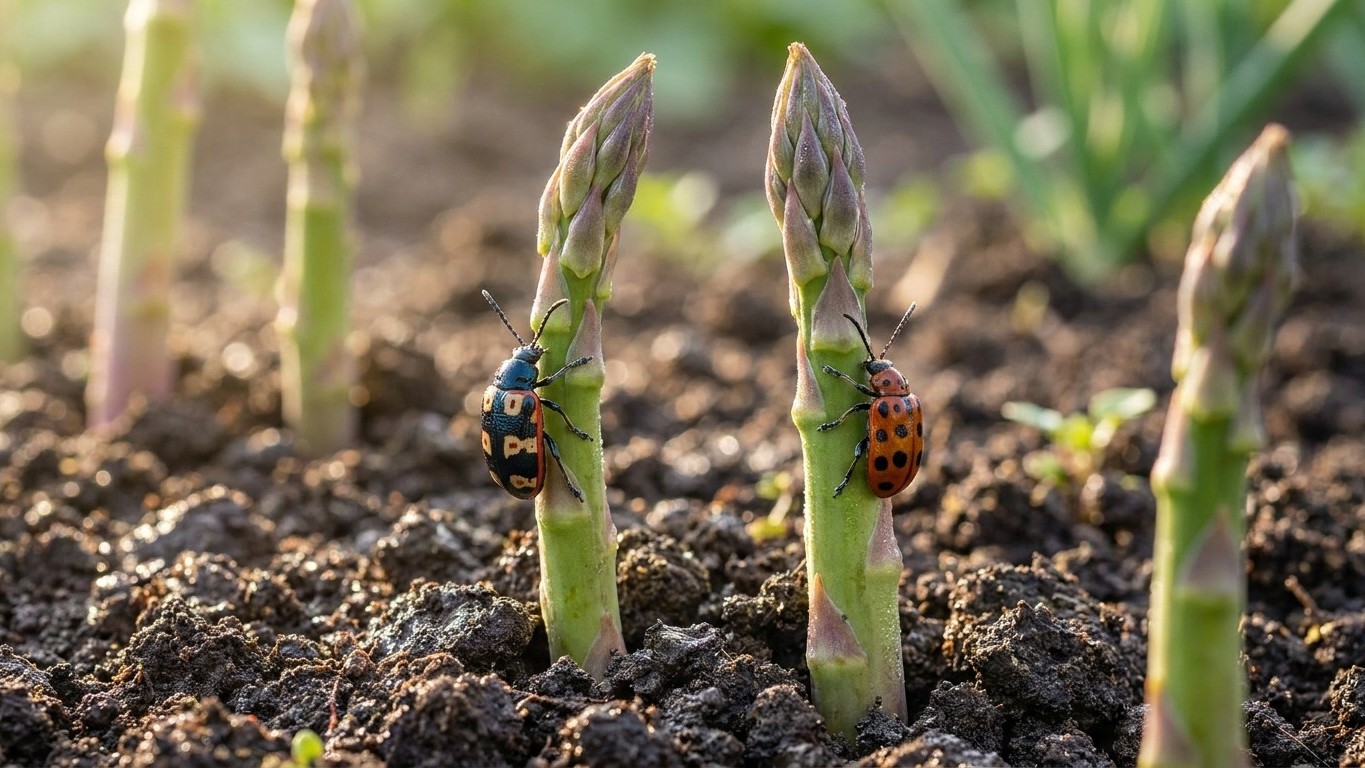

British Columbia gardeners growing asparagus mostly deal with generalist feeders rather than a single dedicated asparagus pest: aphids, cutworms, wireworms, flea beetles, grasshoppers, slugs, spider mites, and earwigs turn up on this crop, usually on the fern rather than the spear itself. Which one shows up, and how much it matters, depends on the stage of the bed and the stretch of the season.
Which pests attack asparagus in British Columbia
The documented list for this territory, drawn from University of Idaho Extension and WSU Extension (the two neighboring services whose pest data covers this border region), names twenty species across garden vegetables generally: aphids, brown marmorated stink bug, cabbage maggot, carrot rust fly, Colorado potato beetle, corn earworm and earwigs, cutworms, cutworms and armyworms, flea beetles, grasshoppers, imported cabbageworm, imported cabbageworm and loopers, onion maggot, onion maggot and onion thrips, pea leaf weevil, slugs, spider mites, squash bug, tomato hornworm, western spotted cucumber beetle, and wireworms.
Most of that list has no business on an asparagus bed. Cabbage maggot and the cabbageworms need brassica leaves. Carrot rust fly and onion maggot are tied to their namesake root crops. Colorado potato beetle and tomato hornworm feed on nightshades. Pea leaf weevil wants legume foliage, squash bug and western spotted cucumber beetle stay on cucurbits, and brown marmorated stink bug is a broad feeder that shows up on fruiting vegetables far more than on a fern-topped perennial. None of these belong on this page, and if you see one of them in your garden, the plant it is damaging is probably standing right next to your asparagus row, not the asparagus itself.
What is left is the short, useful list: aphids, cutworms and armyworms, earwigs, flea beetles, grasshoppers, slugs, spider mites, and wireworms. All eight are generalists that happen to find asparagus foliage or young spears worth a meal, not specialists bred for this one crop. That matters for how you watch for them: you are checking a fern and a soil line, not scanning for one signature insect the way you would for a crop with a dedicated pest.
| Pest | Feeds on this crop here? | Why |
|---|---|---|
| Aphids | Yes | Colonize the feathery fern once it leafs out |
| Cutworms / armyworms | Yes | Clip tender spears and young growth at the soil line |
| Earwigs | Yes | Chew ragged holes in spear tips and fern needles |
| Flea beetles | Yes | Leave small shot holes in emerging tissue |
| Grasshoppers | Yes | Strip fern foliage later in the season |
| Slugs | Yes | Rasp tender spear tips in damp conditions |
| Spider mites | Yes | Stipple and bronze fern needles in dry heat |
| Wireworms | Yes | Tunnel into crowns and spears from the soil |
| Cabbage maggot, carrot rust fly, Colorado potato beetle, onion maggot, onion thrips, pea leaf weevil, squash bug, tomato hornworm, cabbageworms, cucumber beetle, stink bug | No | Tied to brassicas, roots, nightshades, legumes, or cucurbits, not asparagus |
When each one shows up, and what it does first
Crowns go into 8-inch furrows in early spring, and the average last spring frost for this region lands around March 18, though in half the years frost arrives later than that date, so the calendar below runs from crown planting rather than from a fixed month. In the first two seasons after planting, nothing gets harvested at all: the fern grows undisturbed while the crown builds strength underground, and that changes which pests matter, because a fern that is never cut is a fern that feeds insects all summer without interruption.
Wireworms are the earliest concern, and they are already in the soil before the crown ever goes in the ground. They tunnel into the crown and the base of new spears from underneath, so the first sign is often a spear that never fully emerges or comes up chewed and stunted. Slugs follow close behind in cool, damp spring weather, rasping the tender tips of the first spears each season, whether that is the harvestable spears of year three onward or the exploratory shoots of years one and two.
As the weather warms and the fern feathers out, cutworms and armyworms clip young growth at the soil line overnight, leaving a severed stem with no obvious insect in sight during the day. Flea beetles show up around the same window, leaving small shot holes rather than clean cuts. Earwigs arrive once the fern is fully leafed out, chewing ragged notches into both spear tips and needle-like foliage, and aphids begin forming small colonies on the underside of that same fern growth.
The driest stretch of summer is when spider mites become the main worry, since dry, hot conditions favor them and stressed fern is more vulnerable. Grasshoppers build in numbers later in the season and strip fern foliage in a way that looks like general thinning rather than a single hole pattern. None of these pests target a spear that is being cut on a harvest schedule until year three, when the bed starts producing spears worth watching closely for four weeks, then six, then eight, as the plant matures.
Telling the damage apart from everything else
A lot of what looks like insect damage on asparagus is actually soil, water, or cold doing the work instead. The dominant soil profile mapped across this province’s agricultural regions is a young Brunisol, loam to silt in texture, with a median surface pH around 5.8 and roughly 5 percent organic matter, generally well drained. That drainage matters because asparagus stays in the same spot for ten to fifteen years once it starts producing, so a bed that sits wet after rain is not a problem you fix next season, it is a problem you live with for over a decade.
| Symptom | Likely cause | What settles it |
|---|---|---|
| Ragged chew marks on spear tips | Earwigs, or late frost injury | Frost damage blackens the tip uniformly; chewing leaves irregular notches, sometimes with frass |
| Spears clipped cleanly at the soil line | Cutworms/armyworms, or a slug | A slime trail nearby points to a slug; a clean overnight cut with no trail points to a cutworm |
| Stippled, bronzed fern needles | Spider mites, or drought stress | Fine webbing on the underside of the fern confirms mites, worse during the driest weeks of summer |
| Fern yellowing across the bed | Aphid buildup, or a nutrient issue in acidic, low-organic soil | Aphid clusters show on the underside of foliage; uniform yellowing with no insects present points elsewhere |
| Weak or stunted spear emergence | Wireworms, or a poorly drained pocket in the bed | Digging near the base turns up wire-like larvae; standing water an hour after rain points to drainage instead |
None of this is a substitute for a look at the actual plant. A spear that comes up thin and chewed could be a wireworm, a cold snap, or a crown that was planted too shallow. The safest move is describing what you see to your local extension office rather than guessing from a symptom list alone.
What actually works here, and what is a waste of time
On a bed with a short useful season, timing beats treatment almost every time. A floating row cover laid down right after crowns are planted, and kept in place until the fern is established, blocks cutworms, flea beetles, and early slug damage without anyone needing to identify the exact culprit. Handpicking slugs and cutworms in the early morning, when they are still active near the soil surface, catches both before they do real damage, and it costs nothing.
Tilling exposed soil in the fall, once the fern has died back on its own, brings wireworms and other soil-dwelling larvae up where birds and cold temperatures can take care of them before next spring’s crowns or established plants push new growth. Keeping the bed and its borders weeded removes the cover that grasshoppers and aphids use to build up numbers before moving onto the fern itself. Watching soil moisture through the driest stretch of summer keeps the fern from the kind of stress that invites spider mites in the first place.
What does not work is spraying anything broad-spectrum without knowing what you are actually treating. A product aimed at a beetle does nothing for a wireworm tunneling underground, and treating fern foliage after it has already died back for the season is a season too late, since the pest has usually already moved on to overwinter elsewhere. Because pesticide registration for edible crops varies by product and by what is legally approved for use in this region, this is a question for your local agricultural extension office, not a guess based on a product label from somewhere else.
Where to check this for your own county
The pest list behind this page comes from University of Idaho Extension and WSU Extension, the two extension services closest to this border region with published pest data covering this crop. What is documented at that scale does not tell you what is actually in your own garden, and pest pressure inside a single province varies a good deal between a coastal valley and a drier interior bench.
If you garden near the Idaho or Washington border, the county extension offices tied to those two services are worth a direct call. Elsewhere in the province, your nearest regional agricultural office or provincial extension contact is the better first stop, since they can speak to what is actually showing up locally this season rather than what a neighboring jurisdiction has on file. Bring a photo or, better, the damaged spear or fern piece itself, since a description over the phone rarely settles a case as fast as something an agent can look at directly.
The next step is simple: find the extension or agricultural office nearest your address, and ask what has been reported on asparagus in your area recently. That single call will tell you more about your own bed than any provincewide list ever will.
Common questions
Do I need to spray asparagus every year to keep pests off it?
No. A row cover timed to planting and early growth handles several of the pests on this list without any product at all, and yearly spraying without a confirmed pest is wasted effort and cost.
Can I still harvest spears the year I find pest damage?
Only if the bed has already reached its third year, since no spears are cut in the first two years regardless of pest activity. Damage in years one and two affects the fern that is building the crown for later harvests.
Is wireworm damage something I can fix once crowns are in the ground?
Not easily, since wireworms feed underground and out of reach of most home treatments. Fall tilling before planting and after fern die-back is the more practical long-term approach.
Why does my neighbor’s asparagus have a different pest problem than mine?
Local conditions inside one province vary enough that pest pressure differs from one yard to the next, which is exactly why a provincewide list is a starting point, not a diagnosis, and a call to your local extension office settles what is actually happening in your own bed.