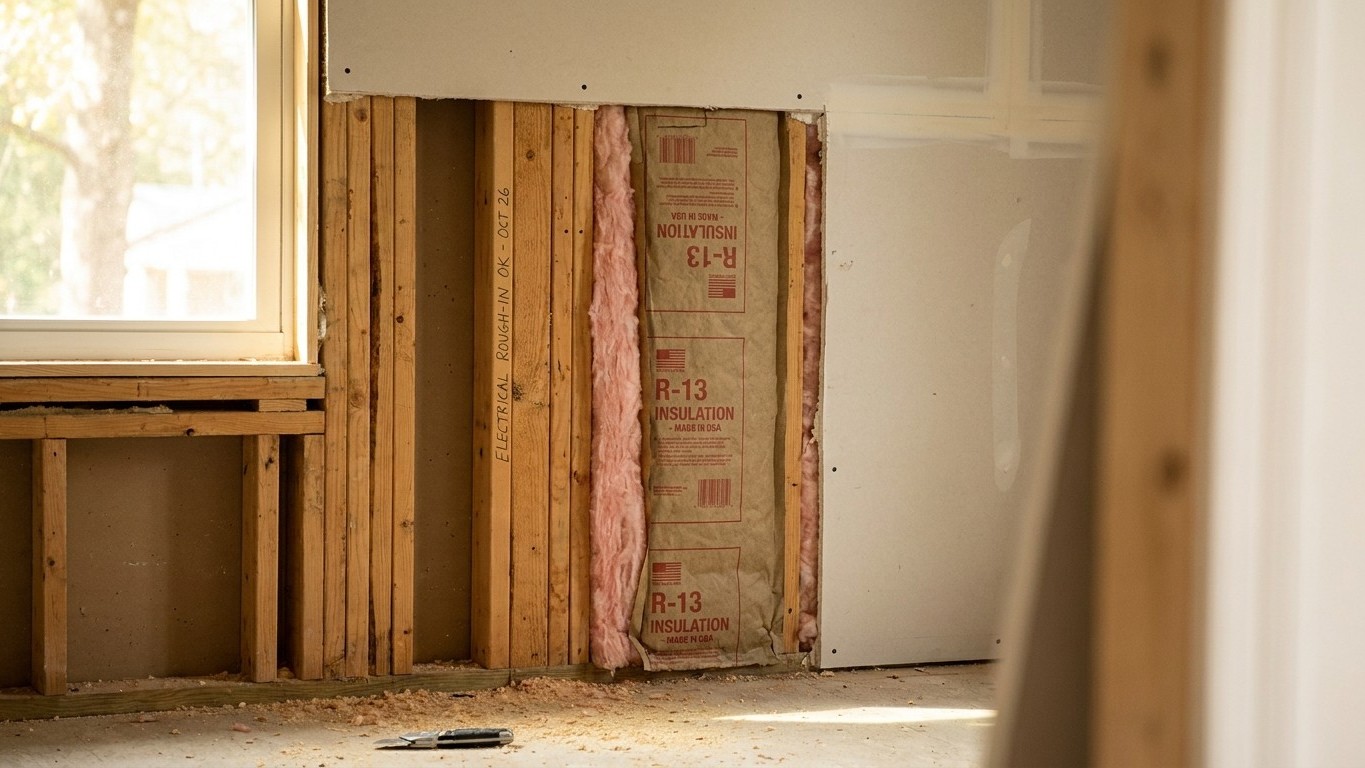

Vermont sits entirely in IECC climate zone 6A, and that single fact settles the question: under the 2021 International Residential Code, a frame wall in Vermont needs an interior vapor retarder. The code doesn’t require it in warm climates, but Vermont isn’t one of them. What changes is which class of retarder, and where the requirement stops applying.
What the code asks for in Vermont

Section R702.7 of the 2021 International Residential Code states that a vapor retarder, of the class listed in Table R702.7(2), shall be provided on the interior side of frame walls. The code then carves out four exceptions, and the one that matters most nationally is this: “A vapor retarder shall not be required in Climate Zones 1, 2 and 3.” Vermont doesn’t get that exception. The whole state, according to the IECC’s Table R301.1, is listed as “6A (all)” with no county-by-county split, which is a rarer situation than most readers realize. Plenty of states have a warm coastal county in one zone and a mountain county two zones colder, forcing anyone checking the rule to look up their own address first. Vermont doesn’t ask that of its residents. Whether a homeowner is in Bennington County or up near the Canadian border in Franklin County, the zone designation is the same.
That means the general rule, not the exception, governs frame wall construction across the state: an interior-side vapor retarder is called for, and the class of that retarder is set by the table the code references, not by whichever material a contractor happens to have on hand. This is where the “not required” language sometimes gets mangled, the exception for Zones 1, 2 and 3 removes an obligation in those places, it doesn’t ban vapor retarders anywhere, and it certainly doesn’t make them illegal to install even where they aren’t mandated. Vermont simply isn’t in that exempted group, so the baseline obligation stands.
None of this tells an individual homeowner what to nail up on their own studs. The code sets a baseline; the class and the placement still depend on the rest of the wall assembly, the insulation type, and how the local jurisdiction has adopted and amended the model code. A wall built with the wrong vapor control doesn’t announce the mistake with a leak or a stain the week after drywall goes up, it shows up years later, as rot inside a cavity nobody opens until something forces the question. That’s the reason this is worth checking with the local building department before framing closes in, not after.
Why the answer is the opposite in a warm climate
The reason Vermont’s answer flips as you move south isn’t arbitrary, and it isn’t bureaucratic caution either. It’s about which direction the water vapor is traveling. In a cold climate like Vermont’s, the warm, moisture-laden air sits inside the heated house all winter. Without a retarder, that vapor pushes outward through the wall assembly and hits cold sheathing, where it can condense. The interior vapor retarder exists to stop that vapor before it ever reaches the cold surface. That’s the entire logic behind R702.7’s default requirement.
Flip the climate, and the physics flips with it. In a warm, humid region, the moisture load isn’t coming from inside a heated house, it’s arriving from the humid outdoor air, pushing inward toward an air-conditioned interior. If a builder puts the same kind of impermeable retarder on the interior side of that wall, they’ve created exactly the wrong surface in exactly the wrong place. The U.S. Department of Energy’s Building America program lays out what happens next in plain terms: “If the wall contains a vapor retarder on the interior side of the insulation, the water vapor will condense on this cool, impermeable surface,” and the result is “ruined insulation, mold, and structural rot of framing members.”
Read that sentence next to R702.7’s exception for Zones 1, 2 and 3, and the code stops looking like a regional quirk and starts looking like a direct response to a physical problem. It’s not that southern building departments care less about moisture control. It’s that the same material, installed in the same spot, causes damage in one climate and prevents it in another. Vermont’s winters put it on the side of the country where the interior retarder is doing the job it was designed for.
The three classes, and why the word matters
The code doesn’t just ask for “a vapor retarder” and leave it there, it defines three classes by permeance, and the class assigned to a given wall depends on the rest of the assembly, not on habit or availability.
| Class | Example materials | Perm rating |
|---|---|---|
| Class I | Sheet polyethylene, nonperforated aluminum foil | 0.1 perm or less |
| Class II | Kraft-faced fiberglass batts, vapor retarder paint | above 0.1 up to 1.0 perm |
| Class III | Latex or enamel paint | above 1.0 up to 10.0 perm |
Sheet polyethylene is what most people picture when they hear “vapor barrier,” but calling it that without qualification skips the part that actually matters: it’s a Class I material, one of three options the code recognizes, and the disagreement between builders in different climates is never about whether to install some kind of vapor control. It’s about which class belongs on that particular wall. A Class I sheet stopping vapor in Vermont is doing the job R702.7 asks for; the same sheet on the interior of a warm-humid wall is the DOE’s cautionary tale from the section above.
Here’s the detail most homeowners miss entirely: ordinary latex paint qualifies as a Class III vapor retarder. Anyone who has painted an interior wall with a standard latex finish already has a vapor retarder on it, whether they intended one or not. That’s often enough to satisfy the code’s intent on an assembly that doesn’t need anything stronger.
One more distinction worth keeping straight: a vapor retarder and an air barrier are not the same thing, even though a single product sometimes does both jobs. A vapor retarder slows moisture diffusion through a material; an air barrier stops bulk air movement through gaps and seams. Confusing the two leads to assemblies that control one problem while leaving the other wide open.
Where the rule stops
R702.7’s default requirement comes with exceptions that apply regardless of climate zone, and Vermont’s builders and inspectors run into these regularly. The code lists them plainly:
- Basement walls
- The below-grade portion of any wall
- Construction where accumulation, condensation, or freezing of moisture will not damage the materials
The basement exception is the one most Vermont homeowners actually encounter, because it runs against instinct. A concrete foundation wall holds moisture and releases it slowly, over years, not days. That assembly needs to be able to dry toward the interior, at least periodically. Seal the interior side of a basement wall with an impermeable sheet, and moisture that would otherwise dry out gets trapped against the concrete instead, with nowhere to go. That’s the reasoning behind treating basement walls differently from the frame walls above grade, and it’s a common source of confusion for anyone assuming the same interior vapor retarder rule applies everywhere in the house. For the specifics of that assembly, the basement wall guide on this site walks through it in more detail.
The third exception, covering construction where moisture won’t damage the materials, is the broadest and the most case-by-case. It exists for assemblies, like certain masonry or unfinished construction, where the failure mode the retarder is meant to prevent simply doesn’t apply. None of these three exceptions overlap with the Climate Zone 1, 2 and 3 exception discussed earlier : Vermont’s 6A designation means that particular exception doesn’t apply here, but the three general exceptions above still do, on any wall in the state that meets their conditions.
Who actually decides, in Vermont
Everything above describes the model code, the 2021 IRC as written by the International Code Council. It is not automatically the code enforced on a specific job site. States and towns adopt building codes on their own schedules, sometimes amending sections, sometimes running a code edition or two behind the current model. The only way to know which version, and which local amendments, apply to a specific project is to ask the local building department directly, before the walls close in.
That question carries real weight in Vermont, because the climate backing up the code language isn’t a mild one. Burlington averages about 6,960 heating degree days a year against a base of 65°F, alongside roughly 656 cooling degree days. Heating degree days measure demand, not temperature, adding up how far below 65°F the average daily temperature falls across the year and by how much. A figure near 6,960 describes a long, sustained heating season, one where a wall assembly spends most of the year working to keep warm, moist interior air away from cold sheathing. That’s the physical condition R702.7’s default requirement is built around, and it’s why the question of vapor retarders in Vermont isn’t a formality.
None of that changes the basic advice: this page describes the rule and what it depends on, not what belongs in any one reader’s wall. A wall built with the wrong vapor control in a climate like Vermont’s doesn’t fail in a way anyone notices right away. It rots quietly, inside a cavity, and the damage surfaces years after the framing was closed up. The local building department, working from whichever code edition the jurisdiction has adopted, is the only source that can answer for a specific address.