
Yes, Insulation keeps an Arkansas home cooler, and here the summer isn’t a footnote to winter. At the reference station in Little Rock, the year averages 69.2 days above 90 F. That’s more than two months of triple-digit heat load pressing down on rooflines, attics and anything living under them.
The short answer for Arkansas

Sixty-nine days above 90 F a year isn’t a mild inconvenience. It’s a sustained stretch, roughly ten weeks scattered across late spring through early fall, where the sun is working the roof deck hard every single day. Compare that to a northern state where a handful of 90-degree days shows up almost as a novelty, and the calculus changes completely. In a place with eight hot days a year, Insulation earns its keep mostly in January. In Arkansas, it earns its keep in July just as much, maybe more.
That’s reflected in how the building code treats this state. Arkansas’s 75 counties fall into two IECC climate zones: 63 counties sit in zone 3A, and 12 counties sit in zone 4A. Both are humid zones, and both sit on the warmer side of the country’s climate divide, not the colder one. Zone 3A is the same zone that covers cities like Atlanta and Charlotte. Zone 4A stretches a bit further toward the transitional middle of the country, where winters carry more weight. But neither zone belongs to the cold end of the spectrum where Insulation is chiefly a heating-season tool.
What that means in practice: for most homes in this state, cooling isn’t a minor slice of the annual energy bill tacked onto a heating-dominated budget. It’s a real half of the story, and in the zone 3A counties, the bigger half. That reframes what Insulation is actually doing in an Arkansas attic. It isn’t just holding warm air in during a few cold snaps. It’s standing between a scorching attic and the living space below for two and a half months of the year, every year.
None of this means winter doesn’t matter here. Arkansas gets real cold snaps, and Insulation still pays off then too. But a homeowner budgeting for insulation work in this state, whether in the zone 3A counties around Little Rock and the southern half of the state or the zone 4A counties toward the north, should weigh the summer side of the ledger seriously. The 69.2 figure is a season length, not a forecast for any single week, but it’s the honest measure of how often this state’s homes are fighting heat rather than cold.
What happens above the ceiling
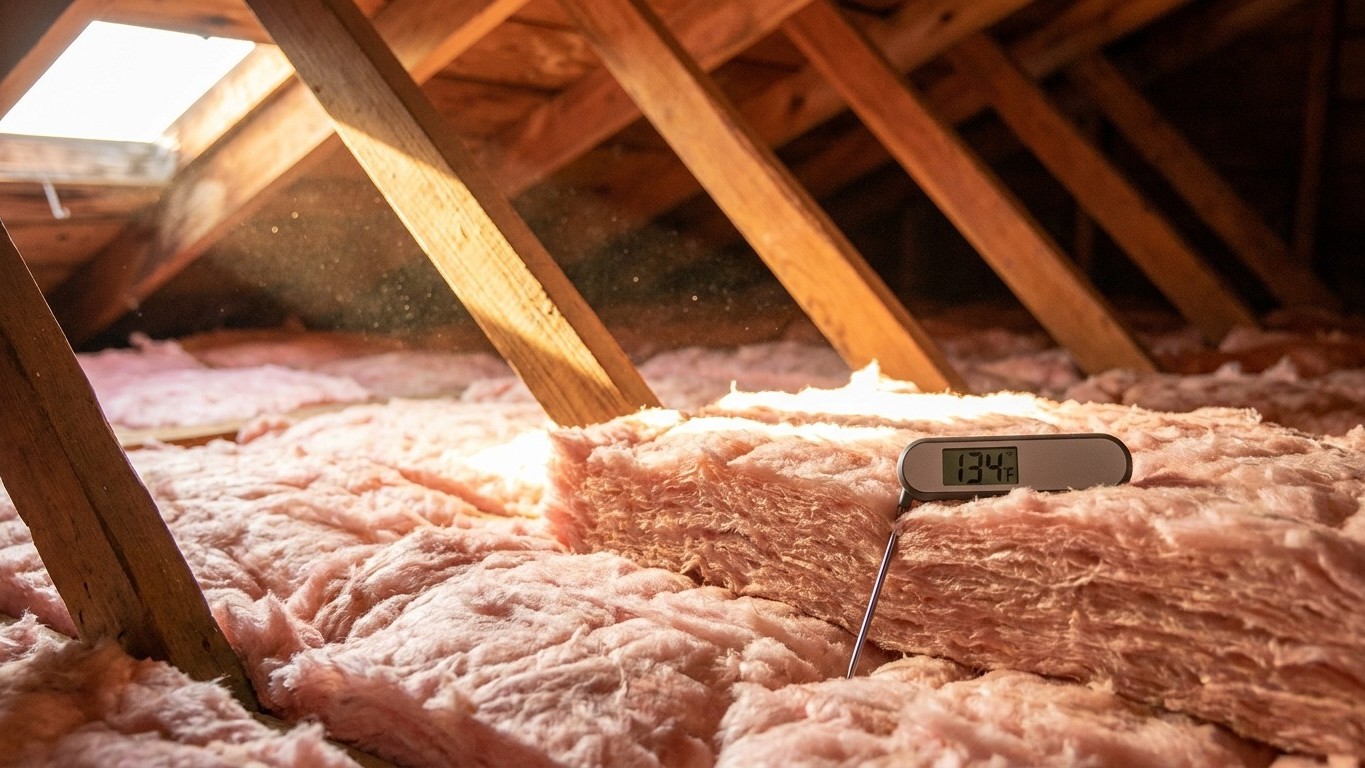
An asphalt shingle roof baking under an Arkansas sun in July doesn’t just get warm, it gets punishing. Attic air temperatures routinely climb far above whatever the thermometer says outside, sometimes by 40 degrees or more, because a dark roof deck absorbs radiant energy all day and has nowhere quick to shed it. That superheated air sits directly above the ceiling drywall, above any ductwork routed through the attic, above stored boxes and holiday decorations. Everything up there becomes a slow-cooking oven, and the only thing standing between that oven and the rooms below is whatever insulation sits on the attic floor.
Here’s the part that surprises people: the insulation doing that job in summer is the exact same material doing the job in winter. It isn’t a seasonal product. Insulation resists heat flow, full stop, and heat flow simply reverses direction with the calendar. In January, heat wants to escape upward from the warm house into the cold attic. In July, heat wants to push downward from the blistering attic into the cooled house. The R-value doesn’t care which direction it’s blocking. That makes attic insulation the rare home improvement that pulls double duty across both seasons without any redesign.
The levels ENERGY STAR recommends
ENERGY STAR publishes retrofit insulation levels for existing wood-framed homes by climate zone, and since Arkansas spans two zones, the two relevant rows differ slightly:
| Zone | Attic if uninsulated | Attic if you already have 3-4 inches | Floor |
|---|---|---|---|
| Zone 3 | R49 | R38 | R19 |
| Zones 4A and 4B | R60 | R49 | R19 |
These figures are retrofit targets for existing homes, not new-construction minimums, and they aren’t three attic numbers stacked together. The first two columns both describe the attic, split by whether it already has some insulation in place; the floor column is a separate space entirely, typically over an unheated crawl space. Since this state straddles two zones, a homeowner shouldn’t guess. The ENERGY STAR climate zone map or a county-level lookup settles which row applies to a specific address, not a state-wide assumption.
What homes in Arkansas cool with
According to the U.S. Energy Information Administration’s 2020 Residential Energy Consumption Survey, 93% of households in Arkansas report using some form of air-conditioning equipment. Of those, 72% use a central air-conditioning unit, while 26% rely on individual equipment: window units, wall units, mini-splits, or portables. Another 82% use ceiling fans, which cost little to run and take some of the load off whatever cooling system is doing the heavy lifting. All of these figures describe a share of households surveyed, not a share of every house standing in the state.
The gap between 93% owning some form of air conditioning and 72% running central air is where insulation strategy gets interesting. In a central-air home, cooled air typically travels through ductwork, and in a huge share of American housing stock, especially anything built before ducts were routinely placed in conditioned space, that ductwork runs through the attic. That’s the same attic sitting 40-plus degrees above outdoor air on a summer afternoon. Ceiling insulation slows heat from pushing down into the living space, but it does nothing to stop that superheated attic air from cooking the ducts themselves, or the cold air moving through them, before it ever reaches a supply register. Sealing and insulating the ducts is a separate job from insulating the ceiling, and in a state with this many hot days, it’s not an optional afterthought.
For the 26% running window units, wall units, mini-splits, or portables, the equation shifts. There’s no attic ductwork to worry about; the relevant envelope is whatever surrounds that single room or zone, walls, windows, the unit’s own seal against the frame. Insulation still matters there, just at a smaller, more localized scale. Anyone running central air through attic ducts in this state should look at duct sealing and duct insulation as a companion project to ceiling insulation, not a substitute for it. Anyone leaning on individual room units should focus tightening efforts on that room’s own envelope rather than assuming attic work will solve a cooling problem confined to one space.
What the heat asks for that the cold does not
Two tools belong specifically to hot climates, and Arkansas’s long stretch of 90-plus days puts at least one of them squarely in play.
A radiant barrier is not insulation, and it carries no R-value. Instead of resisting conducted heat the way fiberglass or cellulose does, it reflects radiant heat before it ever gets absorbed into the attic space, typically installed as a foil-faced material stapled to the underside of the roof deck or draped over the rafters. It earns its place specifically under a sun-loaded roof, which describes an Arkansas attic in July about as well as it describes anywhere in the country. With 69.2 days a year above 90 F, this is a territory where a radiant barrier can pull real weight, paired with, not instead of, standard attic insulation. That’s a very different recommendation than what would apply in a state with a short, mild summer, where the same product would sit largely idle for most of the year.
Vapor moves the other way in summer than it does in winter, and that matters in a state this humid. In a cold, dry climate, water vapor pushes from the warm interior toward the cold exterior, which is why interior vapor retarders make sense there. In a warm, humid climate like most of Arkansas, the damp air sits outside, and it’s pushing inward toward the cooler, drier interior. That’s exactly why the model energy code doesn’t require an interior vapor retarder in the country’s warmest, most humid zones, and installing one anyway can trap moisture rather than block it. Getting this right depends on the specific assembly and local moisture regime, which is a conversation better suited to a dedicated vapor barrier guide for this territory than a single paragraph here.
What the work is worth
ENERGY STAR’s own estimate ties air sealing and insulation to a specific, published range: “EPA estimates that homeowners can save an average of 15% on heating and cooling costs (or an average of 11% on total energy costs) by air sealing their homes and adding insulation in attics, floors over crawl spaces, and accessible basement rim joists.” Both numbers matter, and they answer different questions. The 15% describes heating and cooling costs specifically, lumped together as one category. The 11% describes total energy costs, a broader denominator that includes everything else running on a utility bill.
That heating-and-cooling framing is exactly the point of raising it on a page about summer heat. This isn’t a winter savings figure that happens to apply in July as an afterthought. Cooling costs are baked into that 15% from the start, which lines up with everything else on this page: a state averaging 69.2 days above 90 F a year, spanning two humid climate zones, where central air often runs through attic ductwork exposed to extreme heat. The savings estimate covers work done specifically in attics, floors over crawl spaces, and accessible basement rim joists. It doesn’t extend to walls, windows, or doors, and it’s a modeled average drawn from a “typical” existing U.S. home, not a guarantee tied to any particular house’s construction, age, or current insulation levels.