
Insulation does keep Alabama homes cooler, and in most of the state it works overtime. With nearly two months a year pushing past 90°F, the attic is where that heat lands first. But Alabama isn’t a single climate: 58 counties sit in one Insulation zone, nine along the Gulf sit in another, and the right amount of material depends on which side of that line a house falls on.
The short answer for Alabama

Yes, insulation matters here, and it matters for a long stretch of the calendar. At the Huntsville reference station, the average is 58.5 days a year at or above 90°F, according to NOAA’s 1991-2020 Climate Normals. That’s not a handful of scorching afternoons in August. It’s a run of heat that typically starts building in May and doesn’t let go until well into September, sometimes longer near the coast.
That length of summer changes the math on insulation compared to a state where 90-degree days are rare. In a short-summer climate, insulation earns its keep mostly in winter, holding furnace heat in, with summer benefits as a bonus. Alabama runs the other way. With cooling season stretching across a third of the year or more, the energy a home spends fighting heat gain through the ceiling can rival, or in some houses exceed, what it spends on winter heating. Insulation here isn’t a winter product that happens to help in July. It’s doing real work on both ends of the thermostat, and for a good chunk of the year, the cooling side is the bigger job.
The state’s climate zone map backs that up, though it’s not uniform. Under the 2021 International Energy Conservation Code, 58 of Alabama’s 67 counties fall in zone 3A, a warm-humid zone that still sees real winter cold snaps. The other 9 counties, including Mobile and Baldwin along the coast, fall in zone 2A, a hotter, even more humid zone where the summer load is heavier and the winter load lighter. That’s a split by county count, not by population, and it matters because those nine coastal counties hold a lot of the state’s residents and a lot of its most humid, most cooling-dominated housing stock.
What that means practically: a house in Huntsville and a house in Mobile are both fighting summer heat, but not to the same degree, and not with the same balance against winter. Neither gets a free pass on insulation. The difference is in how much material the ceiling needs and how the two seasons trade off, which is exactly what the next section breaks down.
What happens above the ceiling
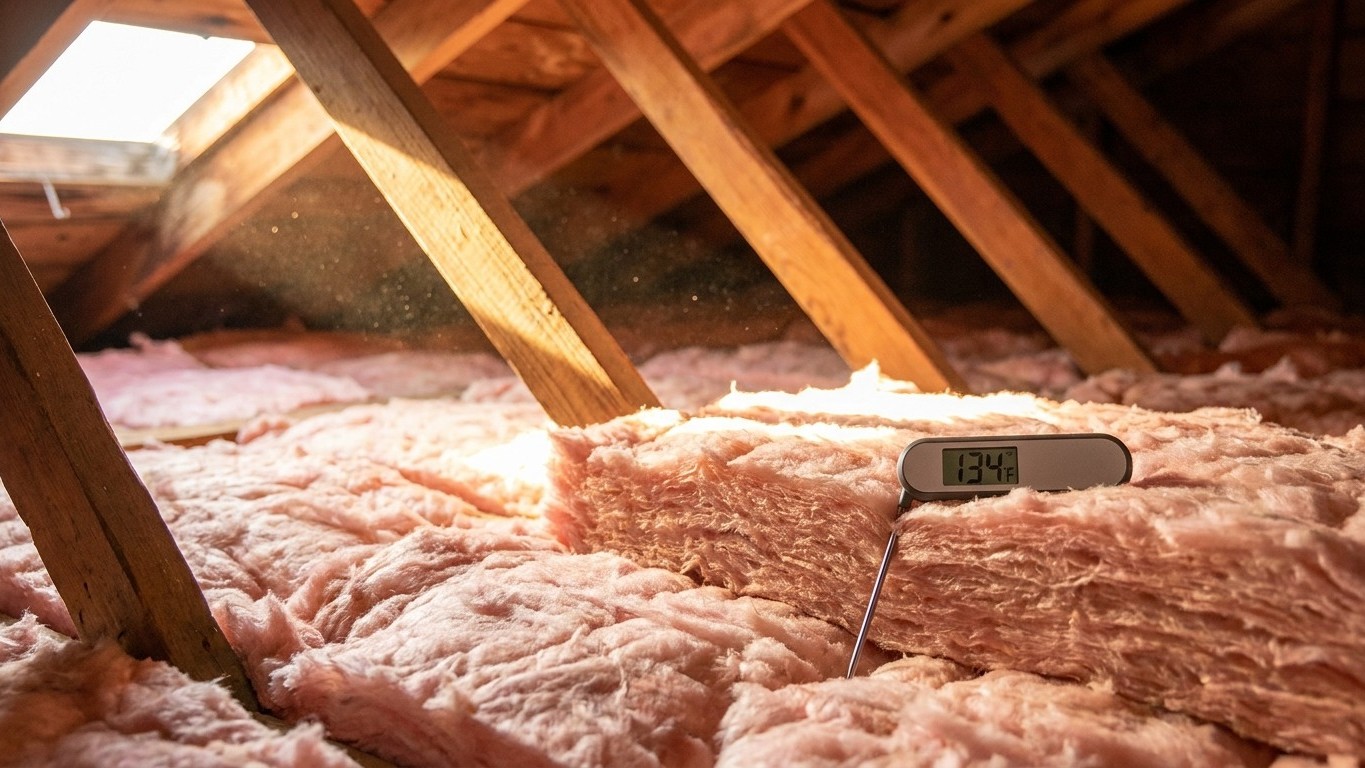
On a sunny Alabama afternoon, the attic isn’t just warm. It’s often 40 to 50 degrees hotter than the air outside, because a dark asphalt shingle roof absorbs solar radiation all day and re-radiates it downward into the attic space below. That superheated air sits directly above the ceiling drywall, the ductwork, and anything stored up there. Heat doesn’t wait for a temperature difference to build before it moves; it flows constantly from that hot attic toward the cooler, air-conditioned rooms below, and the ceiling insulation is the only thing standing between the two.
The useful part of this mechanism is that it runs both directions with the same material. Attic insulation resists heat flow, period. In January, it resists furnace heat trying to escape upward. In July, it resists attic heat trying to push downward. It’s not a winter product doing summer duty as a side effect. It’s a single resistance layer that happens to matter more in Alabama during the hot half of the year than the cold half, given how long and intense that hot half runs.
What ENERGY STAR recommends for retrofits
ENERGY STAR publishes recommended insulation levels for retrofitting existing wood-framed homes, organized by climate zone, and Alabama’s two zones land in different rows of that table. These figures are for adding insulation to an existing house, not requirements for new construction:
| Zone | Attic if uninsulated | Attic if you already have 3-4 inches | Floor |
|---|---|---|---|
| Zone 2 | R49 | R38 | R13 |
| Zone 3 | R49 | R38 | R19 |
Notice the attic target barely changes between the two zones, but the floor target does, R13 versus R19, reflecting the milder winters near the coast versus the colder nights inland. Nobody reading this can determine their own zone from a county count alone. ENERGY STAR publishes an official zone map, and checking it before buying material is the only way to know which row applies to a specific address.
This is the one upgrade that pulls double duty. A homeowner adding attic insulation for a cooler August also gets a warmer January out of the same job, no separate purchase required.
What homes in Alabama cool with
Insulation only does its job if it’s paired with the right expectations about how a house actually cools, and Alabama’s numbers are pretty clear on that front. According to the U.S. Energy Information Administration’s 2020 Residential Energy Consumption Survey, 94% of Alabama households use some form of air-conditioning equipment, and 81% use a central air-conditioning unit specifically. Those figures are shares of households surveyed, not a count of houses standing, but the gap between them is telling.
The 13-point difference between “any AC” and “central AC” represents homes running on something else entirely: window units, wall units, portables, or ductless mini-splits. The survey groups those under individual air-conditioning equipment, used in 20% of Alabama homes. On top of that, 84% of households use ceiling fans, which don’t cool the air but do make a warm room feel more tolerable and let some households run the thermostat a couple degrees higher.
Here’s where insulation and equipment intersect, and where a lot of confusion sets in. In the majority of Alabama homes running central air, the ductwork threading through the house often runs through the attic, the same space that can hit 140°F on a summer afternoon. Ceiling insulation laid across the attic floor does nothing to protect those ducts, because the ducts sit above the insulation, not below it. A perfectly insulated ceiling can still lose a meaningful share of cooled air to duct leakage and heat gain before it ever reaches a vent. That’s a separate repair, sealing and insulating the ducts themselves, and it’s worth checking against this site’s guide to insulating ducts in an attic.
For the roughly one in five households leaning on a window unit, wall unit, or mini-split instead, the calculation is different. There’s no attic duct run to worry about, but the room’s own walls, windows, and ceiling become the whole story, since that single unit is fighting whatever heat leaks into that space alone. This site’s room air conditioner guide covers sizing and placement for exactly that setup.
What the heat asks for that the cold does not
Two products show up in hot-climate conversations that never come up in cold-climate ones, and Alabama’s climate profile puts both on the table, though not identically.
A radiant barrier is not insulation, and it doesn’t carry an R-value. It’s a reflective material, usually foil-faced, installed under the roof deck or draped across rafters, and its job is to bounce radiant heat back before it ever gets absorbed and re-radiated into the attic. It only earns its place under a sun-loaded roof, which describes most of Alabama’s attics for a good stretch of the summer, given the 58.5 days a year at or above 90°F. In a state where the roof deck is baking for weeks at a stretch, a radiant barrier paired with adequate attic insulation is a legitimate combination. It would be a different story in a territory where summer heat is rare and brief; there, the radiant barrier has little to reflect and the money is better spent elsewhere.
The second thing summer changes is which direction moisture travels through the walls. In winter, warm humid air inside a heated house pushes outward toward the cold. In summer, in a warm humid climate, that reverses: the humid air is outside, and it’s pushing inward toward the air-conditioned interior. That’s precisely why the model building code doesn’t require an interior vapor retarder in its warmest, most humid zones, the kind Alabama’s coastal counties fall into. Getting this wrong, by installing a vapor barrier meant for a cold northern climate, can trap moisture inside a wall assembly instead of keeping it out. This is a detail specific enough, and consequential enough, that it deserves its own answer rather than a partial one here; this site’s Alabama vapor barrier page works through it properly.
What the work is worth
ENERGY STAR’s own methodology page puts a number on this, and it’s worth quoting exactly rather than rounding it into something looser: “EPA estimates that homeowners can save an average of 15% on heating and cooling costs (or an average of 11% on total energy costs) by air sealing their homes and adding insulation in attics, floors over crawl spaces, and accessible basement rim joists.”
Both numbers matter, and they’re not interchangeable. The 15% applies specifically to heating and cooling costs combined, while the 11% applies to total energy costs, the wider bill that includes water heating, appliances, and everything else running through the meter. Neither figure stands alone without its denominator, and neither should get quoted without the other.
The detail that matters most for a state like Alabama is that this figure covers heating and cooling together, not one or the other. That’s the whole reason a page like this exists in the first place. The saving isn’t a winter number that happens to carry over into summer as an afterthought; it’s built from both seasons at once, which fits a state where the cooling season runs long and the ceiling is doing real work for a large share of the year.
Two caveats are worth keeping in view. This is an average pulled from energy modeling of a typical existing U.S. home, not a guarantee for any specific house on any specific street. And the modeled work is specifically attics, floors over crawl spaces, and accessible basement rim joists, not walls, windows, or doors, which are separate projects with their own separate math.