
Yes, Insulation helps in Manitoba, but the honest picture is this: Winnipeg’s reference station logs an average of zero days a year above 90°F, so summer heat load barely registers here. The same material that blocks winter cold also slows summer heat gain, it’s just that in this climate, winter carries almost the entire case for the investment.
The short answer for Manitoba

Insulation works here, but the reason to install it in Manitoba is overwhelmingly a winter reason, not a summer one. At the Winnipeg Richardson International Airport reference station, the Environment and Climate Change Canada Climate Normals for 1981-2010 record 0.0 days a year reaching 90°F or higher. That number is the standard measure of summer heat load, the kind of stress that drives air conditioner demand, strains water systems, and cooks an unshaded attic. In Manitoba, at least at this station, that load doesn’t show up in the record at all.
Compare that to the other side of the ledger. The same station sits under roughly 5,648 heating degree days below 18°C, which Natural Resources Canada uses to place it in climate zone 7a, one of the colder zones in the country’s national system, where zones run from 4 (under 3,000 HDD) up through 8 (over 7,000 HDD). Winnipeg’s number puts it well into the upper half of that scale. A house near this station spends its energy budget fighting a long, hard winter, not a rare hot spell.
What that means for a homeowner deciding whether to bother
It means the pitch used on hot-climate pages, Insulation as your first line of defense against a brutal summer, simply doesn’t fit here. If your territory sat further south, this page would tell you cooling could eat up half your annual energy bill. Manitoba’s climate doesn’t ask that question. The honest version is smaller and more useful: Insulation still blunts the discomfort on the handful of genuinely warm days each summer brings, and it still keeps an upper floor from turning into an oven on a July afternoon with full sun. But the return on that same insulation shows up mainly from October through April, when the heating degree days pile up and every gap in the building envelope has to be paid for in fuel.
One more caution worth repeating: the 0.0 figure and the 7a zone both describe the Winnipeg reference station, not every corner of the province. A property well north of the city, or one at a different elevation, could sit in a different zone with different heating degree days. Before buying insulation based on this page, it’s worth checking your own municipality’s degree-day data rather than assuming the capital’s numbers apply exactly to your address.
What happens above the ceiling
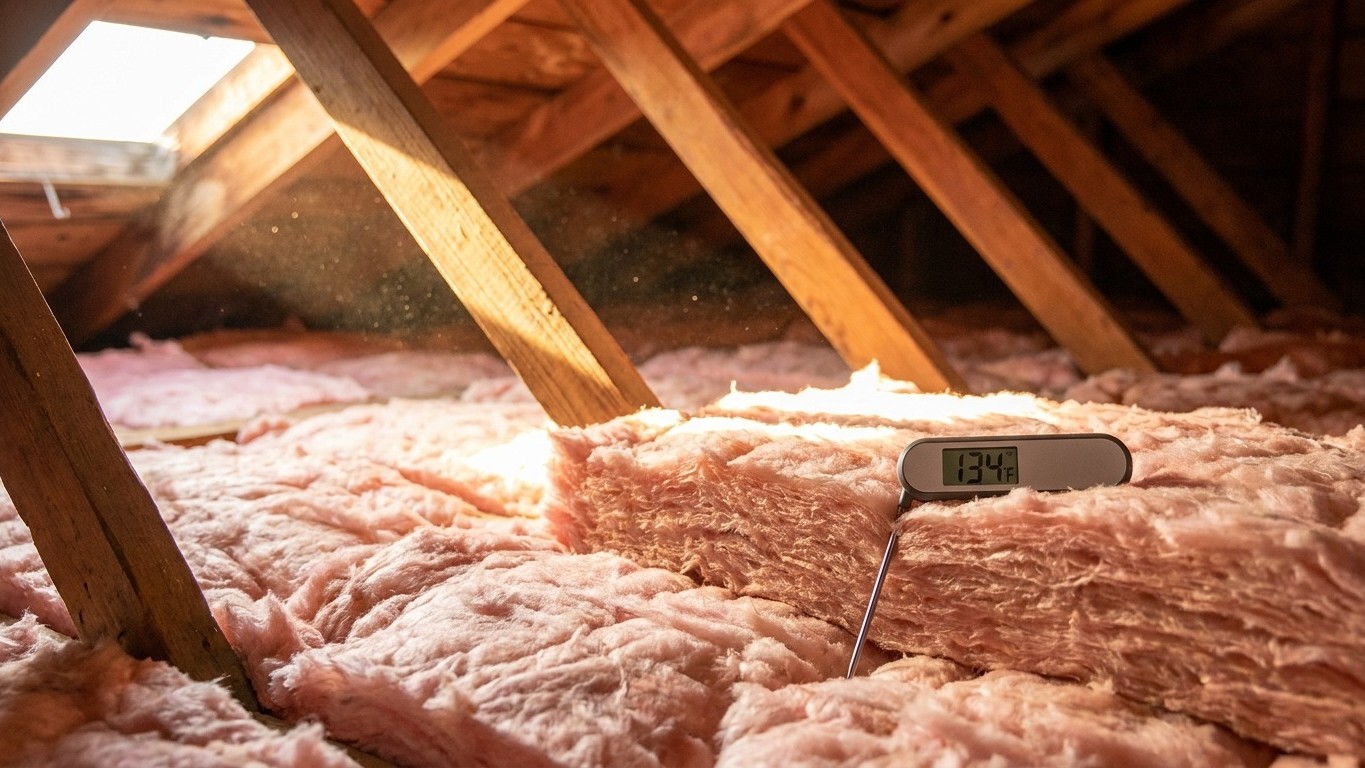
Even in a climate with almost no days over 90°F, an attic under direct sun behaves nothing like the outdoor air. A dark asphalt shingle roof deck absorbs solar radiation all afternoon, and the air trapped just below it can run far hotter than whatever the thermometer says outside. Everything underneath that roof deck sits inside that heat: the ceiling drywall, any ductwork routed through the attic, the boxes of holiday decorations stacked on the joists. On the rare 80-something-degree Manitoba afternoon, that attic space is still working overtime.
The insulation that resists this isn’t a different product from what keeps a Manitoba house warm in January. It’s the same batt, blown-in fiber, or rigid board, doing the same job: resisting the flow of heat through a boundary. In winter, that flow runs outward, from the warm living space toward the cold outdoors. In summer, on a hot attic day, the flow reverses and runs downward, from the superheated attic into the conditioned rooms below. One material, two directions, one job description. That’s worth knowing because it means there’s no separate “summer insulation” to shop for. What you install for the long Manitoba winter is doing double duty on the short list of warm days too.
How much insulation the zone calls for
Natural Resources Canada’s guidance, based on the heating degree days at the Winnipeg reference station, puts that property in climate zone 7a and recommends the following minimums:
| Component | RSI (recommended minimum) | R-value |
|---|---|---|
| Walls | RSI 7.1 | R 40 |
| Basement walls | RSI 5.3 | R 30 |
| Roof or ceiling | RSI 14.1 | R 80 |
| Floor over unheated space | RSI 8.8 | R 50 |
These are recommended minimums for the zone the reference station sits in, not a code requirement in themselves, since actual building code minimums are set provincially and municipally and can ask for more. The ceiling row is the one that matters most for the summer half of this discussion. It’s also, not coincidentally, the row NRCan sets highest, because a well-insulated ceiling is doing year-round work in a zone this cold.
What homes in Manitoba cool with
Statistics Canada’s Canadian Social Survey on Quality of Life and Energy Consumption Behaviours found that 57.2% of households in the Prairie region have air conditioning, compared with 68.3% across Canada as a whole. That figure covers the Prairie region as a single block in the survey, not Manitoba on its own, so it’s a regional stand-in rather than a provincial number, and it describes the share of households surveyed who reported having AC, not the share of houses that need it or the share standing in the province. A lower regional rate than the national average could reflect a milder cooling season, an older housing stock, or both; the survey itself doesn’t say which.
Where insulation and cooling actually intersect depends on how a house is cooled. In homes where central air conditioning runs through ductwork routed through the attic, those ducts sit inside the hottest space in the entire building on a sunny afternoon. Ceiling insulation slows heat moving into the living space below, but it does nothing to protect the ducts themselves, which are exposed to that superheated attic air directly. Sealing and insulating the ducts is a separate job from insulating the ceiling, and skipping it means conditioned air loses its cooling on the way to the vent.
In homes cooled with a window unit or a ductless mini-split, there’s no attic duct run to worry about. What matters there is the envelope of the room itself, meaning the windows, the wall insulation, and how well that space is sealed off from the rest of the house. A well-insulated room holds a mini-split’s output far more efficiently than a leaky one, even on the handful of warm Manitoba days that call for it. This site’s duct insulation guides and room air conditioner guides go into both of those situations in more detail than fits here.
What the heat asks for that the cold does not
Two tools show up on hot-climate pages that have no real place in a Manitoba discussion, and it’s worth saying plainly why.
A radiant barrier is a reflective layer, usually foil-faced, installed to bounce radiant heat away from a roof deck before it can heat the attic air below. It carries no R-value of its own and isn’t a substitute for insulation; it earns its keep specifically in climates where a sun-loaded roof pushes attic temperatures dramatically above outdoor air for long stretches of the summer. Given that the Winnipeg reference station shows zero days a year above 90°F, that’s not the situation a Manitoba attic is dealing with. A radiant barrier isn’t the tool this climate calls for, and installing one here wouldn’t buy back much against the cost of the work.
Vapour movement is the second one, and it runs in the opposite direction from what a warm, humid U.S. climate deals with. In a hot, humid region, the moisture load pushes in from outside, which is why the model building code doesn’t require an interior vapour retarder in its warmest zones. Manitoba’s situation is the reverse of that: a long, cold winter means moisture generated inside the house (cooking, showers, breathing) is what needs to be kept from migrating into the wall cavity, so an interior vapour barrier remains standard practice in this climate. That’s a code and construction detail with its own complications, and it deserves its own page rather than a paragraph tacked onto a summer heat discussion.
What the work is worth
The U.S. Environmental Protection Agency, through the ENERGY STAR program, estimates that “homeowners can save an average of 15% on heating and cooling costs (or an average of 11% on total energy costs) by air sealing their homes and adding insulation in attics, floors over crawl spaces, and accessible basement rim joists.” Both numbers matter, and they answer different questions: 15% against the heating and cooling portion of a bill, 11% against the whole energy bill once every other use of energy in the house is counted in.
That figure is an average drawn from energy modeling of a typical existing U.S. home, not a measurement of any particular house, and it isn’t a promise about what a specific Manitoba property will see. It also names exactly where that modeled work happened: attics, floors over crawl spaces, and accessible basement rim joists. It says nothing about walls, windows, or doors, and it shouldn’t be stretched to cover those.
The reason this figure belongs on a Manitoba page, even with a climate this cold, is the pairing itself. The estimate covers heating and cooling together, as one combined saving, not a winter number that happens to apply in July as an afterthought. For a property where summer cooling load is close to zero at the reference station, that combined figure is really a heating figure wearing a two-season label. The saving in Manitoba comes almost entirely from the heating side of that percentage, and knowing that keeps expectations honest going into any insulation project here.