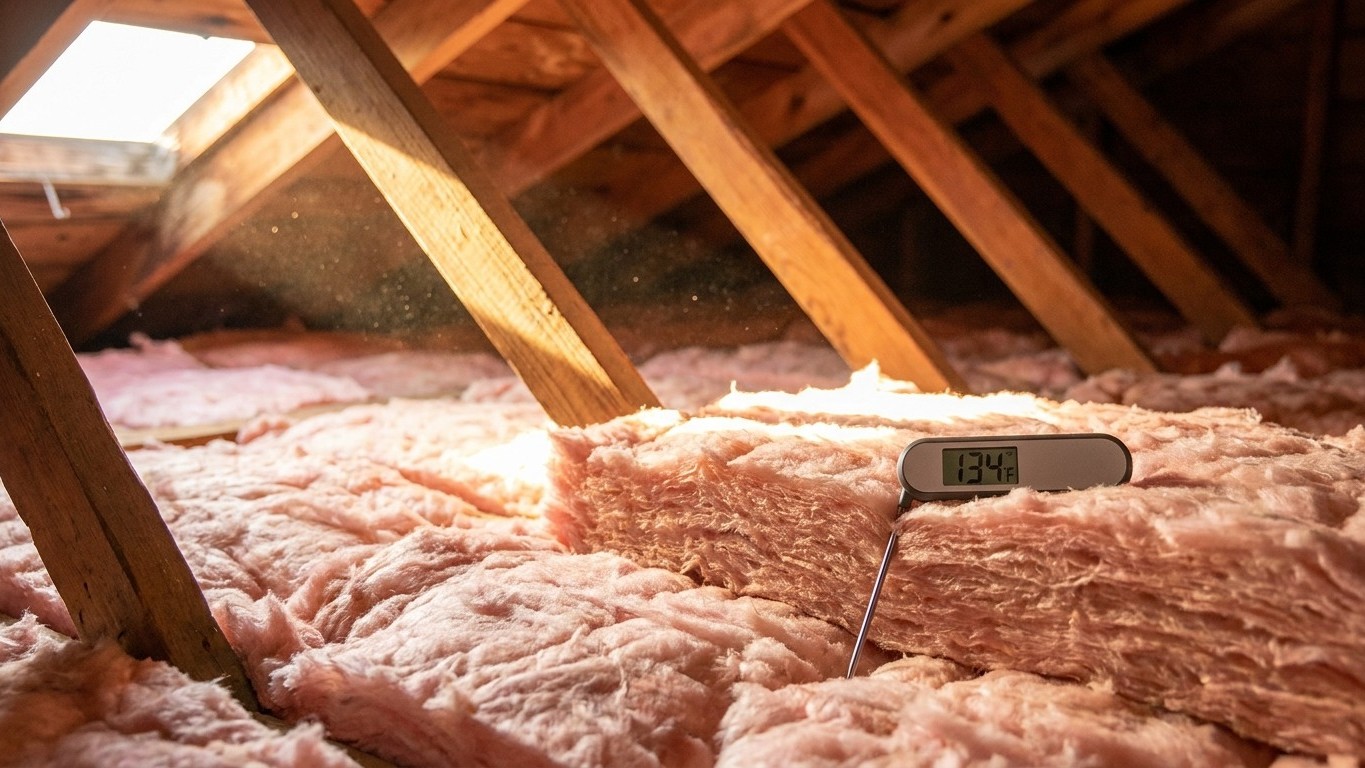

Yes, Insulation keeps a South Dakota home cooler, but summer is the smaller half of the story here. The reference station in Sioux Falls averages just 13.8 days a year above 90°F, while the state’s harsh winters do most of the work on the energy bill. The same attic insulation that blocks January’s cold also blocks July’s rooftop heat, which is exactly why it still earns its keep in a state better known for blizzards than heat domes.
The short answer for South Dakota

Yes, but the honest version of that answer has to account for how short South Dakota’s hot season actually is. At the Sioux Falls reference station, the 1991-2020 NOAA climate normals put the average at 13.8 days a year reaching 90°F or hotter. That’s not a description of the whole state, and it’s not an average temperature either. It’s a count of the days when heat stress, water demand on the lawn, and the risk of a wilting garden actually show up. Compare that to a Gulf Coast city with three months of 90-degree afternoons, and the picture is obviously different.
South Dakota’s 66 counties split across two IECC climate zones: 48 counties sit in zone 6A, and 18 in zone 5A. Both of those are cold-climate zones on the northern side of the country’s climate divide, the side where heating dominates the annual energy picture and cooling is the secondary concern. There’s no single zone for “South Dakota” as a whole, and a reader shouldn’t rely on this page to tell them which side of that 48/18 county split their own home falls on. That’s a job for the county table or the ENERGY STAR climate zone map, not a blanket statement here.
What that combination means in practice: insulation in a South Dakota home is primarily a winter investment that happens to pay a summer dividend, not the other way around. In a state where 90-degree days are rare enough to count on two hands most years, nobody should expect insulation to transform their cooling bill the way it might in Arizona or Louisiana. The value here is that the same material doing the heavy lifting against a Dakota winter also slows the heat gain during those two weeks of genuine summer discomfort. It’s a bonus benefit riding on top of a winter-driven decision, and that framing matters when deciding how much to spend and where.
None of this means summer heat is irrelevant. Attics in South Dakota still bake under a summer sun, air conditioners still run, and a poorly insulated ceiling still lets that heat migrate downward into living space. The difference from a hot-climate state is one of proportion: here, insulation is judged mostly by how it performs through a five-month heating season, with the short, sharp cooling season as a secondary test it also happens to pass.
What happens above the ceiling
An attic under a summer sun doesn’t just get warm, it gets far hotter than the outdoor air, sometimes by a wide margin, because a dark roof deck absorbs radiant energy all afternoon with nowhere to shed it. That superheated air sits directly above the home’s ceiling, and everything under it, from the drywall to the ductwork to the boxes of holiday decorations, is exposed to that heat load pressing downward. Without a resistant layer between the living space and that attic, the heat migrates through the ceiling by simple conduction, and the air conditioner ends up fighting a battle it shouldn’t have to fight.
The material that stops that migration is the same material that stops heat from escaping upward in January. Insulation doesn’t have a summer setting and a winter setting; it’s a resistance to heat flow in whichever direction that flow happens to be moving. In winter, heat wants to rise out of a warm house into cold air above. In July, it’s reversed: heat wants to push down out of a scorching attic into a cooler house. The R-value doing the work is identical in both cases, which is the single best argument for treating attic insulation as a year-round investment rather than a seasonal fix.
What ENERGY STAR recommends for this zone
ENERGY STAR groups climate zones 6, 5, and 4C together for its retrofit recommendations, which is the group that covers South Dakota’s two zones. For an existing wood-framed home in that group, the recommended levels are R60 for an attic that currently has no insulation, R49 for an attic that already has 3 to 4 inches in place, and R30 for the floor. These three figures are not three attic numbers: the first two are the attic, sorted by starting condition, and the third is a separate figure for the floor over an unconditioned space.
These are retrofit targets for existing wood-framed construction, not requirements written into new-construction codes, and they don’t translate into a specific number of inches since that depends on the material used. A homeowner working out exactly which of South Dakota’s two zones applies to their own county should check the ENERGY STAR climate zone map or the county-level IECC table rather than assume based on this page.
What homes in South Dakota cool with
Nationally, the U.S. Energy Information Administration’s Residential Energy Consumption Survey tracks how homes actually stay cool, and the gap between two of its figures tells a real story: 92% of homes use some form of air-conditioning equipment, but only 76% use a central air-conditioning system. That 16-point gap is filled by individual equipment, window units, wall units, portables, and ductless mini-splits, which cover 19% of homes on their own. Another 68% of households run ceiling fans, usually alongside whatever cooling system they already have, not instead of one. Every one of those figures is a share of households surveyed, not a share of houses standing, and that distinction matters when reading any state-level cooling data.
The connection to insulation splits along exactly that equipment line. In a home where central air runs through ductwork routed through the attic, that duct system sits inside the single hottest space in the building all summer long. Ceiling insulation laid across the attic floor does nothing to protect those ducts, because the ducts themselves are up in the heat, not down below the insulation layer. Sealing and insulating the ducts is a separate job entirely, distinct from the attic floor insulation discussed above, and it’s worth treating as its own project rather than assuming attic work covers it.
In a home cooled by a window unit, a wall unit, or a ductless mini-split, the equation is simpler: there’s no attic ductwork to worry about, and the insulation and air sealing of that specific room’s walls, ceiling, and windows is what determines how hard that unit has to work. Given that 19% of South Dakota-relevant households (per the national RECS breakdown) rely on this kind of individual equipment, that’s not a niche scenario. Readers running ducted central air should look at the site’s duct insulation guides; readers running a window unit or mini-split should look at the room air conditioner guides for the envelope details that matter most in that setup.
What the heat asks for that the cold does not
Two products get recommended for hot climates that have no real place in a state like South Dakota, and it’s worth being direct about that instead of listing them as generic options.
A radiant barrier is a reflective layer, usually foil-faced, installed under the roof deck or across the rafters, and it works by reflecting radiant heat back before it ever reaches the attic insulation. It carries no R-value of its own, it isn’t a substitute for insulation, and its entire purpose is cutting the radiant heat load under a roof that’s baking in strong, sustained sun, day after day, for months. That’s a description of a Texas or Arizona attic, not a South Dakota one, where the sun-loaded roof season is measured in a couple of hot weeks rather than a summer-long siege. For a state averaging 13.8 days above 90°F, a radiant barrier isn’t the tool that moves the needle; the insulation levels covered above are.
Vapor direction is the second hot-climate consideration, and it works in reverse of what most northern homeowners assume. In a warm, humid climate, moisture-laden outdoor air pushes inward through the wall assembly during summer, which is exactly why the model code doesn’t require an interior vapor retarder in the country’s warmest, most humid zones. South Dakota’s zones don’t carry that warm-humid designation, so the vapor dynamics here follow the more familiar cold-climate pattern instead. Getting the vapor barrier question right for this specific climate is its own topic with its own rules, and it deserves the dedicated vapor barrier page for this territory rather than a quick answer folded into a summer-heat discussion.
What the work is worth
ENERGY STAR’s own methodology page puts a number on this: “EPA estimates that homeowners can save an average of 15% on heating and cooling costs (or an average of 11% on total energy costs) by air sealing their homes and adding insulation in attics, floors over crawl spaces, and accessible basement rim joists.” Both figures matter, and so do their denominators: 15% is measured against heating and cooling costs specifically, while 11% is measured against total energy costs, a broader base that includes everything else the utility bill covers.
That combined framing is the whole point of this page. The savings estimate isn’t a winter number that happens to carry over into summer, it’s a heating-and-cooling figure from the start, built on modeling that treats both seasons as part of the same equation. For a state where winter clearly dominates the energy math but summer still shows up on the bill, that combined estimate is a more honest way to think about the payoff than treating insulation as a purely cold-weather purchase.
A few limits are worth holding onto. This is an average drawn from energy modeling of a typical existing U.S. home, not a guarantee tied to any specific house, its age, its current insulation levels, or its local climate. The modeling also covers a specific set of locations: attics, floors over crawl spaces, and accessible basement rim joists. It says nothing about walls, windows, or doors, and it shouldn’t be stretched to cover work done in those areas. There’s no price attached to this estimate and no payback period, and the federal 25C tax credit that once applied to this kind of work closed at the end of 2025, so it plays no part in weighing the decision now.