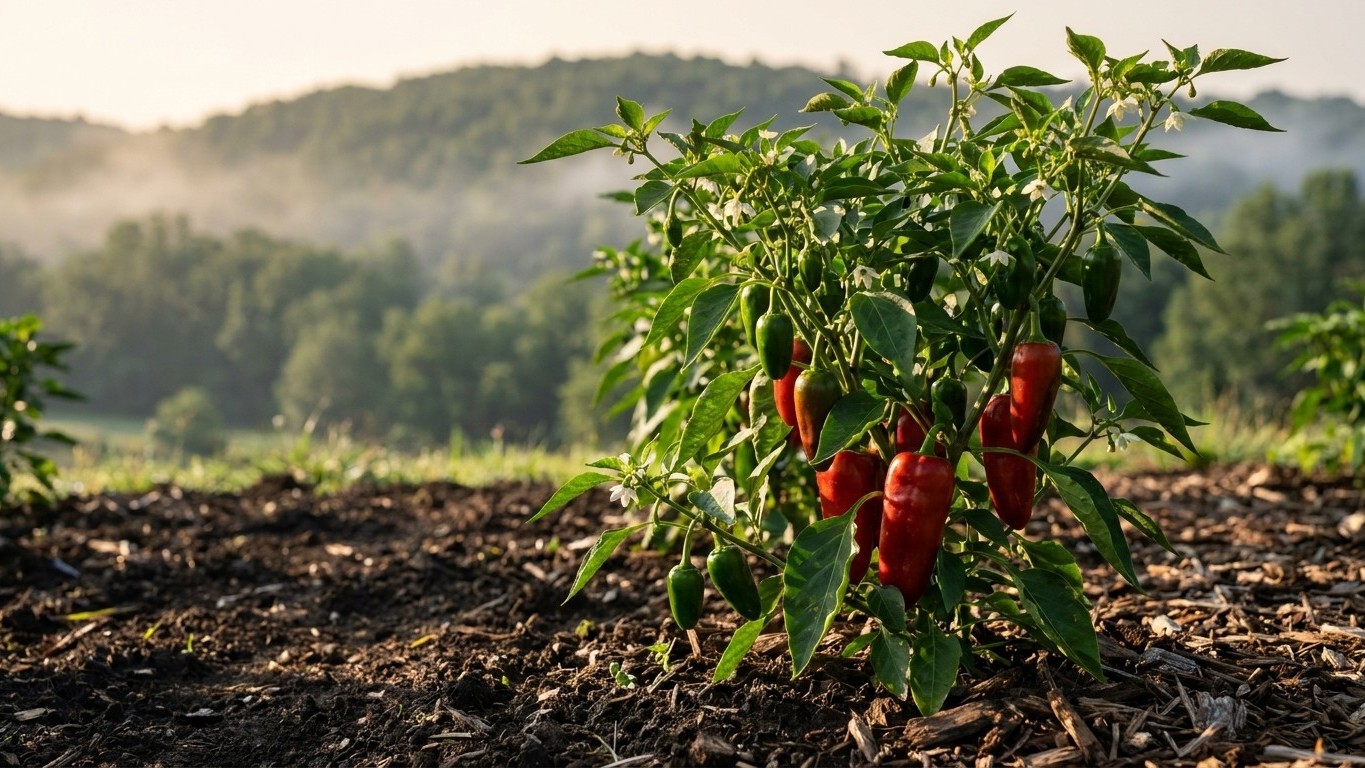

British Columbia gardens see pepper pressure from a short list of insects: aphids, Colorado potato beetle, cutworms, flea beetles, spider mites, tomato hornworm, and a few others that show up when the weather lines up. None of them arrive on a fixed date. They arrive when the plant reaches a certain stage, and that stage is set by this territory’s frost-free window, not by a month on a calendar.
Which pests attack pepper in British Columbia

The documented list for this territory, as tracked by University of Idaho Extension and WSU Extension, includes: Aphids, Brown marmorated stink bug, Cabbage maggot, Carrot rust fly, Colorado potato beetle, Corn earworm and earwigs, Cutworms, Cutworms and armyworms, Flea beetles, Grasshoppers, Imported cabbageworm, Imported cabbageworm and loopers, Onion maggot, Onion maggot and onion thrips, Pea leaf weevil, Slugs, Spider mites, Squash bug, Tomato hornworm, Western spotted cucumber beetle, and Wireworms.
That’s a long list, and most of it has nothing to do with a pepper plant. Cabbage maggot and both cabbageworm entries feed on brassicas, not nightshades. Carrot rust fly wants carrot-family roots. Onion maggot and onion thrips need an onion or a leek. Pea leaf weevil is a legume specialist. Squash bug and western spotted cucumber beetle are cucurbit feeders, after squash, melon, and cucumber vines. None of those seven touch a pepper leaf, and finding one in the garden says nothing about what’s happening to the peppers a few feet away.
What’s left is the group that actually bites into pepper foliage, stems, roots, or fruit: aphids, brown marmorated stink bug, Colorado potato beetle, corn earworm and earwigs, cutworms (both entries), flea beetles, grasshoppers, slugs, spider mites, tomato hornworm, and wireworms. Colorado potato beetle and tomato hornworm target it because pepper is a nightshade, same family as potato and tomato, and both insects don’t discriminate much within that family. Wireworms and cutworms go after the plant below and at the soil line, which matters most in the weeks right after it goes into the ground. The soil has to reach 60°F (16°C) before that transplant goes out, and only after frost has passed — before that, none of these pests have a plant to feed on yet.
When each one shows up, and what it does first
Pepper transplants in this territory typically go into the ground several weeks after the average last spring frost, which falls around March 18 at the Vancouver Int’l A station, and that date is a mean, not a guarantee, since frost lands later than that in half of all years. Seedlings started indoors need 8 to 10 weeks before they’re ready, and they should not go outside until the soil itself has warmed to 60°F (16°C).
Cutworms are usually the first sign of trouble, and the damage looks nothing like an insect at first: a seedling that stood upright the evening before is simply lying flat the next morning, severed right at the soil line. This happens within days of transplanting, while the stem is still soft. Flea beetles follow close behind, riddling young leaves with tiny round holes, sometimes before the plant has even put out its second set of true leaves. Wireworms work underground during that same early stretch, chewing on roots and the base of stems in a way that shows up above ground only as a seedling that wilts for no visible reason.
Aphids build up steadily as the plant grows, clustering on new growth and the undersides of leaves, and their feeding shows first as curled, slightly sticky foliage. Colorado potato beetle and tomato hornworm tend to appear once the plant has real size to it, stripping leaf tissue in chunks rather than pinholes. Spider mites favor hot, dry stretches, and while this territory rarely produces true heat extremes : Vancouver Int’l A averages just 0.07 days a year above 32°C, and 0.29 days above 30°C — even a short dry spell can be enough to bring on the fine stippling and webbing mites leave behind. Corn earworm and earwigs, along with grasshoppers, show up later, once fruit has set, and go straight for the pods themselves rather than the leaves.
Fruit set itself fails at both ends of the temperature scale: nights below 55°F (13°C) or days above 90°F (32°C) can stop Pollination cold. Given how rarely this territory crosses that hot threshold, a cool night is the far more likely culprit here, and since this site doesn’t track summer night minima, that’s something to watch in your own garden rather than assume from the season.
Telling the damage apart from everything else
Not every blemish on a pepper plant is a pest. Cold nights, uneven watering, and a couple of common diseases mimic insect damage closely enough to send someone reaching for the wrong fix.
| Symptom | Possible pest | What tells it apart |
|---|---|---|
| Seedling cut off at soil line | Cutworm | A curled gray or brown larva sits just under the soil surface nearby; damping-off disease instead rots the stem into a soft, water-soaked collapse with no larva present |
| Small round holes across leaves | Flea beetle | Holes are round and evenly scattered; hail or mechanical bruising leaves ragged, torn tissue instead |
| Curled, sticky new growth | Aphids | Check the underside of the leaf for clusters of small soft-bodied insects; a nutrient shortfall causes yellowing between the veins without any stickiness |
| Fine speckling and webbing | Spider mites | A hand lens shows tiny moving dots on webbing; drought stress alone wilts the whole plant but leaves no webbing |
| Tunneled or chewed fruit | Corn earworm | An entry hole with frass (droppings) marks the tunnel; sunscald instead leaves a flat, pale, papery patch with no hole |
| Wilting seedling, no visible leaf damage | Wireworm | Pull the plant gently and check the roots and stem base for chewing; transplant shock looks similar but the roots are intact |
None of this replaces a look through a hand lens or, better, a sample sent to a local extension office. The step that actually settles the question is checking the base of the stem and the underside of the leaf before deciding on anything else — most of these look-alikes separate cleanly once someone actually turns the leaf over or brushes back the soil.
What actually works here, and what is a waste of time
On a growing season built around a short frost-free stretch, timing beats almost everything else. A row cover put over the bed right at transplanting keeps flea beetles and early cutworm moths off the plant during its most vulnerable stretch, and it can come off once the plant has enough size to shrug off minor feeding. A cutworm collar pushed about 2 inches into the soil around each stem at transplant stops that particular loss cold, and it costs nothing but a strip of cardboard or a cut-down cup.
Handpicking works better than most gardeners expect on Colorado potato beetle and tomato hornworm, especially in a home garden where the plant count is small enough to check every few days. Slugs respond to the same logic: removing the damp hiding spots near the base of the plant does more than any product ever will. Keeping nitrogen fertilizer moderate also helps, since lush, over-fed growth is exactly what draws aphids in and keeps them multiplying.
What’s a waste of effort here is treating for heat-driven blossom drop, since this territory almost never crosses the 90°F (32°C) mark that causes it. Spraying broadly and on a schedule, rather than after actually confirming a pest, tends to burn through a short season without solving anything, and it knocks back the same insects that keep aphids and mites in check on their own. Any decision about an actual pesticide, including what’s legal to use and where, belongs with the local extension office, not a general list of tips, this site doesn’t recommend products, and neither should any gardener without checking what’s permitted first.
Where to check this for your own county
The pest list above comes from two specific sources: University of Idaho Extension and WSU Extension, both of which document conditions in the states bordering this territory rather than the territory itself. That matters, because pest pressure documented at the state or provincial level doesn’t resolve down to any one garden. A flea beetle outbreak reported across a whole region can still skip a particular yard entirely, and a garden two properties over can have a wireworm problem that never shows up in any regional summary.
Because BC’s own agricultural extension isn’t the source behind this documentation, the most useful next step is contacting the county office nearest the local climate match, in Idaho or Washington, for anything county-specific those services publish, alongside whatever regional agricultural resource covers the actual garden. The one thing worth confirming before acting on any of this is whether the pest in question has actually been seen locally this season, not just documented somewhere in the wider region.
A local office can also confirm a diagnosis from an actual sample, which beats any photo comparison or symptom table for anything that matters enough to treat. That’s the difference between a documented pest list and a garden-specific answer.
Common questions
Do all these pests actually show up on pepper plants every year?
No. The list reflects what’s been documented across the region over time, not what appears in any single garden in any single season. Aphids and flea beetles tend to be the most consistent; something like corn earworm depends heavily on how the season unfolds.
Can row covers stay on all season?
They can, but pepper flowers benefit from some pollinator access, so many gardeners remove covers once the plant starts flowering and pest pressure has passed its early peak.
Why don’t spider mites show up more often here, given how much they like heat?
This territory rarely crosses into true heat extremes, averaging only 0.07 days a year above 32°C at the Vancouver Int’l A station. Mites still appear during shorter dry spells, just less severely than in a consistently hot climate.
Is it safe to transplant right on the average last frost date?
Not really. March 18 is a mean date from Environment and Climate Change Canada, and frost lands later than that in about half of all years. Waiting until the soil itself reaches 60°F (16°C) is a more reliable signal than the calendar date alone.