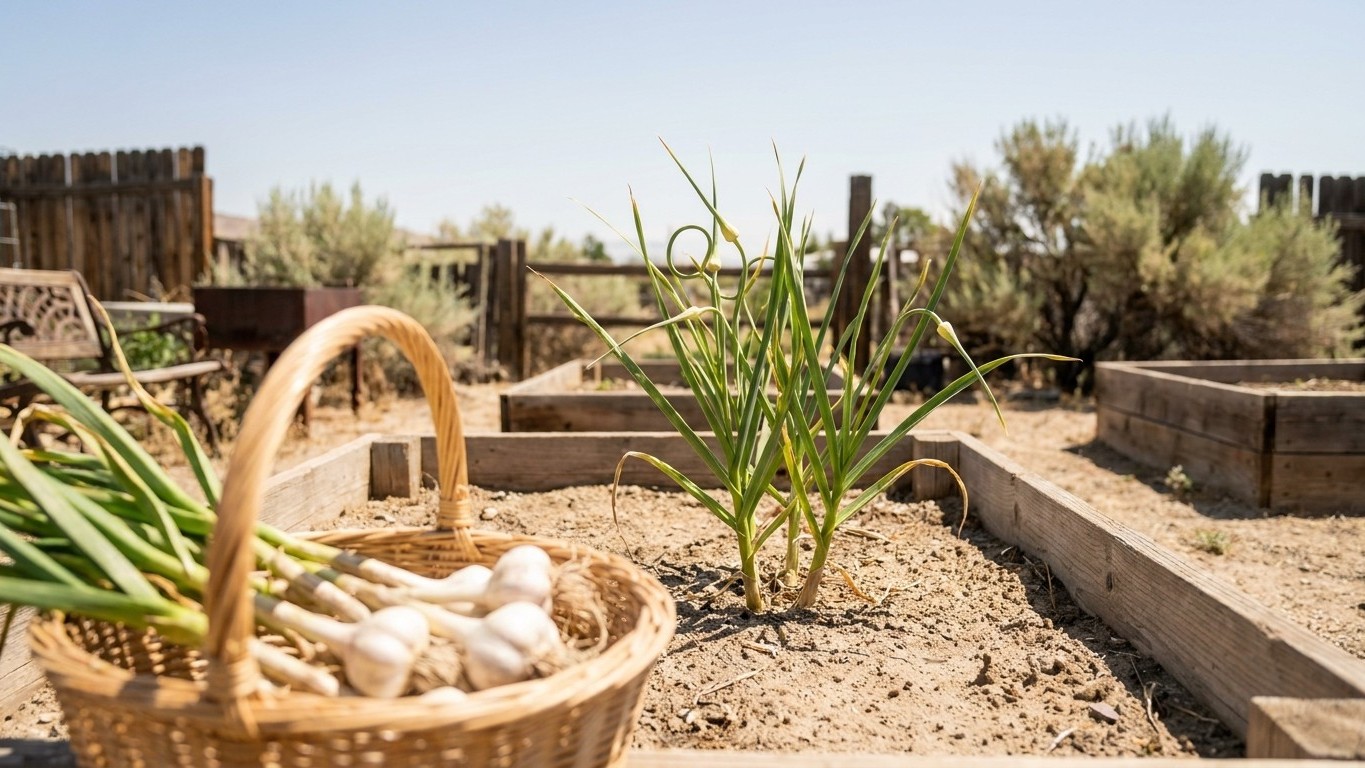

In Arizona’s low desert, garlic comes out of the ground by late spring or early June, once the lower leaves have gone brown and the tops have flopped over. There’s no frost signal to wait for here. You cure the bulbs for two to four weeks in a shaded, airy spot protected from summer sun, then move them into a cool, dark corner of the house for the months ahead.
When garlic is ready to lift in Arizona
Garlic grown in Arizona’s low desert follows a fall-to-summer cycle: cloves go into the ground in autumn, once the worst of the heat has broken, and the crop comes up the following summer. That’s the opposite of what gardeners in colder states expect, and it trips people up who move here from somewhere with a real winter.
The reason has nothing to do with frost. NOAA’s Climate Normals for the Phoenix area (station USW00023183, 1991-2020) list a 365-day frost-free season, and the underlying daily records show the ground reached 32°F in only 6 of the 30 years covered. A fall-freeze planting calendar simply doesn’t apply to the low desert. What actually governs the garlic calendar here is heat, not cold. Bulbs need a stretch of cool weather to size up properly, and then they need to finish and dry down before the real heat of early summer sets in. Miss that window on either end and you either get small bulbs or a crop that’s still green when 100°F afternoons arrive.
Watching the plant is more useful than watching the calendar. As the bulb matures, the lower leaves yellow and dry first, working their way up the stalk. Once roughly the bottom half of the foliage has browned and the rest has started to lose its color and flop, the bulbs are usually ready to come out. Pull one test bulb and check it: the cloves should be plump and distinct under the wrapper, not fused into a single mass and not rattling loose inside a papery shell that’s split open. Both extremes mean you either waited too long or not long enough.
Flagstaff and the high country are different
Anyone gardening in Flagstaff or the higher elevations of the state is working with a genuinely different climate, one that does freeze hard in winter. That changes the planting window on the front end, though the same rule applies on the back end: lift by leaf color and bulb feel, not by a date circled on the calendar. This page focuses on the low-desert timeline, where heat, not frost, sets the schedule.
Curing it, and where to hang it here
Curing is what turns a fresh-pulled bulb, wet from the soil, into something that will keep for months. The leaves and outer wrapper need to dry down slowly, sealing the cloves inside a papery skin. Rush this step or do it in the wrong spot and the bulbs either rot from trapped moisture or cook from too much heat.
The process itself is simple: leave the roots and tops attached, brush off loose soil without washing the bulbs, and lay or hang them somewhere shaded with good airflow for two to four weeks. Bulbs are ready to move on to trimming once the outer wrappers are papery and dry and the neck has tightened down.
Finding the right spot for that stretch is the part that’s genuinely different in Arizona. A garage with the door down in June can run hotter than the outside air, and that kind of heat will effectively pre-cook the cloves instead of curing them. Direct sun does the same thing faster. A covered patio, a carport, a shaded shed with the door propped open, or a porch out of direct light all work better than an enclosed space. What you’re after is shade plus airflow, not shade alone.
One quirk worth knowing: the same dry desert air that makes curing fast here can also make it too fast if bulbs sit in direct sun or a hot enclosed space, drying the outer wrapper before the inside has finished converting starches and firming up. That produces bulbs that look cured on the outside but are still soft or shriveled once you get past the first layer. Slower, shaded, well-ventilated curing beats fast and hot every time. If you’re running a swamp cooler near the curing area, keep the bulbs out of that humid air stream too. It undoes the drying you’re trying to accomplish and invites mold on the wrappers.
Storing it through a Arizona winter
Once cured, trim the tops to an inch or two above the bulb, clip the roots close, and brush off any remaining loose soil without breaking the wrapper. From there, storage is about finding a spot that stays cool, dark, and dry through the winter months, and Arizona’s climate actually works in your favor for the dry part.
Low ambient humidity across most of the state means mold and rot during storage are less of a worry here than in humid regions. The bigger risk indoors is heat, not moisture. A kitchen pantry near an oven, a closet on a wall that gets afternoon sun, or any interior space that runs warm through fall and winter will shorten storage life by pushing the bulbs to sprout or shrivel early. A cooler interior closet, a mudroom, an unheated section of garage once summer heat has passed, or a dedicated pantry shelf away from appliances all tend to work better.
Mesh bags, loosely woven baskets, or braided strings all allow the airflow that bulbs need to keep through winter. Sealed plastic bags or airtight containers trap the small amount of moisture bulbs still release after curing, and that’s enough to start rot in an otherwise well-cured bulb. Check stored garlic periodically through the winter and pull any bulb that’s gone soft or started sprouting before it affects its neighbors.
Garlic held this way in Arizona typically stores for several months once properly cured, though how long depends on the variety planted and how thoroughly the curing step was done. Bulbs cured too fast in a hot, sealed space tend to lose storage life even if they looked fine coming off the curing rack.
What goes wrong here
The University of Arizona Cooperative Extension documents a range of pests found in the state’s home gardens, and several of them show up on allium crops like garlic. Aphids, thrips, whiteflies, and spider mites are the ones most likely to trouble a garlic bed directly, feeding on foliage and sometimes stressing the plant enough to affect bulb size. The extension service also documents beet leafhopper, a known vector of curly top virus, along with false chinch bug, grasshoppers, green fruit beetle, squash bug, and tomato hornworm as pests found across Arizona gardens more broadly, though these tend to target other vegetable crops rather than garlic specifically.
- Aphids
- Beet leafhopper (vector of curly top virus)
- False chinch bug
- Grasshoppers
- Green fruit beetle
- Spider mites
- Squash bug
- Thrips
- Tomato hornworm
- Whiteflies
Beyond pests, the failures specific to this climate mostly happen after the harvest, not before it. Leaving bulbs in the ground past their window as early-summer heat builds can cause sunscald and split wrappers, since exposed bulbs near the soil surface take direct sun once the leaf canopy has died back. Curing in a hot, closed garage or in direct sun produces bulbs that look done on the outside but are soft or shrunken at the core. And storing garlic in a warm kitchen closet through the winter, rather than a cooler part of the house, cuts weeks or months off how long the crop actually keeps.
Gardeners with questions specific to their county, including variety recommendations and local pest pressure, can reach out through the University of Arizona Cooperative Extension, which maintains offices across the state.
Common questions
Do I need to wait for a fall frost to plant garlic in Arizona’s low desert?
No. NOAA’s data for the Phoenix area shows essentially no reliable frost, with 32°F reached in only 6 of 30 years on record. Planting timing here is driven by cooling temperatures and the summer heat that follows, not by a frost date.
How long does curing take before garlic is ready to store?
Roughly two to four weeks in a shaded, well-ventilated spot, until the outer wrappers are papery and the neck has dried down. Hot, sealed spaces or direct sun can shorten that visually while leaving the inside of the bulb undercured.
Can I store garlic in the garage through an Arizona summer?
Not during the hottest months. A closed garage can run hotter than outside air in summer, which damages both curing and stored bulbs. Once temperatures drop in fall, an unheated garage or interior closet works better.
Which pests are most likely to affect a home garlic bed in Arizona?
Among the pests documented by the University of Arizona Cooperative Extension, aphids, thrips, whiteflies, and spider mites are the ones most commonly associated with allium crops like garlic, while others on the list tend to target different garden vegetables.