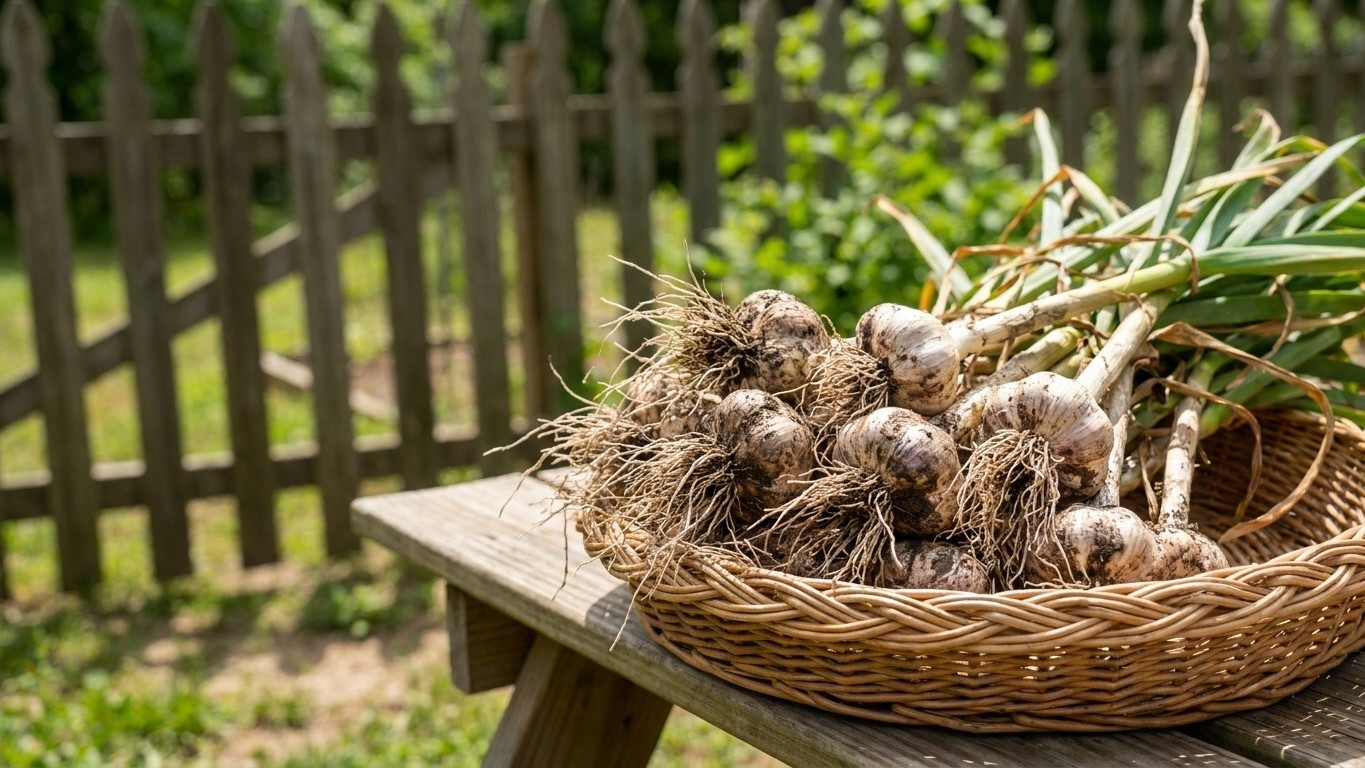

Softneck garlic is the safer bet for most of Arkansas, since the state’s winters usually run mild and uneven rather than steady cold. Hardnecks like German White can still do fine, but they’re gambling on a longer cold stretch that doesn’t always show up. So if you’re not sure which way to go, plant a softneck like Inchelium Red or Lorz Italian, and get the cloves into the ground between mid and late October so they have time to root before the cold sets in.
The short answer for Arkansas

For most of Arkansas, softneck garlic is the more forgiving choice. If you haven’t yet settled the basics of bed prep and clove separation, that groundwork is covered in Growing Garlic in Arkansas. Varieties such as Early Red Italian, Inchelium Red, Italian Late and Lorz Italian tolerate a mild, uneven winter better than hardnecks do, because they don’t depend on a long stretch of hard cold to divide properly into cloves. Hardneck varieties like German White, Chesnok Red and Duganski can still produce a good crop in Arkansas, but they’re a bigger gamble in a warm winter.
Why the date moves
The reason comes down to timing. NOAA’s 1991-2020 climate normals put the first fall freeze at the Little Rock station between November 7 and November 20, based on the 32°F freeze-probability data from station USW00013963. That’s a 30 to 70 percent probability window, not a hard line, and it’s a midpoint. In roughly half of all years, the first real freeze lands later than November 20, and in the other half it lands earlier. Treat it as the point around which to plan, not a date to count on.
Hardneck types are the ones that actually need that cold. They rely on a sustained chilling period to trigger proper clove formation below ground, and a string of unusually mild weeks over winter can leave the bulbs small or undivided. Softnecks are more forgiving of a warm stretch, which is part of why they’ve historically been the steadier bet through the mid-South.
What the catalog window buys you
All fourteen of the varieties in our catalog, softneck and hardneck alike, are set out in the same general window: mid October to late October. That timing gives the cloves several weeks of root growth in soil that’s still workable, before the freeze window opens in November. Roots, not top growth, are what matter going into winter. A clove that’s rooted in before the ground turns cold will overwinter fine regardless of neck type. One that goes in late, after a warm October, is the one that struggles.
| Variety | Neck type | Set-out window | Best fit in Arkansas |
|---|---|---|---|
| Early Red Italian | Softneck | Mid Oct to late Oct | Mild winters, most of the state |
| Inchelium Red | Softneck | Mid Oct to late Oct | Mild winters, most of the state |
| Italian Late | Softneck | Mid Oct to late Oct | Mild winters, most of the state |
| Lorz Italian | Softneck | Mid Oct to late Oct | Mild winters, most of the state |
| Bavarian Purple | Hardneck | Mid Oct to late Oct | Colder pockets, higher elevation |
| Blue Music | Hardneck | Mid Oct to late Oct | Colder pockets, higher elevation |
| Chesnok Red | Hardneck | Mid Oct to late Oct | Colder pockets, higher elevation |
| Duganski | Hardneck | Mid Oct to late Oct | Colder pockets, higher elevation |
| Fall Festival | Hardneck | Mid Oct to late Oct | Colder pockets, higher elevation |
| Georgian Crystal | Hardneck | Mid Oct to late Oct | Colder pockets, higher elevation |
| Georgian Fire | Hardneck | Mid Oct to late Oct | Colder pockets, higher elevation |
| German Red | Hardneck | Mid Oct to late Oct | Colder pockets, higher elevation |
| German White | Hardneck | Mid Oct to late Oct | Colder pockets, higher elevation |
| Ivan | Hardneck | Mid Oct to late Oct | Colder pockets, higher elevation |
Working it out for your own garden
The mid-October to late-October window given for every variety in our catalog isn’t arbitrary. It’s built by counting backward from the point when the ground reliably turns cold, so cloves get several weeks of root growth before winter locks up. Here’s the arithmetic behind it, so you can adjust it for your own site.
Start from the freeze window, not the frost date
NOAA’s 1991-2020 climate normals give the first fall freeze, the 32°F threshold, at the Little Rock station as falling somewhere between November 7 and November 20. That’s the threshold that matters for garlic, because established cloves shrug off a light frost without harm. Counting back roughly three to four weeks from the front edge of that window lands you in mid October, which is why the catalog set-out range starts there and runs into late October rather than stretching further into fall.
Don’t confuse this with the lighter 36°F frost threshold. The National Weather Service’s Little Rock office puts that date at October 31 in fall and April 3 in spring, and it’s the number that matters for tender plants like tomatoes, not for garlic cloves that are going into the ground to root rather than to grow top growth through winter.
Adjust for what your site actually is
Little Rock’s data describes the middle of the state at a fairly modest elevation. If your garden sits higher, in the Ozark Plateau in the northwest or the Ouachita Mountains in the west-central part of the state, cold settles in earlier and the same October window may need to shift toward its earlier edge. If you garden lower and further into the Delta in the east, the ground tends to stay workable later into fall, and the later half of the window is more likely to still be root-friendly.
None of the figures here quantify exactly how many days elevation shifts the freeze date in Arkansas specifically, and it would be a guess to invent one. What you can do is watch your own soil. If it’s still easily worked in mid October, you’re in the safe part of the window regardless of what the calendar says. Soil condition beats the calendar whenever the two disagree. For the full week-by-week version of this backward count, using your own reference station’s numbers instead of Little Rock’s, see When to Plant Garlic in Arkansas: Counting Back From the First Frost.
What changes across Arkansas
Every figure in this article is anchored at the Little Rock station, which sits in the center of the state at a modest elevation. Arkansas is not one climate, and garlic that thrives in one corner of it can struggle in another.
Uplands versus lowlands
The Ozark Plateau in the northwest and the Ouachita Mountains running through the west-central part of the state sit at meaningfully higher elevation than Little Rock. Cold air settles into these uplands earlier in fall and holds on longer into spring, which is exactly the kind of sustained chill that hardneck varieties such as German White, Georgian Crystal, Blue Music and Bavarian Purple are built to use. Growers in these areas are the ones best positioned to plant a hardneck-heavy bed.
The Delta lowlands across eastern Arkansas run the other direction. They’re flat, low in elevation, and the growing season there tends to stay warmer later into fall. A soft winter in this part of the state is more likely to leave a hardneck bulb small or poorly divided, which is where a softneck like Italian Late or Lorz Italian earns its keep instead.
Where the Little Rock figures fit directly
The Arkansas River Valley, running through the center of the state near Little Rock itself, is the closest match to the NOAA figures used throughout this article. If you garden along that corridor, the November 7 to November 20 freeze window is a reasonably direct fit. Move north into the highlands or south and east into the lowlands, and expect that window, and the October planting range built from it, to drift earlier or later by an amount this data doesn’t quantify. Your county extension office is the place to narrow it down.
The mistakes this climate punishes
Arkansas’s winter is mild enough, and uneven enough, that the mistakes worth worrying about here aren’t the same ones you’d read about in a Minnesota gardening guide.
Betting the whole bed on hardneck
Planting an entire row in hardneck varieties like Georgian Fire, Ivan or German Red, on the assumption that Arkansas gets a proper hard winter every year, is the single most common misstep. Some winters don’t deliver the sustained cold hardneck garlic wants, and the result is small, poorly divided bulbs rather than an outright failed crop, which makes the mistake easy to repeat without noticing why yields are down. Splitting a bed between a softneck like Inchelium Red or Early Red Italian and a hardneck hedges against exactly this.
Planting too late, or too shallow
Waiting past late October because the weather still feels like fall is the second mistake, and it costs the crop root growth it needed before the ground turns cold. Because the first fall freeze at Little Rock can land as early as November 7 in NOAA’s 1991-2020 record, a clove planted in the season’s final week has had almost no time to establish. Shallow planting compounds this. A freeze-thaw cycle through an uncertain Arkansas winter, rather than one long deep freeze, can heave a shallow clove right out of loose soil over the course of the season.
Disease pressure that lines up with the planting window
According to the UC IPM Pest Management Guidelines for Onion and Garlic (UC ANR Publication 3453), these pathogens track soil temperature ranges that overlap Arkansas’s growing season more than a grower might expect:
- White rot is most active in the 50-75°F range, and Arkansas’s monthly mean air temperature falls inside that band across October, November, March, April and May, the same months garlic is in the ground rooting and resuming spring growth.
- Fusarium basal rot‘s wider 59-90°F range overlaps six months of the growing season here, including the October planting window itself.
- Pink root is most active around 75-85°F, overlapping September, June and July, which is the harvest and curing stretch.
These are counts of air temperature against soil-temperature thresholds published from a single reference framework, and a monthly average hides plenty of daily swing, so treat them as a reason to buy clean stock and rotate beds, not as a forecast of disease. Infected planting stock carries both diseases regardless of what the thermometer says, so the single biggest lever a home grower has is starting with certified, disease-free bulbs rather than saved cloves of unknown history.
Checking this against your county
Every date in this article is built from one station near Little Rock, and Arkansas runs from Ozark ridgelines to Delta flatland. Before you commit a bed to hardneck varieties on the strength of a mild-winter bet, or push planting into November because your own site runs warm, check your figures against the University of Arkansas Cooperative Extension Service. County offices can generally point you to the nearest weather station’s normals, which will be a closer match to your actual garden than one statewide figure. Local data beats a state-level estimate every time the two disagree, and it costs nothing but a phone call to check.
Common questions
Can I plant garlic in Arkansas in spring instead of fall?
No. Garlic in this climate is planted in autumn and lifted the following summer, and the varieties in this article are all set out mid October to late October. Spring-planted garlic generally skips the cold period it needs and produces small, undivided bulbs.
What happens if I miss the October window and it’s already November?
You can still plant, but the cloves will have had less time to root before the ground cools, and NOAA’s data puts the first fall freeze at Little Rock as early as November 7 in some years. A heavier mulch layer helps insulate a late-planted clove, but expect smaller bulbs than you’d get from an on-time planting.
Should I just avoid hardneck garlic entirely in Arkansas?
Not necessarily. Hardneck varieties like German White or Duganski can do well, especially at higher elevation in the Ozark Plateau or Ouachita Mountains where cold settles in earlier and lasts longer. In the warmer Delta lowlands, a softneck is the steadier choice, and many growers plant a mix of both rather than committing a whole bed to one type.
Where do I find frost dates for my specific county, not just Little Rock?
The University of Arkansas Cooperative Extension Service can generally direct you to normals from a station closer to your own garden.