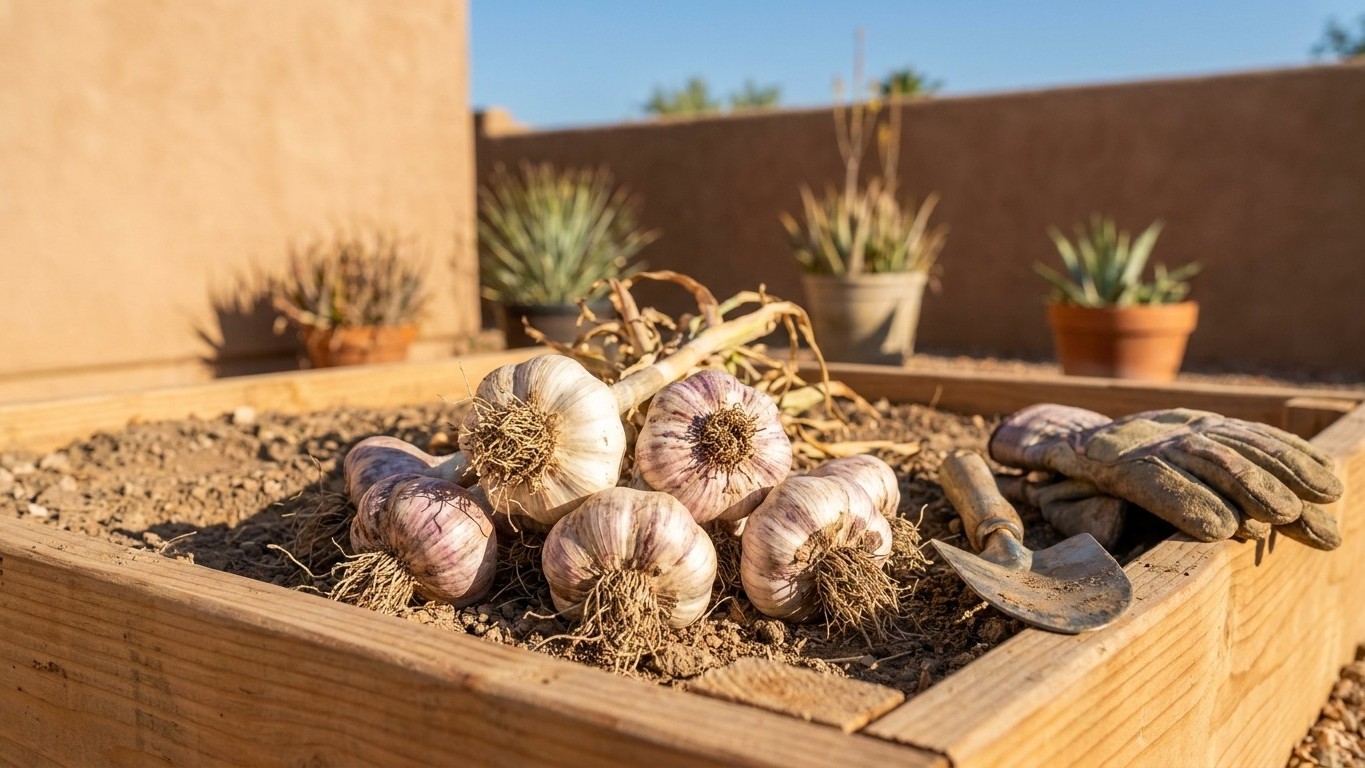

Garlic won’t naturally form a real head in most Arizona yards, and the reason is winter here barely qualifies as winter. The clove needs six to eight weeks of temperatures under 40°F to split into cloves at all, and Phoenix’s own weather record shows a freeze shows up in only a handful of recent springs. So before you plant, either chill your seed cloves in the fridge for those six to eight weeks or skip that step entirely by choosing a softneck variety, something like Inchelium Red, that’s bred to divide without much cold at all; a look at Garlic Varieties That Suit Arizona Winters can help you pick the right one.
Will garlic get the cold it needs in Arizona

Garlic is not like a tomato or a pepper. The clove you plant does not just sprout and grow bigger. It has to sense a stretch of cold first, or it stays a single rounded bulb instead of dividing into the ring of separate cloves you expect at harvest. University of Georgia Extension publication C854 puts that requirement at six to eight weeks with temperatures below 40°F after planting. Skip that chilling and you still get a garlic plant. You just don’t get a garlic head.
Low-desert Arizona plainly falls short of that window. NOAA’s 1991-2020 climate normals list Phoenix’s frost-free season at a full 365 days, and NOAA’s RCC ACIS daily records at station USW00023183 show the mercury reached even a light 32°F freeze in only 6 of the past 30 springs. There is no sustained run of sub-40°F weather to speak of most winters. States with a real winter clear that threshold with no effort from the grower at all, which is worth seeing in contrast: growing garlic in Arkansas works off a genuine frost anchor that Phoenix simply does not have.
Arizona’s high country is a different climate entirely. Flagstaff and the White Mountains sit at elevations where hard freezes are routine, and that cold almost certainly delivers the chilling garlic wants without any intervention. No comparable long-term station figure for those areas is included here, so treat that as a general expectation rather than a number, and check locally before you plant.
For anyone gardening in the low desert, there are two workable paths, not one. The first is to refrigerate your seed cloves for six to eight weeks before planting, kept at roughly 39 to 40°F and away from fruit, since ripening produce gives off ethylene that can damage the cloves. The second is to plant a softneck type, which generally divides with less cold than a hardneck needs and is the more forgiving choice where winters run mild. Neither path is a guarantee of a huge head, but both beat planting untreated hardneck cloves into a winter that never gets cold enough to do the work for you.
When to put the cloves in
No frost date to plant against
Most garlic planting calendars start with a fall frost date and count backward. That approach does not work in low-desert Arizona, because there isn’t one to count from, which is why knowing When to Plant Garlic in Arizona requires a different approach. NOAA’s 1991-2020 climate normals list no reliable fall freeze at all for Phoenix, with the frost-free season running the full year in most years. Anchoring a planting date on a frost that essentially never comes would only invent a false precision.
What local growers use instead is the drop in soil temperature as the worst of the summer heat finally breaks. Garlic wants to go into ground that has cooled well down from its summer peak, so cloves can put down roots while the soil is still workable and the air isn’t punishing. The exact week varies with the season and with your specific yard, and there’s no single safe date to hand you here. This is one place where asking your local nursery or extension office what other growers nearby are doing beats trusting a printed calendar.
In a state with a dependable fall freeze, the calculation looks completely different. Growers in New Jersey, for instance, can set a planting window a defined number of weeks ahead of a known first frost (see growing garlic in New Jersey for how that anchor is used). Arizona’s low desert has no equivalent marker, so the goal shifts from timing against frost to timing against soil temperature and against how the plant behaves once it’s in the ground: you want roots established, not a lot of leafy top growth, heading into the coolest stretch of the year.
Elevation is the biggest variable across the state. Higher ground cools faster and harder in fall than the valley floor does, which means the whole planting window shifts earlier the higher you go. Arizona has no large lake or coastline to complicate that picture the way it does in other regions, so elevation is essentially the whole story here. If you’re at altitude and get real hard freezes, treat those freezes the way a cold-climate grower would treat theirs, planting in time for roots to establish before the ground locks up, and lean on your county extension office for a date.
Which types suit Arizona
Hardneck and softneck garlic are not interchangeable, and here the choice is decided by winter, not preference. Hardneck garlic wants a real cold season to perform, producing a scape and a tight ring of large cloves when it gets one. Softneck garlic tolerates a mild winter far better, forms cloves with less cold, and stores substantially longer in the pantry afterward, which matters in a state where summer heat arrives early and stays late.
Given that most of Arizona’s populated growing areas fall into the low-desert climate described above, softneck varieties are the more dependable choice for the majority of the state’s gardeners. From the cultivar list available for this region, that means types like Early Red Italian, Inchelium Red, Italian Late and Lorz Italian, all softneck, all bred to get by without a hard winter.
Where elevation supplies a genuine cold season, hardneck varieties become a realistic option and often reward the grower with bigger cloves and a scape to harvest along the way. The hardneck names available here are Bavarian Purple, Blue Music, Chesnok Red, Duganski, Fall Festival, Georgian Crystal, Georgian Fire, German Red, German White and Ivan.
| Variety | Neck type | Best fit in Arizona |
|---|---|---|
| Early Red Italian | Softneck | Low desert, mild-winter areas |
| Inchelium Red | Softneck | Low desert, mild-winter areas |
| Italian Late | Softneck | Low desert, mild-winter areas |
| Lorz Italian | Softneck | Low desert, mild-winter areas |
| Bavarian Purple | Hardneck | High country with a real freeze |
| Blue Music | Hardneck | High country with a real freeze |
| Chesnok Red | Hardneck | High country with a real freeze |
| Duganski | Hardneck | High country with a real freeze |
| Fall Festival | Hardneck | High country with a real freeze |
| Georgian Crystal | Hardneck | High country with a real freeze |
| Georgian Fire | Hardneck | High country with a real freeze |
| German Red | Hardneck | High country with a real freeze |
| German White | Hardneck | High country with a real freeze |
| Ivan | Hardneck | High country with a real freeze |
Catalogue days-to-maturity figures for these cultivars are counted from transplant of the young plant, not from the clove going into the ground, and they typically shift by a week or two either direction depending on the season. Since garlic here isn’t transplanted at all, use those published figures only as a rough sense of relative earliness between varieties, not as a literal countdown for your own garden.
Soil and bed preparation
Drainage comes before everything else. Garlic sits in the same patch of soil through the entire growing season, from fall planting into the following summer, and standing water around the cloves will rot them long before any fungus or pest gets a chance. If your soil holds water after a good soak, raised beds or mounded rows solve most of the problem without any other intervention.
Working the bed before planting
Arizona’s desert soils are commonly low in organic matter and often alkaline, sometimes with a hard caliche layer sitting a foot or so down that blocks both roots and drainage. Break up that layer where you find it, and work several inches of compost into the top of the bed in the weeks ahead of planting. That does two things at once: it loosens compacted ground so water actually moves through it, and it feeds a crop that will be drawing on that same soil for the better part of a year.
Garlic generally prefers soil on the neutral to slightly acidic side, and desert soils tend to run the other direction. A simple soil test before planting tells you where you stand and whether an amendment is worth the effort, rather than guessing. Rake the bed to a fine, even surface just before you plant, since cloves set at an uneven depth root unevenly too, and that unevenness tends to show up later as a ragged, mixed-size harvest.
What the climate here favours, and what it does not
The UC IPM Pest Management Guidelines for Onion and Garlic, UC ANR Publication 3453, publish soil temperature ranges for the fungi and pathogens most likely to trouble a garlic crop. The figures below compare Arizona’s monthly mean air temperatures against those published ranges, which is a useful screen but not a diagnosis. Those thresholds are measured in soil, not air, and soil lags air by weeks and swings far less, so a month where the air average falls inside a disease’s range is a tendency toward that disease being active, never a confirmed infection.
Where the risk concentrates
- Fusarium basal rot (Fusarium oxysporum f. sp. cepae): air temperature sits inside the published 59-90°F range in 7 of the 11 growing-season months, September through May with the exception of December and January.
- White rot (Sclerotium cepivorum): air temperature sits inside the published 50-75°F range in 6 months, November through April, including one month at the pathogen’s published optimum.
- Southern blight (Sclerotium rolfsii): air temperature sits inside the published 86-95°F optimum in 3 months, September, June and July, all three at the optimum itself.
- Pink root (Setophoma terrestris): air temperature sits inside the published 75-85°F optimum in 2 months, October and May, both at the optimum.
Read the other side of that same list and the picture balances out. Fusarium’s range misses the heart of winter, December and January, when Arizona’s air runs too cool for it. White rot’s range misses the hottest stretch of the year entirely, from May through September, when the state is nowhere close to its 50-75°F band. Southern blight and pink root each occupy only a couple of months apiece rather than sitting in range all season. None of that means a given disease can’t show up outside its listed months. Infected seed garlic carries these pathogens regardless of the weather, which is exactly why sourcing clean, certified seed stock matters as much as anything else.
Getting it through the winter
What mulch needs to do for a garlic bed depends entirely on which Arizona you’re gardening in. In the low desert, the ground essentially never freezes, so a mulch layer is doing moisture and temperature buffering work rather than frost protection. A few inches of straw laid down not long after planting keeps the soil from swinging as hard between a warm afternoon and a cool desert night, and it holds moisture so you’re not fighting evaporation all winter on top of everything else.
In the high country, mulch is doing a different and more urgent job. Repeated freeze-thaw cycles heave soil, and a shallow-planted clove can get pushed right up out of the ground by that heaving, exposing it to cold and drying air and effectively undoing the planting. A solid mulch layer put down once the ground starts to cool insulates against those swings and keeps the clove anchored at the depth you set it.
Pull mulch back gradually in spring once new growth is clearly underway, rather than leaving it thick right through the season. A heavy, damp mulch layer sitting against actively Growing Garlic in warm weather is exactly the kind of moist, moderate environment that favors the fungal pressures described above. Thinning it out as the weather turns lets the soil surface dry between waterings again, which matters more in a state where several of those pathogens have a real window to work with.
Harvest and curing here
Harvest timing comes from the plant, not the calendar. Wait until the lower third to half of the leaves have browned and died back while the upper leaves are still green, then lift a test bulb or two to check that the cloves have separated and the wrapper is intact. Pull too early and you lose size and storage life. Wait too long and the wrapper splits, which lets soil pathogens straight into the cloves.
Curing in a dry climate
Arizona’s dry air is an advantage at curing time, since the mold and rot problems that plague curing in humid states are far less likely here. That same dry heat is also a hazard if you cure in direct sun: bulbs can scald and cook rather than cure properly. Cure in a shaded, well-ventilated spot, out of direct sun, with air moving freely around the bulbs, roots and tops left on until the outer wrappers are fully papery and dry. In Arizona’s low desert, that dry ventilated shade does the job faster than it would in a humid state, but rushing it and storing bulbs before they’re fully dry is the single most common way to lose a crop that survived the whole growing season intact.
Local help
County-level planting windows, soil test results and pest identification are all things a printed guide can’t give you with any real precision, and that’s exactly what your local office is for. The University of Arizona Cooperative Extension can point you to the office serving your county for a soil test, a locally-informed planting window, and help identifying anything that shows up in the bed once the crop is growing.
Common questions
Can I grow garlic in Phoenix without refrigerating the cloves first?
You can, and it will grow, but expect a higher share of round, undivided bulbs since the clove never gets the sustained cold it needs to split. Refrigerating cloves for six to eight weeks before planting, or choosing a softneck variety, both improve your odds of a properly divided head.
Can I Plant Garlic in spring instead of fall in Arizona?
No. Garlic is a fall-planted, early-summer-harvested crop everywhere, including Arizona, and spring planting doesn’t leave enough time before summer heat shuts growth down. Plant once the fall soil has cooled from its summer peak, not when the weather warms up again.
Does living at a higher elevation in Arizona change any of this?
Yes, substantially. Flagstaff and the high country get real hard freezes that the low desert never sees, which changes both the planting window and which garlic type is likely to perform, favoring hardneck varieties over the softneck types better suited to the valley floor. Check with your local extension office for guidance specific to your elevation.
Can I plant garlic bulbs from the grocery store?
You can, but it’s a gamble. Grocery garlic isn’t sold as seed stock, may have been treated to suppress sprouting, and can carry soilborne diseases like Fusarium basal rot or white rot into a bed that wasn’t infected before. Certified seed garlic from a known source costs more but removes that risk.
Why did my garlic come out as one round bulb with no separate cloves?
That’s a vernalization failure, meaning the clove didn’t get enough sustained cold after planting to trigger division. It’s the expected outcome for untreated hardneck garlic grown in low-desert Arizona’s mild winters, and it’s exactly what pre-chilling the cloves or switching to a softneck variety is meant to prevent.