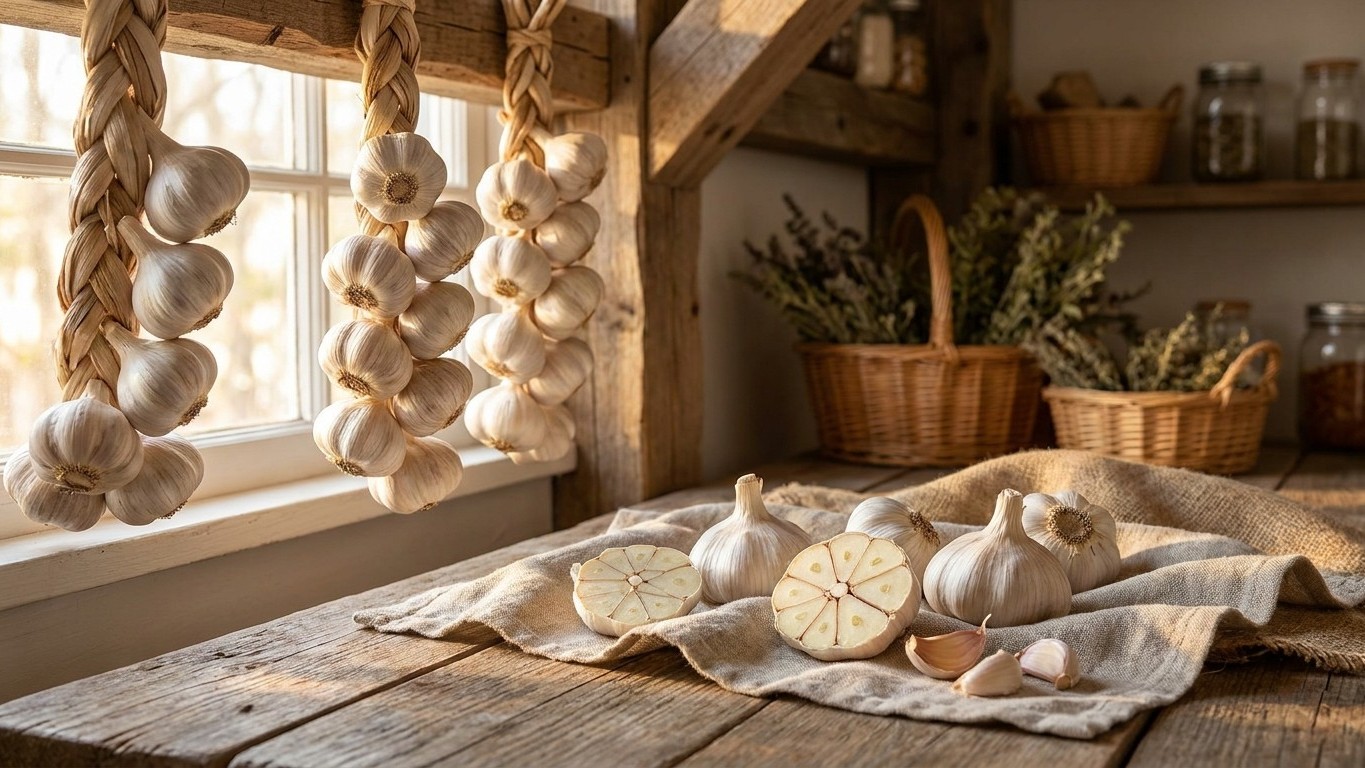

In Manitoba, garlic planted the previous fall usually comes out of the ground between mid-July and early August, once the lower third to half of the leaves have turned brown and started to dry. That’s the direct signal growers here rely on, more than any date on a calendar, because a cool, wet spring can push lifting a full two weeks later than a hot, dry one.
When garlic is ready to lift in Manitoba
The leaf-browning rule works because each green leaf on a garlic plant corresponds to a wrapper layer around the bulb underground. Pull too early, while six or seven leaves are still green, and the bulb hasn’t finished sizing up, plus the papery wrappers won’t have formed enough to protect it in storage. Wait too long, past the point where most leaves have collapsed, and the wrappers start to split and the cloves separate inside the skin, which shortens how long that bulb will keep.
The timing traces back to when the cloves went into the ground the previous autumn. Manitoba growers plant garlic in fall, generally aiming for a window before the soil locks up for winter but late enough that the cloves don’t push top growth before freeze-up. First fall frost at Winnipeg Richardson International Airport averages September 22, based on Environment and Climate Change Canada’s 1981-2010 climate normals. That’s a midpoint, not a guarantee: in one year out of two, the first frost actually lands later than September 22, and in colder pockets north of Winnipeg or on higher ground, it can arrive weeks ahead of that average. A crop planted with that variability in mind, rather than against a fixed date, tends to establish roots evenly and comes up more uniformly the following June.
Reading the bulb, not just the leaves
Leaf color gets a grower close, but pulling one test bulb from the row settles it. Brush away the soil and check whether the cloves have separated cleanly inside the wrapper and whether that wrapper still feels intact rather than papery-thin or already splitting. A bulb pulled a few days early will still cure fine; one left too long in wet ground risks staining or rot that no amount of curing will fix afterward. Given how much Manitoba’s spring moisture varies year to year, that one test bulb is worth more than any fixed date on a chart.
Curing it, and where to hang it here
Curing is what turns a freshly pulled bulb, still carrying field moisture in its stem and outer layers, into something that will keep for months. The process needs airflow, shade, and time, not sun and not a rush. Bulbs left curing in direct sun can scald, and the outer wrappers that are supposed to protect the cloves through winter end up bleached and brittle instead of tough.
The practical setup most Manitoba growers land on is a garage, a shed, or a covered porch with the doors or windows cracked for cross-ventilation. A basement works too, provided it isn’t damp, since trapped humidity is what invites mold on the outer skins during the cure. Bulbs get spread on screens, hung in loose bundles of five or six by the stems, or laid on slatted shelving, anything that keeps air moving around each bulb rather than stacking them in a pile where the center ones sweat.
How long the cure takes
Three to four weeks is the general range before garlic is fully cured in most climates, and Manitoba’s late-summer air, warm days but drier than a coastal climate, tends to sit toward the faster end of that. The bulb is ready when the outer wrappers rustle like paper and the stem above the bulb has gone fully dry and stiff rather than soft or green. Cutting into that stem while it’s still pliable is a common mistake: any moisture trapped inside gets sealed in with the cloves, and that’s often where storage rot starts weeks later.
Once cured, trim the roots close to the base and cut the stems down to an inch or two if the garlic will be stored loose, or leave the stems long if it’s going to be braided. Either way, brushing off loose soil rather than washing the bulbs keeps the outer wrapper intact, which matters more for storage life than how clean the bulb looks on day one.
Storing it through a Manitoba winter
Cured garlic wants cool, dry, and dark, somewhere in the range most root cellars or unheated back entries can hold through a Manitoba winter without much extra effort. A pantry shelf away from the stove, a cold room, or an unheated closet against an exterior wall all work, as long as the space doesn’t swing warm during a January thaw or when the furnace kicks the house up several degrees.
Humidity matters as much as temperature. Garlic stored somewhere damp, a basement corner near a sump pump or a bin sitting directly on a concrete floor, tends to sprout early or develop soft spots at the base of the clove. Mesh bags, loosely woven baskets, or old pillowcases hung from a hook all let air circulate around the bulbs, which plastic bags and sealed containers don’t. A sealed container traps the small amount of moisture every bulb still gives off even after curing, and that moisture is enough to start mold on the wrapper within a few weeks.
What shortens storage life
Bulbs with any bruising, a nick from the digging fork, or a wrapper that split during the cure won’t store as long as intact ones, so it’s worth sorting those out early and using them first rather than mixing them into the batch meant to last through spring. Checking the stored garlic every few weeks and pulling any bulb that’s gone soft prevents that one bulb from affecting its neighbors in the same bag. Manitoba’s dry winter air is actually an advantage here, since low ambient humidity outdoors translates to drier indoor air than a coastal province would have, which favors long storage as long as the garlic isn’t stashed somewhere damp by accident.
What goes wrong here
Most of the trouble with garlic in Manitoba traces back to timing rather than pests: pulling too early because a hot week made the leaves look further along than the bulb actually was, or leaving bulbs in wet soil after a late-summer rain because the calendar said it wasn’t time yet. Both mistakes are avoidable by pulling that one test bulb before committing the whole row.
On the pest side, the extension services covering the neighboring states, NDSU Extension and University of Minnesota Extension, document onion maggot (Delia antiqua) and cabbage maggot (Delia root maggot) as pests affecting allium and brassica crops in growing conditions similar to Manitoba’s. Onion maggot larvae tunnel into the base of the bulb, and damage from that feeding often isn’t obvious until a bulb that looked fine at harvest turns soft in storage a month or two later. There’s no separate published list of pests specific to Manitoba garlic on this site, so growers watching for trouble in an allium bed are working from the same species documented just south of the border, not a longer or different list.
The single biggest storage failure isn’t a pest at all, though. It’s curing garlic in a spot that seemed dry at the time, a garage in early September, for instance, but that gets damp once the weather turns and the doors stay shut. Checking that the curing space still has airflow a week or two into the process, not just on day one, catches that problem before it costs the whole crop. For growing-condition specifics by region, Manitoba Agriculture is the provincial resource worth checking.
Common questions
Can garlic be harvested if a few leaves are still green?
Yes, and it’s usually the better mistake to make. A bulb pulled with a little too much green left in the leaves still cures fine, while one left in the ground too long risks split wrappers and separated cloves that won’t store as well.
Does rain right before harvest ruin the crop?
It can delay lifting rather than ruin anything outright. Pulling bulbs out of saturated soil traps moisture against the wrapper and slows the start of curing, so waiting a few dry days after a rain, even if it pushes past the ideal leaf-color window, usually gives a better-keeping bulb than digging into mud.
How long does properly cured garlic actually keep in Manitoba?
Well-cured bulbs stored cool, dry, and dark commonly last through winter into spring, though that varies by variety and by how carefully bruised or damaged bulbs were sorted out before storage. Checking stored bulbs periodically and removing any soft ones extends how long the rest of the batch lasts.
Is a root cellar necessary for storing garlic here?
No. An unheated closet, a cold back entry, or a pantry shelf away from heat sources works as well as a dedicated root cellar, provided the space stays dry and doesn’t swing warm during a midwinter thaw.