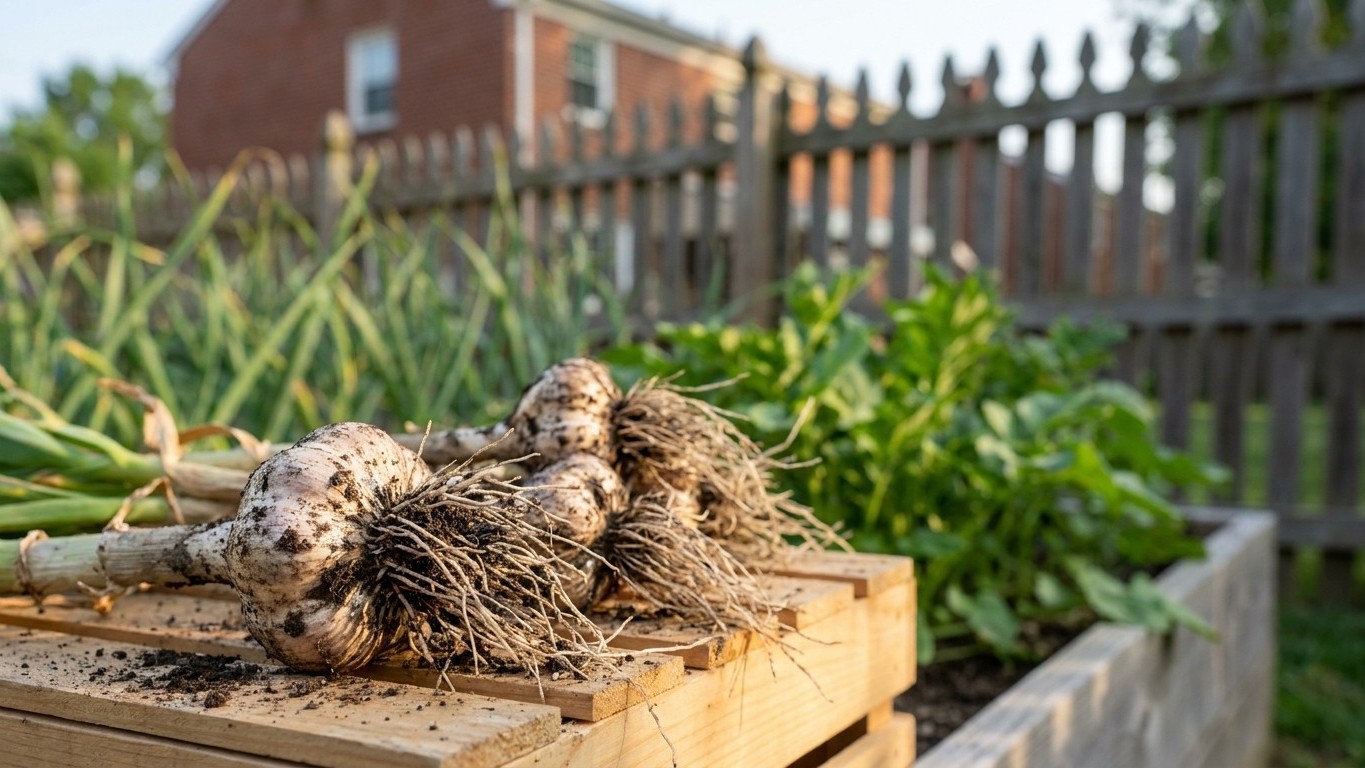

Garlic goes into Maryland ground from early October to mid-October, timed so cloves root before the first hard freeze. NOAA’s 1991-2020 climate normals put Baltimore’s first fall frost at October 26 to November 5, and Maryland growers count back three to four weeks from that window to land on a planting date. The single action that follows: mark a date in that early-to-mid-October range now, then check it against frost data for your own county before you order seed garlic.
The short answer for Maryland

Six to eight weeks below 40°F is what actually splits a fat bulb from a marble-sized dud, and Maryland winters clear that mark with room to spare — which is why frost itself isn’t the thing to plant around. Baltimore’s first freeze lands anywhere from October 26 to November 5 in a given year, sometimes earlier, sometimes later, so treating that window as a deadline gets the timing backward. Count from it instead, and the real question becomes how many weeks of root growth your cloves need before the ground shuts them out.
Why the window sits ahead of frost, not after it
Garlic does not need protection from frost. The plant tolerates hard freezes once established, and a touch of cold in November does the crop no harm. What it needs is time: roots have to grow before the soil drops into the low 40s and stays there, and then the clove has to sit through a stretch of cold weather to differentiate into the individual cloves you will harvest next summer. The University of Georgia Extension, publication C854, puts that chilling requirement at six to eight weeks of temperatures under 40°F. Near Baltimore, the growing season logs 21.8 weeks below that mark, so a Maryland winter clears the requirement several times over.
The frost date is a midpoint, not a safe date
October 26 to November 5 is not a date to circle and plant on. It is the middle of a distribution. In roughly half the years on record, Baltimore’s first freeze arrives before October 26, and in the other half it holds off past November 5. Planting in early to mid-October gives cloves a buffer on either side of that spread, which is the point of counting backward from the frost window rather than planting on it.
Working it out for your own garden
The three-to-four-week rule is the part of this calculation you can carry to any county in the state, as long as you swap in your own frost data. Start with the first fall frost date for the weather station nearest you, not Baltimore’s, since a single reference city does not describe a whole state. Then count back three to four weeks from the early end of that range to find the earliest sensible planting date, and count back three weeks from the late end to find the latest.
Showing the arithmetic
For Baltimore itself, the math looks like this. NOAA’s 1991-2020 normals put the first fall frost at October 26 to November 5. Back up three to four weeks from October 26 and you land in the last days of September. Back up three weeks from November 5 and you land in mid-October. Stack those two calculations together and the sensible planting range comes out to roughly early October through mid-October, which is why that is the window named for every cultivar in Maryland’s garlic catalog. See Garlic Varieties That Suit Maryland Winters for what fits your soil and taste, from Inchelium Red to German White. Catalog days-to-maturity figures for garlic describe the following summer’s harvest, not the fall planting date, so they do not change this arithmetic. They only shift the June-to-July window on the other end, and by a week or two depending on the season.
Redoing the math for your own address
- Find the average first fall frost date for the weather station nearest your garden, from NOAA or your county extension office.
- Subtract three to four weeks from the early end of that range for your earliest planting date.
- Subtract three weeks from the late end for your latest planting date.
- Treat the result as a window, not a single day, since frost dates themselves are ranges built from decades of data, not fixed points.
Elevation is the biggest single factor inside Maryland’s borders. Ground several hundred feet higher than Baltimore cools faster in fall, which pulls the first frost forward and pulls the planting window forward with it. Distance from the Chesapeake Bay works the other way: the water holds heat into fall and delays the first frost for towns close to the shoreline, pushing the planting window a bit later. A garden in a river valley or a known frost pocket can run days to weeks ahead of the open, flatter ground around it, even within the same county.
None of this changes the chilling side of the calculation. Even in a district that runs two weeks behind Baltimore in the fall, the season still delivers far more than the six to eight weeks of sub-40°F weather garlic needs, going by the University of Georgia Extension threshold measured against Baltimore’s 21.8-week count. The chilling math is not the limiting factor anywhere in Maryland. The frost timing is.
What changes across Maryland
Baltimore’s frost window is a starting point, not a statewide figure. Western Maryland runs weeks later than the rest of the state, and the Eastern Shore runs milder, per the same NOAA data that sets Baltimore’s normals. Both shifts trace to geography a grower can point to on a map, not to vague regional feel.
Where the mountains push planting earlier
Garrett and Allegany counties sit at real elevation on the Appalachian Plateau, and that height brings the first hard freeze on weeks earlier than it arrives in Baltimore. A garlic bed in Oakland or Cumberland should go in earlier than the early-October start that works for the Baltimore area, since the three-to-four-week countback runs from an earlier frost date to begin with. Growers in this part of the state are better served checking a nearby station’s own normals than borrowing Baltimore’s window outright.
Where the Bay pushes planting later
The Eastern Shore counties, buffered by the Chesapeake Bay and the Atlantic, hold warmth longer into fall than the Piedmont around Baltimore does. That delays the first frost and shifts the whole planting calculation toward the later end of the early-to-mid-October range, sometimes past it. A grower on the Shore who plants on the same date as a grower in Frederick County is not making an equivalent choice, because the soil temperature each is working with differs even on the same calendar day.
| Region | Frost timing relative to Baltimore | Why |
|---|---|---|
| Western Maryland (Garrett, Allegany) | Weeks earlier | High elevation on the Appalachian Plateau |
| Central Maryland (Baltimore area) | NOAA 1991-2020 normal: October 26 to November 5 | Reference station used in this article |
| Eastern Shore | Later, milder | Buffered by the Chesapeake Bay and the Atlantic |
The mistakes this climate punishes
Maryland’s ample winter chill, 21.8 weeks below 40°F near Baltimore per the University of Georgia Extension threshold, means garlic here almost never fails from lack of cold. The mistakes that do cost a crop are timing and moisture problems, not the choice between hardneck and softneck types.
Planting too late for the frost that actually shows up
Since October 26 to November 5 is a midpoint, a grower who waits until the very end of the recommended planting window is gambling on the later half of that range showing up. In a year when frost lands closer to October 26, cloves planted in late October have had almost no time to root before the ground cools hard. The safer error is to plant toward the early end of early-to-mid-October rather than the late end, especially on ground you have not tracked yourself for a full season.
Planting too shallow for a freeze-thaw climate
Maryland winters swing above and below freezing repeatedly rather than locking into one long freeze, and that cycling heaves shallow-planted cloves out of loosened soil over the winter months. A generous planting depth, plus a thick layer of straw mulch, holds cloves in place through those swings and moderates the soil temperature the clove actually experiences underground.
Wet soil and the diseases that come with it
White rot, caused by the fungus Sclerotium cepivorum, is active across a 50 to 75°F soil temperature range according to UC IPM’s Pest Management Guidelines for Onion and Garlic, UC ANR Publication 3453. Maryland’s average air temperatures fall inside that range in five months of the growing season, including October, the same month cloves go into the ground, and again in spring as the crop resumes growth. That does not mean white rot is guaranteed anywhere in the state, and it does not mean the reverse either: air temperature only describes possibility, and infected planting stock carries the fungus regardless of climate. Fusarium basal rot follows a similar pattern, with average air temperatures inside its published 59 to 90°F range in four months of the season. Certified, disease-free seed garlic matters more in this climate than the exact planting date does, and well-drained soil with a rotation away from recent onion or garlic beds cuts the risk further.
Checking this against your county
Every figure in this article comes from a single reference station near Baltimore. If you garden in Hagerstown, Salisbury, or anywhere outside the Baltimore-Washington corridor, your own first frost date can run days or weeks off the range given here. Confirm it before you order seed garlic. University of Maryland Extension maintains local offices that can point you to frost and soil data collected close to your own garden, and pairing that county-level figure with the three-to-four-week countback above gets you a planting window built for your address, not for Baltimore’s.
Common questions
What happens if I plant garlic too late in Maryland?
Cloves planted after the mid-October end of the window still root in most years, but with less root mass going into the cold months. The bulbs that result the following summer tend to run smaller, and a late planting is more exposed if that year’s frost lands on the early side of the October 26 to November 5 range. If you find yourself planting in late October or early November, plant a bit deeper and mulch heavier to compensate for the shorter rooting period.
Should I plant hardneck or softneck garlic in Maryland?
Either works here. Maryland’s winter cold clears the six-to-eight-week chilling requirement for both types many times over, so the choice comes down to flavor and storage life rather than climate fit. Softneck types such as Lorz Italian generally store longer in the pantry. Hardneck types such as Duganski and Chesnok Red tend toward a stronger, more complex flavor.
Can I still plant garlic if the soil feels warm in early October?
Yes. Air temperature and soil temperature are not the same thing, and Maryland soil in early October is often still holding late-summer warmth even after the air has cooled. Garlic tolerates that fine, since real root growth only ramps up as the soil cools further over the following weeks. Planting on the calendar window matters more than waiting for a particular soil feel underfoot.
Do I need to mulch garlic right after planting?
A layer of straw mulch after planting matters in Maryland’s climate specifically because of the freeze-thaw cycling described above, not because the state gets extreme cold. Mulch moderates the swings in soil temperature that can heave shallow-planted cloves and helps hold moisture through dry fall stretches. Pull it back partway in spring once new growth appears, so shoots are not smothered under a thick, wet layer.
If you follow the almanac, here is when to plant garlic by the moon. It is a tradition, not a proven method.