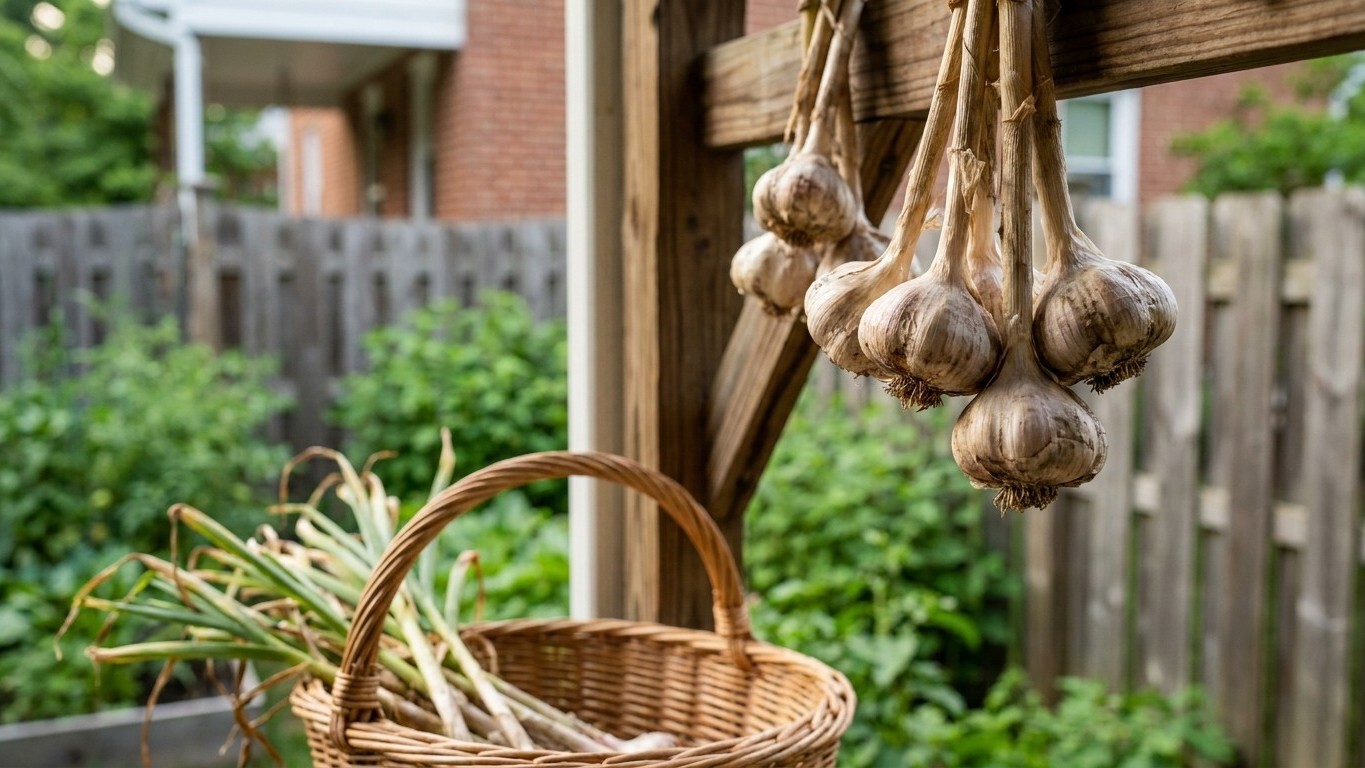

Maryland’s winter cold is more than enough for either hardneck or softneck garlic to split into full bulbs. The University of Georgia Extension (Bulletin C854) puts that requirement at six to eight weeks below 40°F, and a Maryland winter runs about 21.8 weeks below that mark. Plant any of the varieties below in early October to mid October, timed to the NOAA frost normals for the Baltimore area, and confirm your own county’s frost timing with UMD Extension before you settle on a date.
The short answer for Maryland

Both hardneck and softneck garlic split into full bulbs here without any trouble, so the real question isn’t whether your yard is cold enough — it’s which one you’d rather eat and how long you need it to keep in storage. Plant in early to mid October, giving cloves several weeks to root before the ground shuts down for winter. Check your county’s frost timing before you settle on a date.
That planting window is anchored on giving cloves several weeks of active root growth in soil that has not yet gone cold, before winter shuts growth down entirely. Garlic goes into the ground in autumn and stays there through the whole cold season, and you lift the bulbs the following summer, not before. The date is not built around the frost itself as a deadline to beat. What matters is root establishment before the ground cools hard, not avoiding frost on the leaves, since garlic tolerates freezing air far better than it tolerates a shallow, unrooted planting.
The frost window deserves one caution before you use it: a frost date is a midpoint, not a safe date. In one year out of two, the Baltimore area’s first freeze falls after November 5, and in the other, it falls before October 26. Treat the range as a planning tool, not a circled day on the calendar.
Fourteen options, one Maryland window
All fourteen varieties below carry the same October planting window, because Maryland’s frost timing sets that date, not the variety’s origin. What differs between them is neck type and, in practice, how each stores once you’ve lifted and cured the bulbs.
| Variety | Neck type | Set-out window |
|---|---|---|
| Early Red Italian | Softneck | Early October to mid October |
| Inchelium Red | Softneck | Early October to mid October |
| Italian Late | Softneck | Early October to mid October |
| Lorz Italian | Softneck | Early October to mid October |
| Bavarian Purple | Hardneck | Early October to mid October |
| Blue Music | Hardneck | Early October to mid October |
| Chesnok Red | Hardneck | Early October to mid October |
| Duganski | Hardneck | Early October to mid October |
| Fall Festival | Hardneck | Early October to mid October |
| Georgian Crystal | Hardneck | Early October to mid October |
| Georgian Fire | Hardneck | Early October to mid October |
| German Red | Hardneck | Early October to mid October |
| German White | Hardneck | Early October to mid October |
| Ivan | Hardneck | Early October to mid October |
Working it out for your own garden
The early-October-to-mid-October window above is not a fixed calendar date. It is a calculation run backward from a local frost normal, and you can rerun it for wherever you actually garden.
The arithmetic behind the window
Start with NOAA’s 1991-2020 climate normals for the Baltimore area: first fall frost falls between October 26 and November 5. Garlic wants roughly two to four weeks of active root growth in soil that has not yet gone cold, before top growth needs to slow for winter. Count back two to four weeks from that frost window and you land in early to mid October, which is exactly the planting range the catalog gives. Notice the shape of that arithmetic: a range counted back from a range produces another range, not a single day. Anyone who names a specific planting date for Maryland garlic is rounding off information that doesn’t exist at that resolution.
The cold requirement itself is a separate calculation, and it is generous almost everywhere in the state. The University of Georgia Extension (Bulletin C854) sets the vernalization threshold, the amount of time below 40°F a clove needs to split into a full bulb, at six to eight weeks. A Maryland winter delivers roughly 21.8 weeks below 40°F at the reference station, close to three times that minimum. That margin is why variety choice here is a matter of taste and storage life, not survival.
Adjusting for your own site
Three things move your true planting date away from the Baltimore figure: elevation, distance from open water, and how your soil drains. Higher ground cools faster in autumn than a valley floor a few miles away at lower elevation. A garden near open water, whether the Chesapeake Bay or a large reservoir, holds warmth longer into fall than an inland garden at the same latitude. A heavy clay soil that stays wet into November keeps root zones warmer than a fast-draining sandy soil, but wet clay also raises the disease risk.
If your local frost date runs a week or two earlier than the Baltimore normal, shift your planting window a week or two earlier too. If it runs later, you have room to plant later without losing the root-establishment period this arithmetic depends on. For the full week-by-week version of this calculation, see When to Plant Garlic in Maryland: Counting Back From the First Frost.
What changes across Maryland
The October window above is built on one reference point, the Baltimore-area station in NOAA’s climate normals, and Maryland’s geography doesn’t sit still around that point.
Western Maryland runs weeks behind
Garrett and Allegany counties, on the Appalachian Plateau, run weeks colder and later than the Baltimore figure because of elevation. A grower there should expect the true local frost date well ahead of the Baltimore range and plant garlic correspondingly earlier, checking county-level normals rather than applying the Baltimore window as written.
The Eastern Shore runs the other way
Moderated by the Chesapeake Bay on one side and the Atlantic on the other, the Shore’s fall stretches out longer than the Baltimore normal suggests, and the first frost there typically lands after the Baltimore range rather than inside it. A gardener on the Shore has more room to plant into mid or even late October without losing the root-establishment period the arithmetic above depends on.
Between those two extremes sits most of the state’s population and most of its garlic beds, close enough to the Baltimore-area normals that the October window applies with only minor adjustment. The Piedmont, the rolling terrain between the mountains and the coastal plain, tracks closest to the Baltimore-area reference figures. None of this changes the total winter cold that lets any Maryland garden grow either garlic type: the 21.8-week figure from the University of Georgia Extension describes weeks below 40°F broadly, and every part of the state clears the six-to-eight-week cloving requirement several times over even where the fall planting date shifts by two or three weeks.
The mistakes this climate punishes
Most of the failures reported around Maryland trace back to a handful of decisions made in the first week of planting, not to weather nobody could have predicted. If you haven’t settled on site and soil prep yet, that groundwork is covered in Growing Garlic in Maryland, and the mistakes below assume it’s done.
Planting too shallow for a real Maryland winter
Cloves set at the depth recommended for a milder climate are the most common failure here. A shallow-planted clove has little insulation from the freeze-thaw cycles that punctuate a Maryland winter, and a thaw in January or February followed by a hard refreeze heaves half-rooted cloves right out of loosened soil. Plant deeper than a default written for a milder region, and lay three to four inches of straw mulch before the ground freezes hard, not after the first hard freeze has already come and gone.
- Planting depth, not variety, decides most winter losses here
- Mulch timing matters more than mulch thickness
- Drainage decides disease exposure, not the calendar
Treating variety choice as a survival question
Because Maryland’s winter cold clears the cloving requirement by such a wide margin, growers often spend their planning effort on the wrong worry. Whether a bed holds Duganski or Inchelium Red will not decide whether the crop survives winter. Depth, mulch timing, and drainage decide that, in a mild year and a hard one alike.
Ignoring soil-borne disease risk at planting
Maryland’s growing-season air temperatures sit inside the published range for white rot (Sclerotium cepivorum) for five months of the year, September, October, April, May and June, including one month at the disease’s optimum, according to the University of California’s IPM guidelines for onion and garlic (UC ANR Publication 3453). Fusarium basal rot (Fusarium oxysporum f. sp. cepae) overlaps for four months: September, May, June and July. Those published thresholds are for soil temperature, which lags air and swings less than air does, and a single reference count doesn’t describe every Maryland field. Neither risk depends on how cold Maryland gets: both pathogens travel in infected seed garlic and contaminated soil regardless of climate, so sourcing clean, certified stock and avoiding a bed that stayed wet the previous season matters more than any planting-date decision.
Checking this against your county
Before locking in a planting date, check your own county’s numbers against the state’s land-grant extension service. UMD Extension maintains county offices across Maryland that can confirm local frost timing and flag conditions, such as a known history of white rot in a particular field, that a statewide page can’t see.
A five-minute call or search beats a guess, especially in a state where the western counties and the Eastern Shore can differ from the Baltimore normal by two weeks in either direction.
Common questions
Is hardneck garlic even worth trying in Maryland or should I stick to softneck?
Hardneck garlic grows well across Maryland because the state’s winter cold is far beyond the six to eight weeks either type needs to split into cloves. Choose hardneck for cold-hardiness and flavor variety, and softneck if you want longer storage and tighter, easier-to-braid bulbs.
What happens if I plant my garlic late, like December?
A December planting misses most of the root-establishment window, so cloves go into winter with little anchoring and often come up weak or thin the following summer. If you’re that late, plant anyway rather than waiting for spring, but expect a smaller bulb and mulch heavier than usual.
Can I just plant garlic from the grocery store instead of a named variety?
You can, but grocery garlic is rarely labeled for origin or disease status, and it may carry soil-borne pathogens like the ones behind white rot or fusarium basal rot into a bed that had none. Certified seed stock costs more per bulb but removes that unknown, which matters more in Maryland’s humid growing season than in a drier climate.
Do I need to remove the mulch in spring or leave it on?
Pull the bulk of the straw back once new green shoots push through reliably in spring, leaving a thin layer to suppress weeds. Mulch left too thick and too long into spring holds moisture against the neck of the plant longer than it should, which works against the drainage the disease section above already flags as a risk.