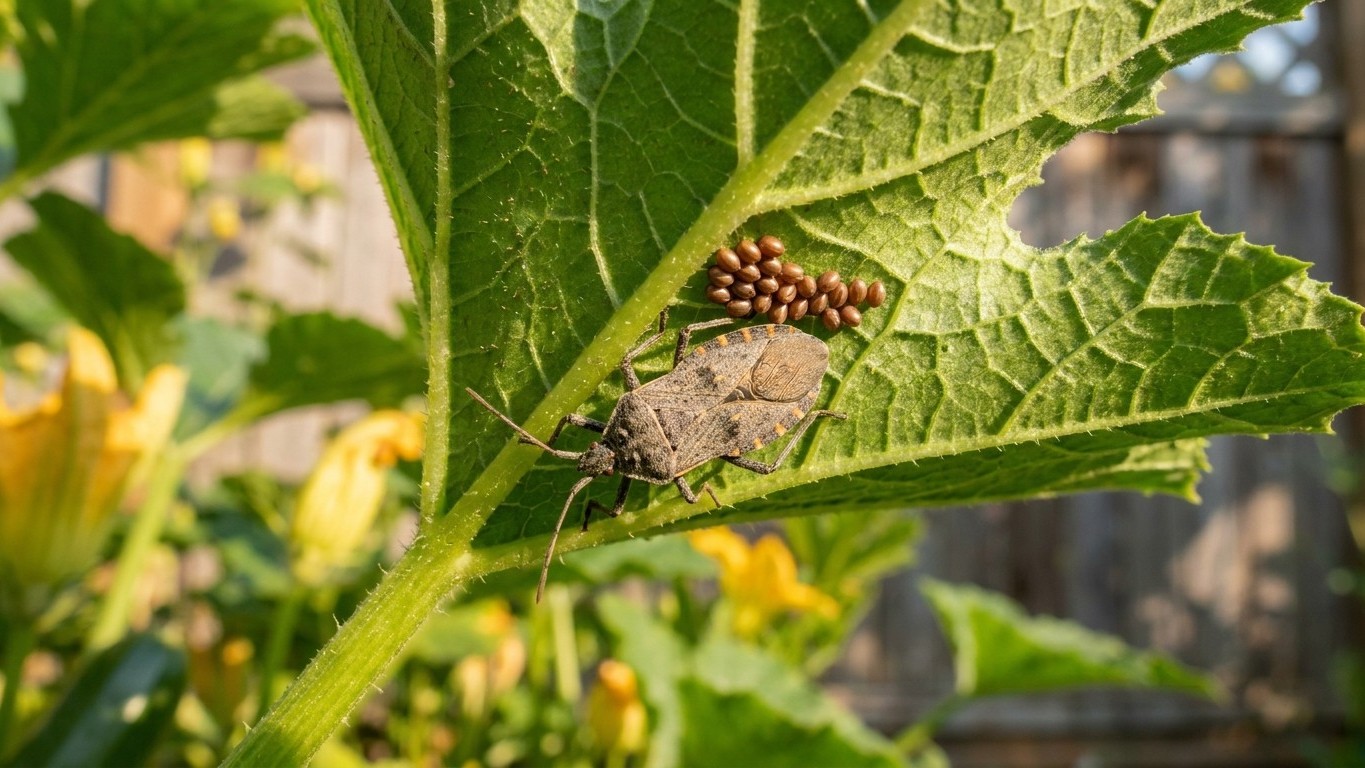

Squash bugs (Anasa tristis) show up in British Columbia gardens from mid-June through early September, with the heaviest pressure hitting in July and August once cucurbit vines have sprawled out and adult bugs start laying eggs. The insect is most established in the warmer growing pockets of the province, the Okanagan Valley and parts of the Fraser Valley, where longer stretches of heat let populations build faster than they do along the cooler, damper coast. Nothing eliminates squash bugs outright, but a mix of early scouting, hand removal, row covers timed to bloom, and destroying crop debris in fall keeps populations low enough that they don’t wreck a zucchini or pumpkin patch.
What a Squash Bug Actually Looks Like

Adults are roughly five-eighths of an inch long, flat-backed, and dull grayish-brown with orange or yellow stripes along the edges of the abdomen. They move slowly and tend to cluster near the base of the plant or tuck under leaves when disturbed, a habit that makes them easy to miss if you’re only glancing at the top of the foliage.
The eggs are the giveaway most gardeners learn to spot first. They’re a distinctive bronze or copper color, laid in tidy rows or clusters on the underside of leaves, often right in the V formed by two leaf veins. A single female can lay well over a hundred eggs across a season, which is why catching and crushing an egg cluster in June saves a lot of grief in August.
Nymphs go through several stages before reaching adulthood. Freshly hatched nymphs are gray with black legs and look almost spider-like; as they mature they turn a dusty gray-white before darkening toward adult coloring. Gardeners sometimes confuse young nymphs with beneficial insects, so a close look, or a photo compared against an extension service ID sheet, is worth the extra minute before you spray anything.
Squash Bug or Something Else?
Squash bugs are frequently mixed up with stink bugs, which share a similar shield shape but are typically more rounded and often green or brown with a smoother, less angular outline. Squash bugs also give off a distinct, somewhat unpleasant odor when crushed, similar to stink bugs, but they specifically target cucurbits: zucchini, pumpkin, winter squash, cucumber, and melon. If the damage is on tomatoes or beans instead, you’re likely dealing with a different pest entirely.
When Squash Bugs Show Up in British Columbia’s Growing Season
Squash bugs overwinter as adults, tucked under leaf litter, mulch, woodpiles, or garden debris left standing over winter. In BC’s climate, that means the insects that survive the cold months emerge in spring once soil and air temperatures climb consistently above roughly 60°F, generally sometime in late May or early June depending on the region.
Those overwintered adults fly to newly emerging cucurbit seedlings and begin feeding almost immediately, using their piercing mouthparts to draw sap from stems and leaves. Egg-laying typically starts a couple of weeks after emergence, once the bugs have fed enough to reproduce, putting peak egg-laying in most of southern BC somewhere in late June through July.
Okanagan Valley: Longer Exposure Window
The Okanagan’s hot, dry summers and extended frost-free season give squash bugs more time to complete a full life cycle, and in warmer years there’s a real possibility of a partial second generation appearing in late summer. Growers in this region, especially those with pumpkin patches or winter squash grown for fall markets, tend to see the most persistent pressure because the insect has more calendar time to build numbers before harvest.
Fraser Valley and Coastal Areas: Slower Build-Up
Coastal BC’s cooler, wetter spring conditions delay both plant growth and insect activity. Squash bug populations here tend to build more slowly and rarely reach the density seen in the Okanagan, though home gardens with squash, zucchini, or cucumber can still see damaging numbers by late summer, particularly in sheltered, sun-warmed spots like raised beds against a south-facing wall.
The Damage Pattern to Watch For
Squash bugs don’t chew leaves the way beetles do. They pierce plant tissue and remove sap, injecting a toxin as they feed that causes leaves to wilt, turn yellow, then brown and crisp at the edges, a condition sometimes called “anasa wilt” after the bug’s scientific name. On young plants, heavy feeding at the base of the stem can kill the entire seedling within days. On established vines, the damage usually starts as scattered yellow speckling on leaves and progresses to entire leaves collapsing, even though the roots and stem may still look intact.
Fruit can also be affected directly, developing sunken, discolored spots where bugs have fed, which shortens storage life for winter squash and pumpkins even if the plant itself survives. This matters more in BC than gardeners might expect, since a good share of the province’s pumpkin and squash production is grown specifically for fall storage and market sales, meaning cosmetic and shelf-life damage translates directly into lost value.
What Actually Stops Squash Bugs
Control works best as a layered approach rather than a single fix, because squash bugs are tough, mobile, and quick to rebound if only one tactic is used.
Cultural Controls: Timing and Sanitation
Fall cleanup does more heavy lifting than most gardeners realize. Removing and destroying old vines, fruit, and mulch after harvest eliminates the overwintering sites adults rely on to survive a BC winter. Leaving squash debris in a compost pile that doesn’t heat up sufficiently just relocates the problem rather than solving it.
Rotating cucurbit crops to a different part of the garden each year, rather than planting zucchini or pumpkin in the same bed season after season, also reduces the odds that overwintered adults find food within easy crawling distance in spring.
Physical and Mechanical Controls
Floating row covers placed over young plants right after transplanting or seeding, and left on until flowering begins, block adults from reaching seedlings during the most vulnerable early weeks. Covers need to come off once flowers open, since bees and other pollinators need access to set fruit.
Hand-picking adults and nymphs in the early morning, when the insects are sluggish from cooler temperatures, remains one of the more effective low-tech methods for a home garden. Checking the undersides of leaves for egg clusters every few days during June and July, and scraping or crushing them, interrupts the life cycle before it starts.
Some gardeners lay a board or shingle flat on the soil near the base of plants overnight; squash bugs tend to congregate underneath by morning and can be collected and disposed of in one pass.
Biological and Natural Predators
A parasitic fly, Trichopoda pennipes, lays its eggs on adult squash bugs and is one of the more consistent natural checks on populations in North America, including parts of Canada. Encouraging general garden biodiversity, flowering plants nearby to support beneficial insects, avoiding broad-spectrum insecticide use that kills off natural predators along with the pest, gives these controls a better chance to establish.
When Insecticides Make Sense
Chemical control is most effective against young nymphs, since adult squash bugs have a tougher exoskeleton and are notoriously resistant to many products. If infestations are heavy enough to threaten a crop, insecticidal soap or a labeled contact insecticide applied directly to nymphs in the early morning, when bugs are exposed and less mobile, gives the best results. Spraying blooming plants during the day risks harming pollinators, so timing matters as much as product choice.
Home gardeners in BC should always check current product labels for approval in the province and for use on food crops, since registered pest control products and restrictions can change from year to year.
Planning Around the Risk in BC Gardens
Staggering planting dates so not every squash and zucchini plant reaches the vulnerable seedling stage at the same time can spread out the risk of a single wave of overwintered adults wiping out an entire planting. Some growers also plant a small number of “trap” squash plants slightly earlier than the main crop; these attract the first wave of adults, concentrating them in one spot for easier hand removal before the main planting even emerges.
Resistant or tolerant varieties exist within the squash family, with butternut types generally showing somewhat less susceptibility than zucchini or pumpkin, though no variety is immune once populations are high. For BC gardeners in the Okanagan dealing with repeat pressure year after year, choosing butternut or other less-preferred types for at least part of the planting can reduce overall losses without giving up cucurbits altogether.