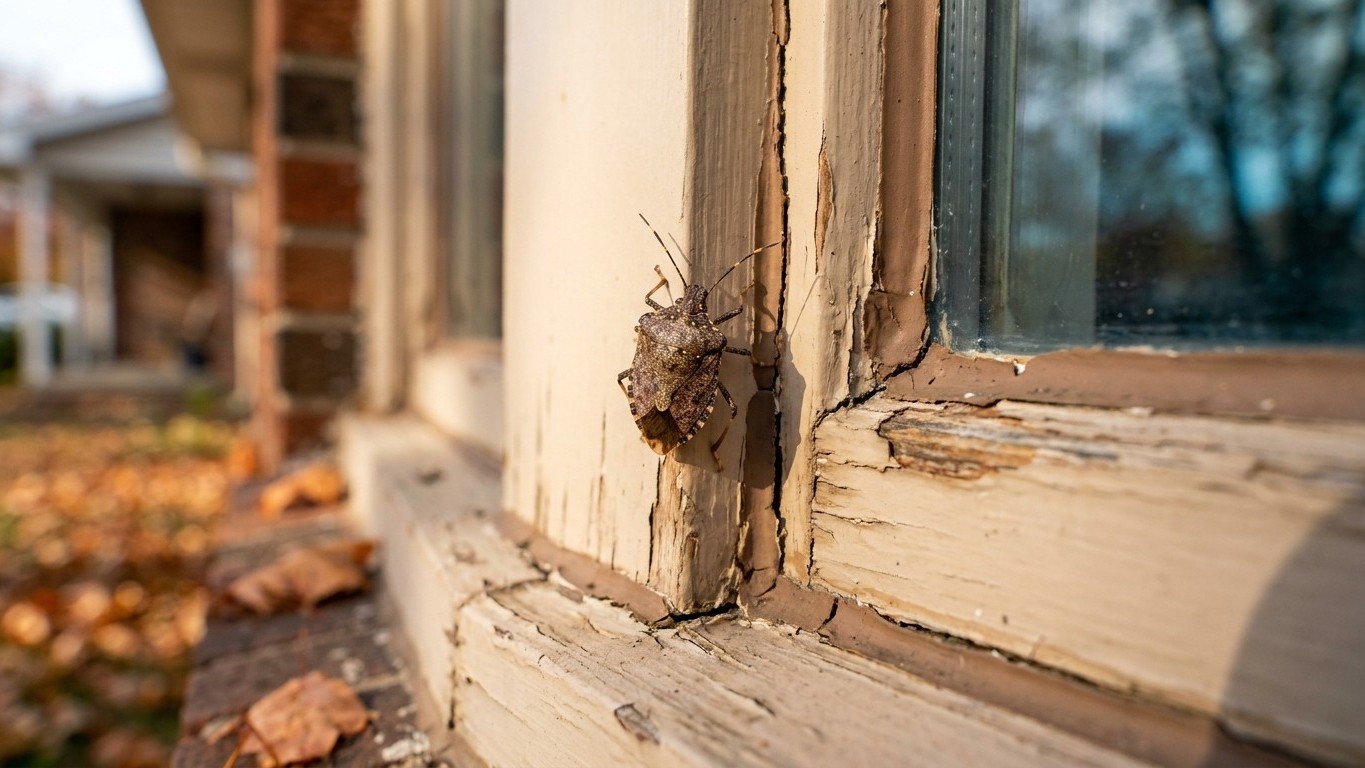

Brown marmorated stink bugs start showing up in British Columbia homes in mid-September, when cooling temperatures push them to look for winter shelter, and again briefly in spring when they crawl out of hiding. The insect has been confirmed in the Lower Mainland since around 2015, with the heaviest activity in Metro Vancouver’s warmer, built-up neighborhoods. Sealing gaps around windows, doors, and siding is the single most effective way to keep them out, and it works far better than any spray applied after the fact.
Where Brown Marmorated Stink Bugs Have Settled in British Columbia

This insect isn’t native to North America. It originated in East Asia and turned up in Pennsylvania in the mid-1990s, likely arriving in shipping cargo. From there it spread across the eastern United States before crossing into Canada. British Columbia’s first confirmed detections date to around 2015, concentrated in East Vancouver and neighboring pockets of the Lower Mainland.
Since then, sightings have expanded into Burnaby, Richmond, Surrey, and parts of the Fraser Valley. What’s driving that pattern is heat. Urban areas retain warmth from pavement and buildings, and this species does better in that kind of microclimate than in BC’s cooler, wetter rural zones. That’s a big reason the interior and the Okanagan, so far, report far fewer established populations, even though agricultural officials keep a close eye on that region because of what’s grown there.
The insect hasn’t been declared eradicable at this point. Provincial and federal pest-monitoring programs treat it as an established, spreading species rather than a rare intruder, which shifts the practical question from “can we get rid of it” to “how do we limit the damage and the nuisance.”
The BC Seasonal Calendar for This Pest
Timing matters more than most people assume, because the bug’s behavior changes dramatically by season.
Spring emergence
Adults that spent winter tucked into attics, wall voids, or leaf litter start moving again once daytime temperatures climb into the 60s, usually April into May on the coast. They head back outdoors to feed and mate, and this is when homeowners sometimes find a few sluggish stragglers on windowsills before the bugs clear out entirely.
Summer breeding
Females lay clusters of 20 to 30 pale eggs on the undersides of leaves through June and July. Nymphs pass through five growth stages before reaching adulthood. In the warmer mid-Atlantic states, this species can complete two generations a year. British Columbia’s shorter, cooler growing season usually limits it to a single generation, which is one reason local populations, while established, haven’t exploded the way they did in Pennsylvania, Maryland, or Virginia.
Fall invasion
September and October bring the behavior most people actually notice. Adults cluster on sun-warmed exterior walls, especially south- and west-facing sides of a house, before squeezing through the smallest available gap to get inside. Attics, soffits, chimneys, and gaps around utility lines are common entry points.
Winter dormancy
Once indoors, the bugs go still. They don’t reproduce inside homes and don’t feed on anything in a house. They simply wait out the cold, sometimes reappearing on a warm January afternoon if a furnace kicks the indoor temperature up enough to briefly wake them.
Telling It Apart From Look-Alikes
Brown marmorated stink bugs are shield-shaped, roughly five-eighths of an inch long, with a mottled brown and gray body. The giveaway is the banding: alternating light and dark segments along the edge of the abdomen, plus white bands on the antennae and the last segment of each leg.
British Columbia has several native look-alikes that get mistaken for it, including the western conifer seed bug and various native stink bug species. The confusion usually happens fast, and understandably, because most people only get a quick glance before the bug either flies off or gets flicked away. If disturbed or crushed, this species releases a sharp, almond-or-cilantro-like odor, which is exactly why pest control guidance always says to vacuum it up rather than squish it.
What Actually Stops It
Exclusion beats extermination with this insect, and that’s not a minor distinction. Because it doesn’t breed indoors and causes no structural damage, the entire management strategy revolves around keeping it from getting inside in the first place, then dealing calmly with the few that slip through.
For homes, a handful of measures do most of the work:
- Caulk gaps around window and door frames, utility penetrations, and siding seams
- Install door sweeps and repair or replace torn window screens
- Check attic and soffit vents for gaps large enough to admit an insect roughly the size of a dime
- Reduce exterior lighting at night in September and October, since light draws them toward walls after dark
- Vacuum any bugs found indoors using a hose attachment, then empty the canister outside rather than crushing them
Outdoor insecticide sprays applied to exterior walls in fall can reduce the number of bugs landing on a house, but the effect is short-lived and needs reapplication as residue breaks down. Most extension programs in North America now recommend exclusion as the primary defense, with perimeter treatments as a supplement rather than a solution on their own.
Gardeners dealing with this pest on fruit trees, tomatoes, or peppers have a few additional options. Lightweight row covers keep adults off young plants during peak feeding weeks. Hand-picking in early morning works because the insect is sluggish in cool temperatures and easy to knock into a bucket of soapy water. Pheromone-baited traps, sold for monitoring rather than mass control, can help track when local activity is picking up so protective measures go on at the right time. Targeted insecticide use should follow product label instructions closely, since misapplication near flowering plants can harm pollinators that matter far more to a garden’s health than one stink bug species.
One natural check worth knowing about: a tiny parasitic wasp called Trissolcus japonicus, sometimes nicknamed the samurai wasp, lays its own eggs inside stink bug egg masses and has established itself in parts of North America as a biological control agent. Researchers are tracking whether it’s taken hold in British Columbia populations, since in regions where it has spread naturally, it’s meaningfully reduced stink bug numbers over several seasons without any human intervention.
Why BC Growers Are Paying Close Attention
This isn’t just a household nuisance. Brown marmorated stink bugs feed on more than 100 plant species, and several of them anchor BC’s agricultural economy: apples, pears, peaches, grapes, and hazelnuts among them. Feeding damage shows up as dimpled or discolored patches on fruit skin, sometimes called cat-facing, which doesn’t necessarily make fruit inedible but does make it unsellable at full price in a market that grades heavily on appearance.
The scale of that risk isn’t theoretical. In the mid-Atlantic United States, a single bad growing season in 2010 cost apple growers an estimated $37 million in losses, largely tied to this pest’s arrival and rapid spread through orchard country. That figure is why the Okanagan’s tree fruit industry, along with Fraser Valley berry and hazelnut growers, keeps closer tabs on this species than its current, relatively limited BC footprint might otherwise suggest.
Anyone who spots what looks like a new population, particularly outside the already-confirmed Lower Mainland range, can report it to the Invasive Species Council of BC or a regional agriculture extension office. Early reports from the public have repeatedly helped researchers map how fast this insect is actually moving, since it tends to hitchhike in vehicles, luggage, and shipped goods far more easily than it flies under its own power.
Heated commercial greenhouses present a separate wrinkle worth knowing about. Because artificial warmth can mimic the longer growing seasons the bug enjoys further south, populations inside a warm structure can potentially squeeze in an extra generation that wouldn’t survive outdoors in a typical BC winter, which is one reason greenhouse operators in affected regions monitor for this pest more aggressively than backyard gardeners need to.
Related guides
- Brown marmorated stink bug in Alberta: When It Shows Up and What Stops It
- Brown marmorated stink bug in Connecticut: When It Shows Up and What Stops It
- Brown marmorated stink bug in Illinois: When It Shows Up and What Stops It
- Brown marmorated stink bug in Washington: When It Shows Up and What Stops It
- Brown marmorated stink bug in Montana: When It Shows Up and What Stops It