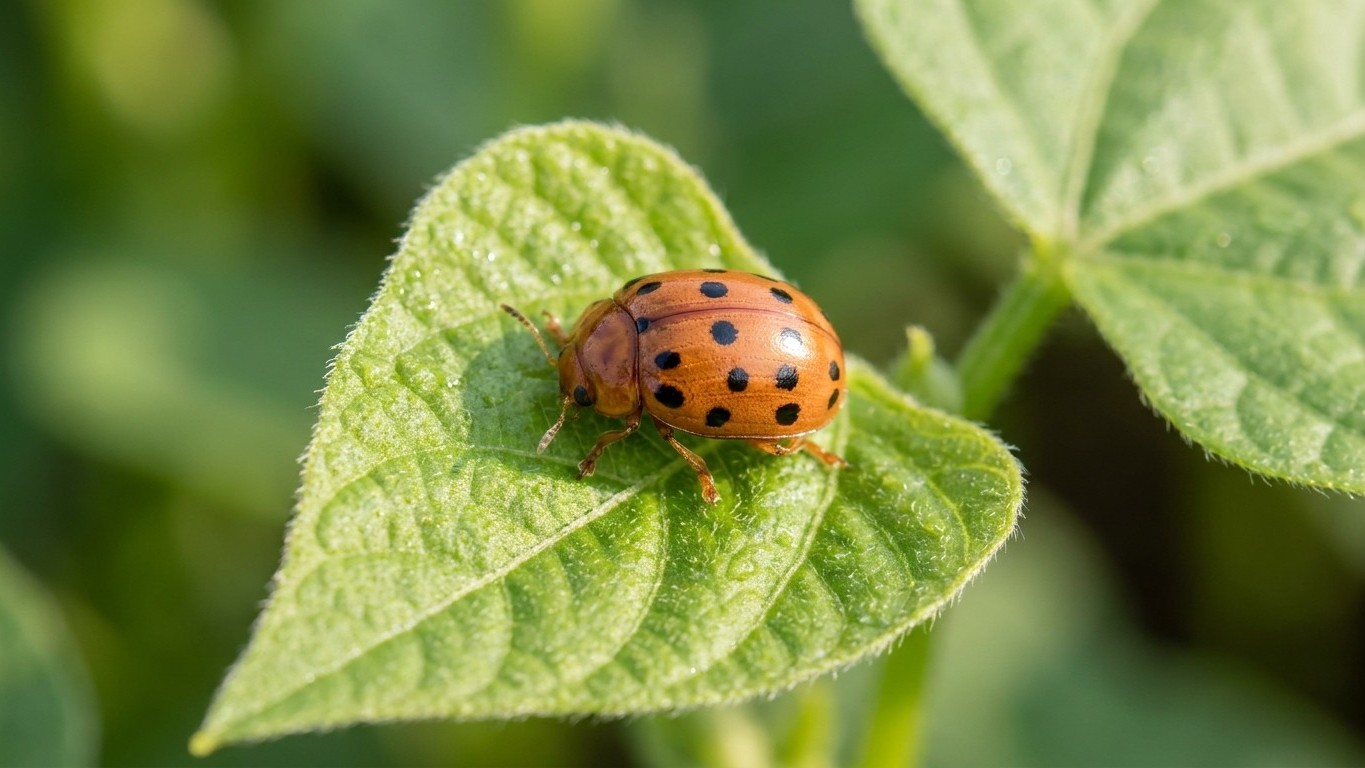

The Mexican bean beetle typically appears in Delaware gardens in mid-to-late May, when overwintered adults crawl out of leaf litter and head straight for young bean plants. What stops it isn’t one single product but a mix of timing, sanitation, and a tiny parasitic wasp that Delaware growers have relied on for decades. Catch the beetle in its larval stage and you have real options. Wait until adults are established on mature plants, and control gets a lot harder.
Identifying the Mexican Bean Beetle in a Delaware Garden

Here’s the confusing part: the Mexican bean beetle (Epilachna varivestis) is technically a lady beetle. It belongs to the same family as the aphid-eating beetles gardeners welcome. But this one is the black sheep of the family, feeding on plant tissue instead of pests. Adults are copper to yellow-orange, oval, and about a quarter-inch long, with sixteen black spots arranged in rows across the wing covers. Compare that to the common Asian lady beetle, which usually has fewer, less uniformly spaced spots and a more domed shape, and the difference becomes easier to spot in the field.
The larvae look nothing like the adults. They’re pale yellow, spiny, and slug-like, feeding in clusters on the undersides of leaves. Eggs are laid in tight groups of 40 to 60, bright yellow-orange, standing upright on the leaf underside like tiny grains of rice. Finding these egg masses early is one of the most reliable ways to head off a bigger infestation, since a single female can lay 500 to 750 eggs over her lifetime.
Damage shows up as lacy, skeletonized leaves, mostly starting from the lower canopy and working upward. Snap beans, lima beans, and soybeans are the primary hosts in Delaware fields and backyard plots, though the beetle will also feed on cowpeas and a handful of other legumes when bean plants run short.
The Delaware Timeline: From Overwintering to Late-Season Feeding
Delaware sits in USDA hardiness zones 6b to 7b, with a growing season long enough and humid enough to support two full generations of Mexican bean beetle most years, sometimes stretching into a partial third generation in warmer coastal areas of Sussex County. Adults overwinter in plant debris, hedgerows, and the edges of woodlots bordering bean fields, tucked under fallen leaves where temperatures stay just above freezing.
Emergence starts once daytime temperatures consistently climb past 65 degrees, usually the second or third week of May statewide, though it can run a week or two earlier in New Castle County than in the cooler pockets of Kent and Sussex. These first adults feed for a couple weeks before mating and laying eggs, which hatch into larvae by early June. That first generation of larvae does noticeable damage through mid-June, followed by a new wave of adults that lay the eggs for generation two.
The second generation is usually the one that catches gardeners off guard. It peaks in late July through August, right when bean plants are setting pods and need healthy foliage the most. A heavily infested plant can lose most of its leaf surface in under two weeks during this window. Feeding tapers off with the first cool nights of September, and surviving adults head for overwintering sites before the first hard frost, typically in late October across most of the state.
What Actually Stops Mexican Bean Beetles
No single tactic wipes out this pest completely, but stacking a few methods together keeps damage well under the threshold where it hurts yield.
Cultural and Physical Controls
Fall cleanup matters more than most gardeners realize. Removing bean plant debris after harvest eliminates a big chunk of the overwintering habitat right on site, forcing beetles to travel farther to find shelter. Rotating bean crops to a different part of the garden each year, ideally at least 50 feet from the previous location, slows the buildup of a resident population.
Floating row covers work well early in the season, from planting through the first few weeks of growth, since they physically block the overwintered adults from reaching young plants. They need to come off once flowering starts, though, to allow pollination. Hand-picking adults and squashing egg masses is tedious but effective for small plantings, especially if done every few days starting in late May when the first adults show up.
Biological Control: The Parasitic Wasp Advantage
The most distinctive tool against this pest is a tiny parasitic wasp, Pediobius foveolatus, which lays its own eggs inside Mexican bean beetle larvae. The wasp larvae develop inside the host, eventually killing it and turning the beetle larva into a small, dark, mummified shell instead of an adult beetle. This wasp doesn’t survive Delaware winters on its own, so it’s typically released fresh each season, timed to coincide with the first generation of bean beetle larvae in June. State extension programs in the mid-Atlantic have distributed these wasps to growers for years precisely because chemical options are limited on beans grown for fresh market sale, and the wasp gives a non-toxic way to knock back the first generation before it can multiply.
Because the wasp only attacks larvae, timing releases to match egg hatch is what determines success. Releasing too early or too late means the wasps have nothing to parasitize and the population crashes before it can establish.
Targeted Sprays When Pressure Is High
When beetle numbers climb past what hand-picking and biological control can manage, targeted sprays fill the gap. Insecticidal soap and neem oil work best against larvae, which have thinner cuticles than adults and are more vulnerable to contact treatments. Spinosad, derived from a naturally occurring soil bacterium, is another option that’s less disruptive to pollinators than broad-spectrum products when applied in the evening after bees have finished foraging for the day.
Pyrethrin-based products offer quicker knockdown on adult beetles but break down fast in sunlight, so late-day application stretches their effectiveness. Whatever the product, spraying the undersides of leaves is what actually matters, since that’s where both eggs and larvae concentrate and where adults spend much of their feeding time.
One detail that trips up a lot of Delaware gardeners: soybean fields bordering a backyard garden can act as a reservoir for the beetle, feeding a steady stream of adults into nearby bean patches all summer long. If a garden keeps getting reinfested despite good sanitation, checking what’s growing in the fields or lots nearby often explains why the pressure never really lets up.