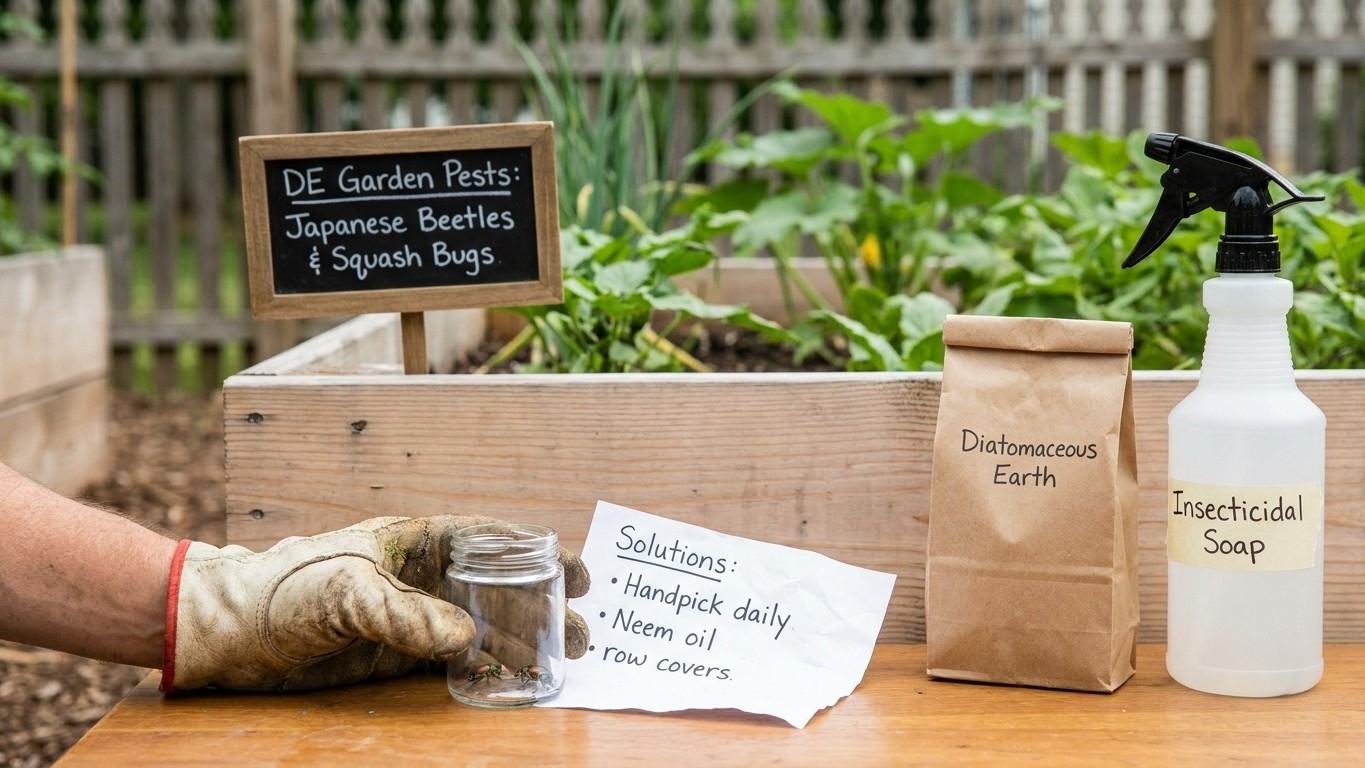

Delaware’s summer heat doesn’t just make one wave of pests, it lets them breed a second and third time before frost, which is why a garden that looked fine in June can be crawling by August. So the answer isn’t a single bug to watch for, it’s a habit: walk your squash, cabbage, and potato plants twice a week starting the moment seedlings are up, watching closely for signs of squash vine borer damage, the striped or spotted cucumber beetles gardeners find chewing on young seedlings, or the shield-shaped adults and egg clusters of the squash bug gardeners contend with each summer, and turn the leaves over.
What Delaware gardens actually deal with

Delaware’s warm, humid summers and long growing season let several insect pests complete multiple generations before frost, which is why numbers build steadily rather than arriving once and leaving. The University of Delaware Cooperative Extension flags nine species that show up most often in home vegetable gardens, including the Mexican bean beetle in Delaware, which gardeners find skeletonizing bean leaves each season. This is not a complete list of everything that can turn up in a Delaware backyard, and pressure varies from county to county, so treat these nine as the core to learn rather than the only pests that exist.
Colorado potato beetle

The adult Colorado potato beetle in Delaware is oval and boldly striped yellow and black across its wing covers, about 3/8 inch long. Its larva is humpbacked and orange-red with rows of black spots, and it’s the larva that does the real feeding damage, stripping potato and eggplant foliage down to the stem, much like the damage caused by the Tomato hornworm in Delaware that gardeners watch for on their tomato plants. The University of Delaware Cooperative Extension notes this insect completes two generations in the region, so a beetle missed in spring can produce a second wave by midsummer. Hand-picking adults and crushing egg clusters on leaf undersides early keeps numbers from compounding.
Imported cabbageworm

The adult stage of the Imported cabbageworm in Delaware is a small white butterfly with a black spot near each wingtip, easy to spot fluttering over cole crops in daylight. Its larva, a velvety pale green caterpillar about an inch long, is the stage that chews irregular holes through cabbage, broccoli and kale leaves and leaves dark green droppings behind. Floating row cover over young transplants blocks the butterfly from laying eggs in the first place, which works better than trying to spot a green caterpillar on a green leaf, and the same row cover approach helps keep the shield-shaped Harlequin bug in Delaware, which gardeners often find on cole crops, off young transplants as well.
Cucumber beetles

Spotted cucumber beetle is yellow-green with twelve black spots, striped cucumber beetle is yellow with three black stripes down its back, and both are about a quarter inch long and quick to fly off when disturbed. Adults chew seedling leaves and flowers, and they can vector bacterial wilt, which is often the more serious problem than the chewing itself. Row cover on seedlings until flowering, removed once bees need access to blossoms, is the most consistent home control.
Squash bug

Adults are flat-backed, shield-shaped and grayish-brown to dark brown, about 5/8 inch long, and cluster with gray, black-legged nymphs on the undersides of squash and pumpkin leaves. Both stages suck sap, leaving yellow speckling that turns brown and can collapse whole leaves on heavily infested plants. The University of Delaware Cooperative Extension lists squash bugs as active from June onward, so checking leaf undersides weekly from planting on catches egg masses before they hatch.
Squash beetle

This is a rounded, yellow-orange beetle with black spots, shaped like an oversized ladybug, with a soft, spiny yellow larva feeding alongside it. Both stages skeletonize squash and pumpkin leaves, chewing between the veins and leaving a lace-like pattern behind. Mistaking it for a beneficial ladybug, rather than a pest in its own right, is the most common identification error gardeners make.
Squash vine borer

The adult is a day-flying moth with an orange and black body and clear wings, often taken for a wasp rather than a moth. It lays eggs at the base of squash stems, and the caterpillar that hatches, cream-white with a brown head, tunnels inside the stem where it stays out of sight until the vine wilts suddenly despite moist soil. Slitting the stem lengthwise to remove the borer and mounding soil over the wound is the only intervention that helps once it’s already inside.
Mexican bean beetle
Adults look like oversized ladybugs, copper to yellow-brown with sixteen black spots, and the larvae are soft, spiny and yellow. Both stages skeletonize bean leaves from the underside, leaving a lacy, translucent pattern that’s often noticed before the insect itself. The University of Delaware Cooperative Extension notes this species has only one generation a year here, but adults lay eggs continuously through summer, so the damage looks constant even without a true second wave.
Harlequin bug
Adults are flat, shield-shaped, and boldly patterned in black and red-orange, about 3/8 inch long, with nymphs carrying the same coloring in a rounder body. Both stages pierce and suck sap from cabbage-family leaves, leaving white-to-yellow blotches and wilting on young plants. The University of Delaware Cooperative Extension counts two to three generations across the mid-Atlantic each year, which is why this pest often seems to reappear no matter how many rounds of hand-picking you’ve already done.
Tomato and tobacco hornworm
This is a large green caterpillar, up to four inches long, with white diagonal stripes down each side and a curved rear horn, black on the tomato hornworm and red on the tobacco hornworm. It’s the caterpillar, not the gray-brown sphinx moth that produces it, that strips tomato and pepper foliage overnight and can chew through green fruit. Checking plants at dusk, when the caterpillars are actively feeding and easiest to spot against the stem, works better than searching under bright midday sun.
Telling damage apart

The pattern of damage tells you more than the plant does. Chewed, irregular holes point to a chewing insect at work right now, while stippled or bleached patches usually mean something has been sucking sap for days before you noticed. Sticky, shiny residue on leaves, sometimes with a black sooty coating, is a signature left by aphids or the sap-feeding nymphs of squash bugs and harlequin bugs, not a disease. Sudden wilting of one vine while the rest of the bed looks fine is a strong clue for squash vine borer, since the damage happens inside the stem where you can’t see it directly.
Fungal and bacterial disease tends to show up as spots with defined edges, often ringed in yellow, or as a uniform gray-brown blight spreading from the bottom of the plant upward. Watering trouble usually hits the whole plant evenly: leaves curl or scorch at the margins under drought stress, or turn uniformly yellow and drop from the bottom when roots are waterlogged. An insect problem is almost always patchy, with some leaves stripped bare while the one next to it looks untouched, because the feeding insect has to move from spot to spot rather than affecting the whole plant at once.
Reading the signs at a glance
| What you see | Likely cause | What to check next |
|---|---|---|
| Ragged holes, chewed leaf margins | Chewing insect active now | Look on the underside of nearby leaves for the insect itself |
| Fine yellow or white stippling | Sap-feeding insect (squash bug, harlequin bug, cucumber beetle) | Check for clustered nymphs on leaf undersides |
| Sticky residue, sooty black coating | Aphids or nymphs excreting honeydew | Wipe a leaf; residue that returns within days means insects are still present |
| Single vine wilting while others look fine | Squash vine borer tunneling inside the stem | Look for a small hole with sawdust-like frass near the base |
| Spots with defined yellow-ringed edges | Fungal or bacterial disease, not insect feeding | Remove and bag affected leaves rather than treating for insects |
When each one shows up
Pest arrival in Delaware tracks plant growth stages and soil temperature more closely than the calendar. Early plantings of potatoes and cole crops are the first targets, since Colorado potato beetle and imported cabbageworm butterflies are active as soon as those crops are up and growing, often well before the heat of summer sets in. As cucurbits move from seedling to flowering, cucumber beetles and squash bugs move in, with the University of Delaware Cooperative Extension noting squash bugs active from June onward near Wilmington, though the exact week shifts earlier or later depending on how warm the spring has been elsewhere in the state.
By midsummer the pest complex compounds rather than replaces itself. The University of Delaware Cooperative Extension puts the heaviest overall pressure in July and August in the Wilmington area, when Colorado potato beetle is working through its second generation, harlequin bug is cycling through its second or third, and Mexican bean beetle adults, though limited to one generation, are still laying eggs continuously. Tomato and tobacco hornworms tend to become obvious later in this window too, once caterpillars have grown large enough to strip a branch overnight.
Further south, gardeners deal with an even longer window because the season simply runs longer, a pattern covered in Garden Pests in Florida: What Shows Up, When, and How to Stop It. Further inland and north, cooler spring soil delays the first generations by weeks, which is the pattern described in Garden Pests in Illinois: What Shows Up, When, and How to Stop It. Delaware sits between those extremes: warm enough for multiple generations of most of these pests, with a real winter that resets populations each year rather than letting them persist through mild months.
Because these figures come from observations near Wilmington, gardeners in Sussex County or along the coast should expect the same general order of arrival but not the same week. Start checking susceptible crops as soon as they’re up rather than waiting for a specific date, since soil warms unevenly across the state.
What actually works
Prevention beats intervention for nearly every pest on this list, because most of these insects are far easier to exclude than to kill once established. Crop rotation breaks the cycle for species that overwinter in soil near last year’s host plants, including Colorado potato beetle and squash vine borer; shifting nightshades and cucurbits to a different bed each year, even by a few feet, cuts down on the head start these pests get from emerging right where they left off. Floating row cover, put on at planting and left until flowering, physically blocks cucumber beetles, squash bugs and cabbage butterflies from reaching the plant at all, which matters because most of these pests do their real damage at the egg-laying and early-nymph stage, long before an adult is noticed.
- Rotate nightshades, cucurbits and brassicas to different beds each year
- Use floating row cover from transplant until flowering, then remove for pollination
- Clean up crop debris in fall, since several of these pests overwinter in old plant material
- Encourage predators like ground beetles and parasitic wasps by leaving some flowering plants nearby
Once a pest is already there
Hand removal remains the most effective single tactic for the larger, slower species: picking Colorado potato beetle adults and squashing their orange egg clusters, or clipping tomato hornworms off by hand at dusk when they’re easiest to see against the stem. For soft-bodied larvae like imported cabbageworm and squash beetle, Bacillus thuringiensis (Bt) sprayed on foliage targets the caterpillar stage specifically without harming bees or predatory insects, though it does nothing against beetles or true bugs.
Marigold borders, garlic sprays and ultrasonic pest repellers don’t have reliable evidence behind them for these species and shouldn’t be relied on as a primary control. Diatomaceous earth can help against soft-bodied crawling stages if reapplied after every rain, but it washes off quickly and does nothing once a pest is already inside a stem, as with squash vine borer. For sap-feeding stages like squash bug nymphs and harlequin bug nymphs, insecticidal soap applied directly to the clustered insects works better than spraying the whole plant, since it has to contact the insect to work and leaves no residual effect against ones that hatch later.
What control costs
None of these approaches costs much in dollars compared with the time they take, and for a home garden, time is usually the real budget. Hand-picking costs nothing but a few minutes each visit, repeated two or three times a week through the pest’s active period, which for most of these species runs from first sighting through July and August. It’s the cheapest option outright and the one that scales worst: a single squash plant might take five minutes to check, but a whole bed of beans crawling with Mexican bean beetle larvae can eat up a Saturday morning.
Row cover and other barriers cost more upfront, since the material has to be bought once and hoops or clips added to hold it off the foliage, but it’s reusable for several seasons if stored dry, and it needs no ongoing labor beyond installing and removing it at the right growth stage. Over a full season, row cover is usually the cheapest option in total time, because it prevents the problem rather than requiring repeated action against it.
Biological controls, meaning purchased beneficial insects or Bt sprays, sit in the middle. Bt has to be reapplied after rain and roughly every week or two while caterpillars are actively feeding, and it only works on caterpillar stages, not beetles or true bugs, so it’s a partial solution bought at a real material cost each application.
Sprays, whether insecticidal soap or a broader-spectrum product, need the most repeat visits of any method, since most only kill on contact and have no effect on eggs or insects that haven’t hatched yet. Insecticidal soap has to hit the nymphs directly to work, which means checking leaf undersides before every application rather than spraying on a fixed schedule.
| Method | Upfront effort | Ongoing effort | Best against |
|---|---|---|---|
| Hand-picking | None | 2-3 checks a week through the season | Larger, slow-moving stages: beetle adults, hornworms, egg clusters |
| Row cover / barriers | Buy material once, install at planting | Remove at flowering, store and reuse | Egg-laying adults of cucumber beetle, squash bug, cabbage butterfly |
| Biological control (Bt, beneficials) | Purchase per application | Reapply weekly or after rain | Caterpillar stages only: cabbageworm, hornworm |
| Sprays (insecticidal soap, etc.) | Purchase per application | Reapply on contact with each new nymph batch | Sap feeders: squash bug and harlequin bug nymphs |
Local help
The University of Delaware Cooperative Extension identifies specimens and tracks pest reports across the state, which is the fastest way to confirm what’s actually eating your plants before spending money treating the wrong thing. A call or photo to the office nearest you beats guessing from an online search, since results and timing vary by county. For more on gardening tasks across the state beyond pests, see our Delaware guides.
Common questions
Why do I keep finding the same bug on my squash every year even after tilling the bed?
Squash bugs and squash vine borer moths overwinter in garden debris and soil near where last year’s cucurbits grew, so tilling alone often doesn’t reach eggs or adults tucked under mulch or in nearby weeds. Rotating cucurbits to a different part of the yard, combined with fall cleanup of vines and old fruit, does more than tilling on its own.
Are the orange, ladybug-shaped beetles on my beans good or bad?
If they’re on bean leaves and the leaves show a lacy, skeletonized pattern, they’re almost certainly Mexican bean beetle, a pest, not a true ladybird beetle. True ladybird beetles are usually found near aphid colonies rather than on bare, chewed foliage, and their larvae look spiky and dark rather than soft and yellow.
Can I just spray one insecticide and cover everything on this list?
No single product handles all nine pests, because they feed differently: chewing insects like Colorado potato beetle larvae need a different mode of action than sap feeders like squash bug nymphs, and Bt only affects caterpillars. Matching the product to the pest’s mouthparts and life stage matters more than picking a stronger spray.
Do container and patio gardens still get these pests?
Yes, cucumber beetles and cabbage butterflies fly in and find container plants just as readily as in-ground beds, though squash vine borer is somewhat less common on patios since it needs a thick enough stem to tunnel into. Row cover still works on containers and is often easier to secure than on a full garden bed.