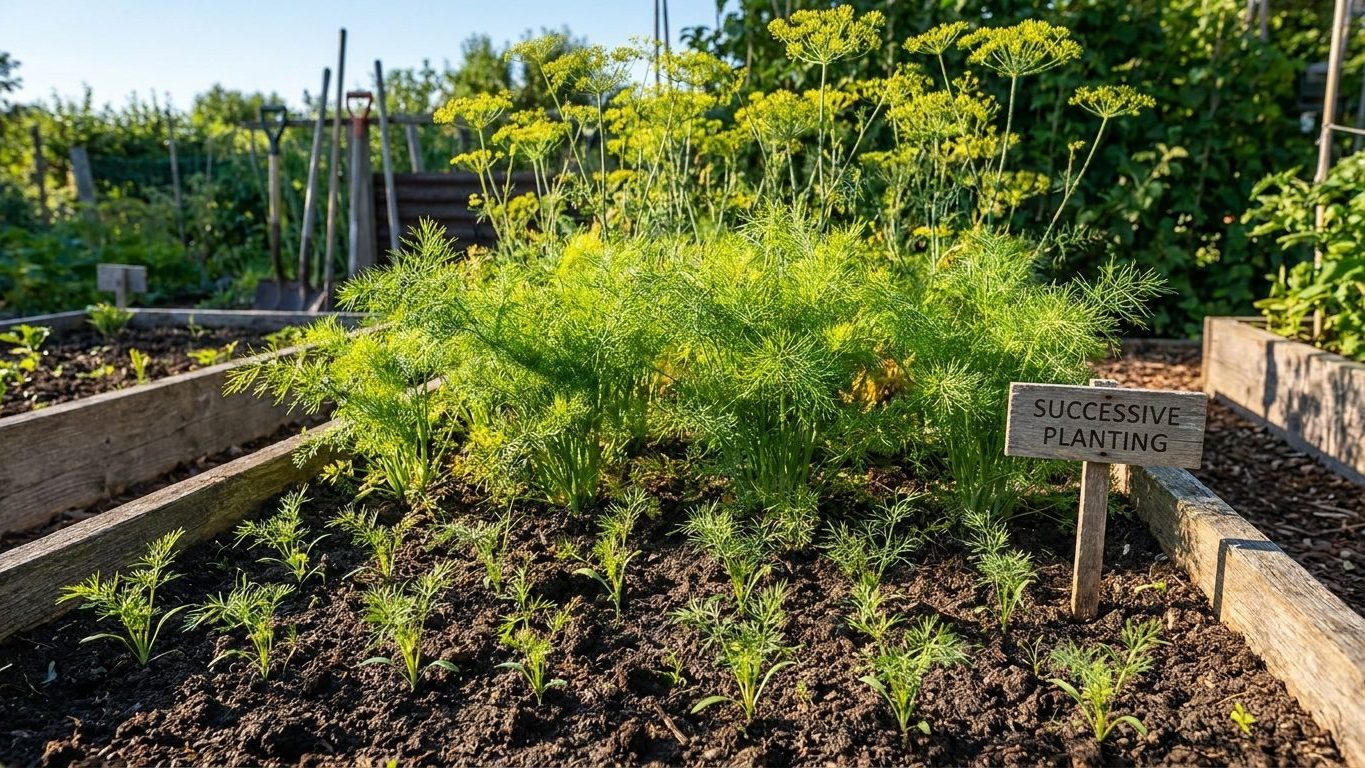

Dill burns through its lifecycle faster than almost any other kitchen herb, which is why a single spring planting rarely gets a household through pickling season. The fix isn’t better care for one patch of plants. It’s treating dill as something you keep starting over, on purpose, every few weeks.
What is actually going on

The thing to understand about dill is bolting. Bolting is what happens when an annual plant switches from making leaves to making a flower stalk and seed, and dill does it faster than most herbs gardeners grow for their leaves. Warm days, long daylight hours, or a stretch of stress (heat, drought, a root disturbance) all push dill toward that switch. Once the central stem shoots up and starts forming its umbrella-shaped flower head, leaf production is essentially finished. The plant has decided its job is reproduction now, not foliage, and it won’t be talked out of it.
This isn’t a flaw to be managed with better technique. It’s the plant’s actual strategy. Dill is a member of the carrot family, an annual that’s built to complete its life, set seed, and be done within a single growing season. Compare that to a shrubby perennial herb that spends years building woody structure and can be trimmed back repeatedly without any pressure to flower. Dill has no such patience. It germinates, grows a rosette of feathery leaves, and then, on a schedule set largely by weather rather than by the calendar on your wall, throws up a flowering stem whether you’re ready for it or not.
Leaf flavor also shifts once flowering starts. The leaves that remain lower on the stalk get sparser and more bitter as the plant redirects its resources upward into the flower head and eventually into seed. Some gardeners let this happen on purpose, because dill grown to the flowering and seed stage is a different kitchen ingredient than dill grown purely for the ferny leaf, sometimes called dill weed. Both are the same plant at different points in its life, not different varieties, and neither requires naming a specific type to understand: it’s a matter of which stage you’re harvesting.
Dill also self-seeds readily. If a plant is left to flower and the seed heads dry and shatter in place, volunteer seedlings often show up in that same bed the following year without anyone sowing a thing. That’s convenient for some gardeners and a nuisance for others, especially if the bed is meant for something else next season.
Dill has a long-standing folk reputation tied to digestion and calming babies, among other traditional uses. This page is about growing and cooking with it, not about evaluating that reputation, so it stops there.
In the garden
Because one planting of dill only produces usable leaf for a limited window before it bolts, the actual technique gardeners use to keep fresh dill coming is succession sowing: small plantings, repeated every few weeks through the growing season, rather than one large planting in spring. The second habit that matters just as much is sowing dill where it will grow, directly in the ground or its final container, instead of starting it indoors and transplanting seedlings later. Dill grows a taproot early, and that root does not appreciate being disturbed. A transplant shock at the root often triggers the very bolting response the gardener was trying to delay.
Where each approach goes wrong
| Practice | What it accomplishes | What happens when it’s skipped or mishandled |
|---|---|---|
| Succession sowing every few weeks | Keeps a rotation of young, leafy plants coming so there’s always foliage at the stage before flowering | Gardeners sow once in spring, harvest hard for a few weeks, then have nothing but bolted, bitter stalks by midsummer with no backup planting behind it |
| Direct sowing into final position | Leaves the taproot undisturbed so the plant grows steadily toward leaf production | Seedlings started in trays and transplanted often stall, yellow, or bolt early as a stress response to root disturbance |
| Full sun and even moisture | Supports steady leafy growth without added stress that can accelerate flowering | Dry spells or deep shade push the plant toward stress-triggered bolting even sooner than warm weather alone would |
| Thinning crowded seedlings | Gives remaining plants room and airflow, encouraging bushier leaf growth before flowering | Left crowded, seedlings grow thin and spindly and race each other toward flowering rather than filling out |
| Harvesting leaf before the flower stalk forms | Captures the mild, ferny foliage at its best, and light picking can slow the plant’s push toward flowering slightly | Waiting too long to pick means the leaf has already gone sparse and bitter by the time it’s cut |
None of these steps rescues a single planting into lasting all season. That’s not how the plant works. What they do is make each individual sowing as productive as possible for the short window it has, while the next sowing behind it is already coming up to take over.
What it depends on where you are
How many succession sowings a garden can fit into a year, and how fast each one bolts, comes down to local conditions. Season length sets the outer limit: a longer frost-free stretch simply allows more rounds of sowing between the last frost of spring and the point in fall when there’s no longer enough growing time left before cold shuts things down. Summer heat matters just as much, maybe more. In regions where summer arrives hot and stays hot, dill sown in early summer can bolt within a fairly short stretch, while the same seed sown a few weeks earlier or later, into milder temperatures, holds in leaf production longer.
Rainfall and humidity patterns shift the picture further. Gardens that get regular natural rainfall through summer have an easier time keeping dill’s shallow upper roots evenly moist without daily watering, which helps delay stress-triggered bolting. Gardens in drier climates, or those relying entirely on irrigation, need more consistent attention to soil moisture to get the same result, and a missed week can show up as bolted plants a few days later.
None of this means the general approach changes. Succession sowing, direct seeding, and harvesting before flowering apply Everywhere dill is grown as an annual herb. What changes by location is the timing: how early in spring the first sowing can safely go in, how many weeks apart the following sowings should be spaced to dodge the hottest stretch of summer, and how late into fall a final sowing still has time to produce usable leaf before the season ends.
This site’s state-level herb guides go into that local timing in more detail for specific regions. For the most reliable answer tied to an exact location, a local Cooperative Extension office, run through the land-grant university system in every state, can give frost date ranges and seasonal guidance specific to that county, something a national guide can’t responsibly attempt.
The mistake that costs the most
The single costliest mistake is sowing dill once in spring and assuming that one planting will carry a household through the whole season, including the exact weeks it’s needed most. Home canners and picklers run into this constantly: cucumbers ripen in a rush in mid to late summer, right when a spring-sown dill patch has usually already bolted and gone bitter weeks earlier. The timing mismatch isn’t bad luck. It’s the predictable result of treating a fast-cycling annual like a set-it-and-forget-it perennial.
The fix isn’t a better single planting. It’s staggering several smaller sowings across the season so that at least one batch of young, pre-flowering plants is ready whenever the kitchen actually needs fresh leaf, whether that’s a summer of steady cooking or one concentrated pickling weekend. Working backward from the date fresh dill is actually needed, and counting back far enough to sow more than once ahead of that date, does more for a reliable harvest than any amount of extra fertilizer or attention paid to a single struggling patch.
Gardeners who let go of the idea of “one dill planting for the year” and instead treat it as a rotating, repeated sowing tend to have fresh leaf on hand far more often than those chasing a single patch back from the edge of bolting. The plant was never going to hold still. Working with that instead of against it is the whole trick.