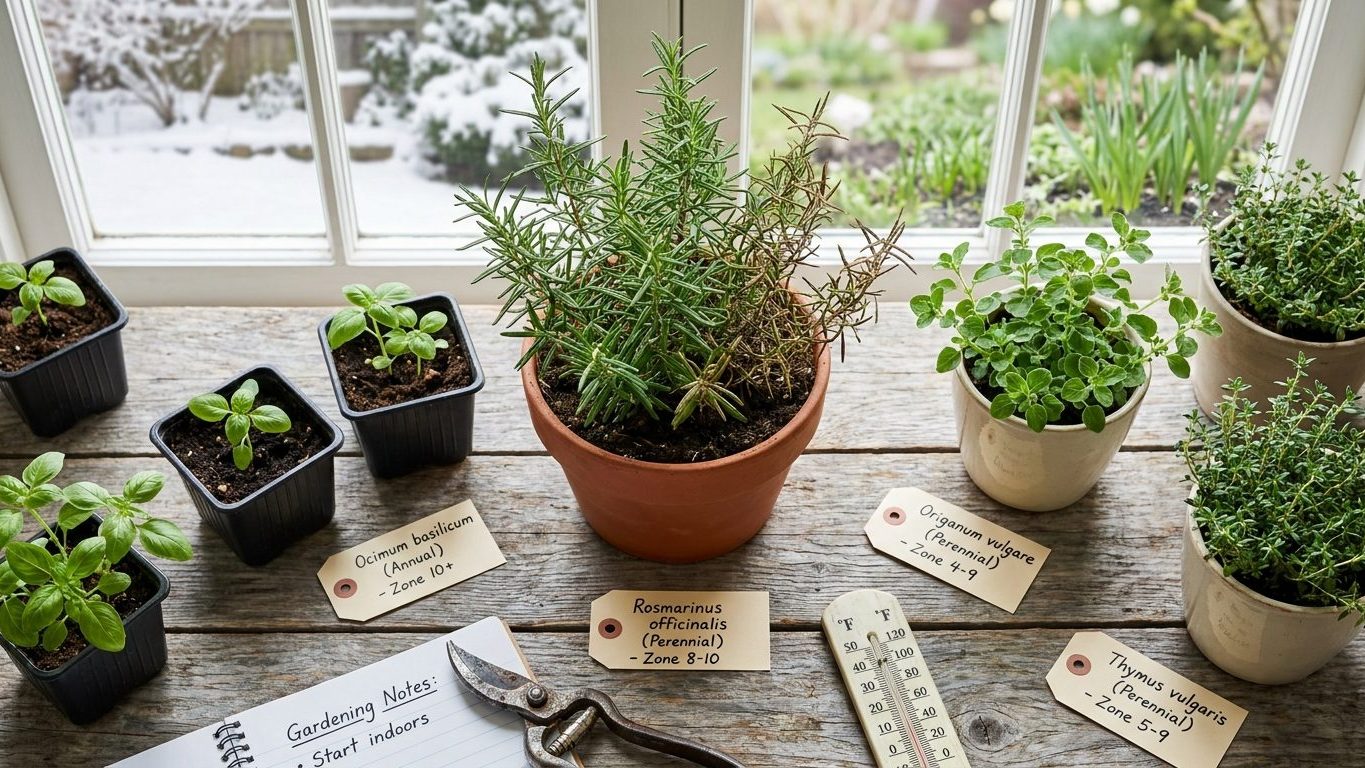

The short answer: some herbs are perennial almost everywhere, some are strictly annual no matter where you live, and a handful switch categories depending on how cold your winters get. A label that says “perennial herb” on a nursery tag is only half the story until you know which group the plant belongs to.
What is actually going on

The thing to understand here is cold hardiness: a perennial herb survives the winter only above a certain low temperature, and that is a property of the place as much as the plant. Every perennial species has a threshold, and below it the roots and crown die along with the top growth. Above it, the plant may look completely dead through January and still push new stems in April. That single number, the coldest temperature a species can take before its tissue fails, is why the same rosemary plant is a permanent shrub in one yard and a dead stick by February in another two states over.
Nurseries and seed racks sort plants into three buckets based on this. A true annual completes its whole life cycle, seed to flower to seed, in one growing season regardless of climate; nothing about a mild winter changes that, because the plant is genetically programmed to die once it sets seed. A true perennial survives cold as long as the ground doesn’t freeze solid at the root zone, and it comes back from the same root system year after year, sometimes for a decade or more. In between sits a group nurseries call tender perennials: plants that are perfectly capable of living for years, but only where winters stay above roughly 20 to 30 degrees Fahrenheit at the coldest. Move that same plant somewhere colder and it behaves exactly like an annual, because the cold kills it outright at the end of season one.
This is why two gardeners three states apart can have completely different, equally correct answers to “is this a perennial?” It’s not a disagreement about the plant. It’s a difference in what the plant is being asked to survive. A woody Mediterranean herb evolved in a climate with mild, wet winters and dry summers; ask it to sit in frozen, soggy clay for three months and the mechanism that kept it alive for a thousand years in its native range simply isn’t built for that combination.
Drainage compounds the cold question. A perennial herb that could technically tolerate a given low temperature in dry soil often dies at a milder temperature if its roots are sitting in wet ground, because ice forms inside waterlogged root cells and ruptures them. That’s a separate failure mode from cold alone, and it’s why the same species survives a harsh but dry winter and dies in a milder but wet one. None of this is about the gardener doing something wrong in the sense of skill; it’s a mismatch between a plant’s built-in threshold and the conditions on a specific piece of ground.
In the garden
Below are twelve common culinary herbs sorted by how they typically behave once the growing season ends, along with what goes wrong when the wrong assumption gets applied. Three of them are marked as climate-dependent because their category flips depending on winter severity where they’re planted.
| Herb | Typical category | What happens if you get it wrong |
|---|---|---|
| Chives | Hardy perennial | Gardeners sometimes pull the whole clump in fall thinking it’s dead; the top dies back completely, but the bulbs below are alive and resprout on their own |
| Thyme | Hardy perennial (woody) | Planted in heavy, wet clay, the woody stems rot at the crown over winter even where the cold alone wouldn’t have killed it |
| Oregano | Hardy perennial | Left unpruned for several seasons, the center of the clump goes woody and stops producing, and gardeners assume the plant died rather than needing to be divided |
| Mint | Hardy perennial (spreading) | Planted directly in a bed instead of a container, the rhizomes travel well beyond where they were planted and are almost impossible to fully remove afterward |
| Winter savory | Hardy perennial | Confused for its close relative summer savory, which is an annual; planting the wrong one and expecting it back next spring |
| Sage | Hardy perennial (semi-woody) | Old plants become leggy and split open in the center after a few winters, which looks like storm damage but is really just the plant’s normal aging |
| French tarragon | Perennial, but weak in humid climates | Grown from seed instead of a division, most seed-grown tarragon lacks the flavor of the true perennial type and gardeners blame the climate instead of the source |
| Rosemary | Climate-dependent | Left in the ground through a hard freeze outside its mild-winter range, an established shrub that took years to size up is lost overnight |
| Bay laurel | Climate-dependent | Grown as a small tree outdoors, then hit by an unusually cold snap; it can lose all its leaves and take a full season to recover, if it recovers at all |
| Lavender | Climate-dependent | Survives the cold fine but rots in a climate with humid or wet winters, which gets misread as a hardiness failure rather than a drainage one |
| Basil | True annual | Brought indoors before frost expecting it to overwinter like a houseplant, it typically declines and dies within weeks regardless of care |
| Cilantro | True annual (bolts in heat) | Planted once in spring and expected to produce all summer, it flowers and stops producing leaf as soon as temperatures climb, well before any frost |
What it depends on where you are
Part of this answer is national and part of it is entirely local, and it’s worth being honest about which is which. The category of a true annual or a true hardy perennial doesn’t change by region: basil dies at first frost everywhere, and chives come back from the root everywhere winter arrives. What changes by region is everything in between, and that’s most of the herbs gardeners actually worry about.
Three regional factors do the real work. Season length determines whether a plant has time to establish enough root mass before winter to survive it at all, which matters as much as the cold itself. Summer heat determines whether a herb bolts, stalls, or thrives during the growing months, independent of whether it survives winter. And summer rainfall, combined with soil drainage, determines whether a plant that could tolerate the cold on paper actually makes it through a wet winter without rotting at the root. A rosemary shrub that’s Perennial in One region with dry winters can behave like a Short-Lived annual in another with the same average low temperature, simply because the ground stays soggy longer.
The most reliable next step is checking the state-specific herb pages on this site for the region in question, since local frost timing and typical winter severity are exactly the details that turn a general category into a usable planting decision. A state or county cooperative extension office is the other resource worth using, since these offices track locally observed hardiness performance that goes beyond what a national plant tag can capture, and their advice is calibrated to the actual soil and climate conditions of that specific area rather than to a broad regional average.
The mistake that costs the most
The single costliest mistake is treating every herb labeled “perennial” at the nursery as equally hardy, without checking which of the three categories a specific plant actually falls into for a specific location. It shows up most often with the climate-dependent group: rosemary, bay laurel, and lavender are all sold as perennial herbs, and that’s technically true, but only within their mild-winter range. A gardener outside that range plants one, watches it thrive all summer, and then leaves it in the ground over winter assuming a plant labeled perennial will simply come back the way chives or oregano do. It doesn’t, and the loss isn’t a small one. Woody herbs like rosemary and bay take multiple seasons to reach a size that actually produces useful amounts of leaf, so losing an established three-year-old shrub to a single hard freeze is a much bigger setback than losing a first-year seedling.
The fix costs almost nothing once the category is understood. Where winters run colder than a tender perennial’s threshold, the plant needs to be grown in a container that can be moved indoors before the first hard frost, or treated deliberately as an annual and replaced each spring, rather than left outside on the hope that this particular winter will be mild enough. Neither choice is wrong. What’s wrong is not making the choice at all, because the plant’s tag never forced the question.
The reverse mistake happens too, though it costs less: pulling a hardy perennial like chives, thyme, or oregano at the end of the season because the top growth has browned and looks dead, when the root system underneath is completely fine and would have resprouted on its own. Before removing any herb that looked thriving all summer, it’s worth checking which of the three categories it actually belongs to for the specific winter conditions on hand, rather than reading dead-looking foliage or a hopeful nursery tag as the final word.