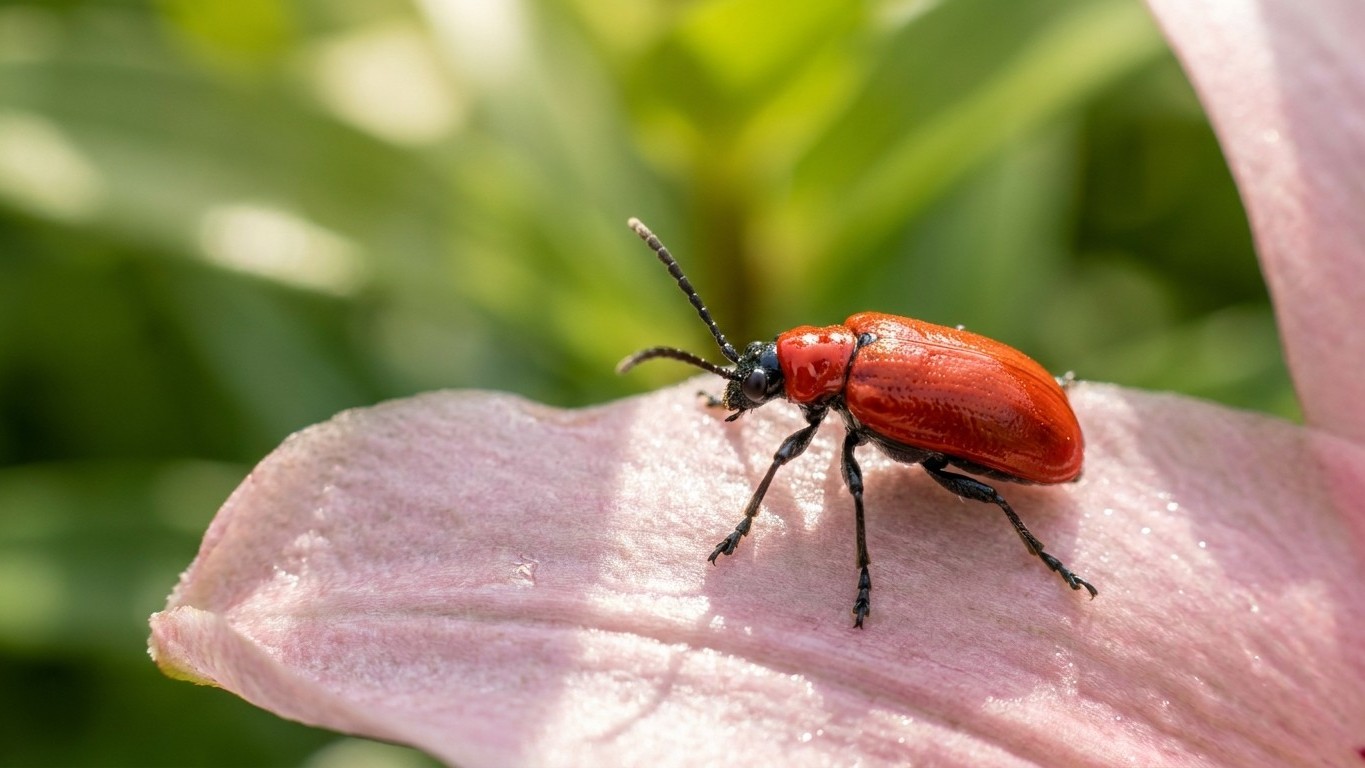

If you’re growing true lilies in Rhode Island, the Lily leaf beetle isn’t a maybe. It’s already here, established statewide, and it shows up like clockwork every spring once soil temperatures climb into the mid-50s. Adults emerge from leaf litter as early as late March in coastal areas like Newport, later in the cooler inland pockets of Providence and Kent counties, and they keep feeding straight through October. The beetle is bright red, easy to spot once you know what you’re looking for, and nearly impossible to ignore once it starts skeletonizing your lily foliage.
Identifying the Lily Leaf Beetle

Adults measure about 3/8 inch long, with a glossy scarlet-red body, black legs, black antennae, and a black head. That combination is the giveaway. A lot of gardeners confuse them with harmless native beetles or even some ladybug variants, but nothing else in a Rhode Island lily bed matches that specific color split between red and black.
The eggs are trickier to spot but far more important to catch early. Females lay them in short, ragged rows on the underside of lily leaves, close to the leaf midrib. Fresh eggs are orange-red and roughly the size of a pinhead. A single female can lay 200 to 450 eggs over her lifespan, which is one reason infestations can go from “a few beetles” to “half the plant is gone” in under three weeks.
Larvae are the real destroyers. They’re soft-bodied, orange or yellowish-green, and they cover themselves in their own excrement as a defense against predators, something that makes them look like slug droppings rather than insects. Don’t let the disguise fool you. These larvae do the bulk of the leaf-stripping damage, often reducing a mature lily to bare stems by midsummer.
When Lily Leaf Beetles Show Up in Rhode Island
The lily leaf beetle overwinters as an adult, tucked into soil, mulch, or plant debris near where lilies grew the previous season, sometimes several feet from the original plant. That’s why fall garden cleanup matters as much as spring vigilance.
Emergence timing in Rhode Island tracks closely with soil warm-up. In a typical year, adults become active in late March to mid-April along the coast and Narragansett Bay shoreline, where winters run milder, and roughly one to two weeks later inland toward Woonsocket and the northern part of the state. Once lily shoots poke through the soil, the beetles are usually already waiting.
Mating and egg-laying start almost immediately after emergence and continue through May and into June. Larvae hatch within a week or two and feed aggressively for three to four weeks before dropping to the soil to pupate. New adults from that generation typically appear by mid to late summer, feed for a few more weeks to build fat reserves, then retreat into the soil by early October to overwinter again.
Rhode Island generally sees one full generation per year, though warm, extended growing seasons have pushed some overlap between adult stages, meaning you can find both old and new adults active on the same plant in August.
Which Plants Are Actually at Risk
This is where a lot of confusion happens at garden centers. Lily leaf beetle feeds almost exclusively on true lilies (the genus Lilium, including Asiatic, Oriental, and Turk’s cap types) and on fritillaria. It does not attack daylilies (Hemerocallis), even though the names sound identical. Daylilies belong to a completely different plant family and hold no appeal for this insect.
That distinction matters for anyone shopping Rhode Island’s active perennial and nursery trade. If you’re buying potted lilies from a local grower or a big-box garden center, inspect the undersides of leaves before you bring plants home. Nursery stock is one of the primary ways this beetle moves between properties and towns, since adults don’t fly especially far or fast on their own.
Fritillaria growers tend to get hit early in the season, since these bulbs leaf out before most lilies, giving overwintered adults a first meal option before the main lily crop emerges.
What Actually Stops Lily Leaf Beetle
Control works best as a layered approach. No single tactic wipes out an established population, but combining a few methods consistently keeps damage manageable season after season.
Hand-picking, with a trick
Adult beetles have a defense mechanism that makes them oddly easy to miss: when disturbed, they drop off the leaf and land upside down, exposing their black underside instead of the bright red top. Against soil or mulch, that black belly blends right in. The workaround is to hold a cup or bowl of soapy water underneath the leaf before you touch the beetle, so it falls straight into the water instead of the ground.
Check plants every three to four days from the moment shoots emerge through June. Early-season removal, before the first big egg-laying wave, has an outsized effect on how bad the summer generation gets.
Egg and larvae removal
Flip leaves regularly and scrape off egg rows with a fingernail or gloved finger, crushing them or dropping them into soapy water. For larvae, a strong jet of water knocks a good number off the plant, and many won’t climb back on. Insecticidal soap or neem oil applied directly to larvae clusters also works, since young larvae have thinner cuticles than adults.
Fall and spring soil cleanup
Since adults overwinter in leaf litter and loose soil near host plants, clearing dead foliage and mulch from around lilies each fall removes a chunk of the overwintering population before it gets the chance to burrow in. This is a low-cost step that pays off every following spring.
Biological control
Researchers with University of Rhode Island and neighboring New England extension programs have worked with a parasitoid wasp, Tetrastichus setifer, released across parts of the Northeast to attack lily leaf beetle larvae from the inside. Establishment has been documented in several New England states, including pockets of Rhode Island, though coverage isn’t uniform statewide yet. Where the wasp has taken hold, larval survival rates drop noticeably, which is part of why some longtime lily growers report lighter damage in recent years compared to when the beetle first arrived.
Targeted insecticides, used carefully
For heavier infestations, products containing spinosad target larvae effectively with lower impact on beneficial insects than broad-spectrum options. Systemic insecticides such as those with imidacloprid can suppress populations too, but they carry real risk to pollinators visiting nearby flowers, so timing applications before bloom and avoiding spray drift onto open blossoms matters if you keep bees or care about local pollinator health.
Rhode Island’s lily leaf beetle population isn’t going anywhere soon, it’s been part of the regional insect landscape since spreading south from its original Massachusetts detection decades ago. What’s changed is the toolkit available to gardeners: better timing knowledge, an established (if patchy) biological control agent, and clearer guidance on which of your plants are actually at risk. For anyone growing true lilies here, the real skill isn’t eliminating the beetle. It’s catching each generation early enough that your lilies bloom before the damage sets in.
Related guides
- Lily leaf beetle in Connecticut: When It Shows Up and What Stops It
- Lily leaf beetle in Massachusetts: When It Shows Up and What Stops It
- Lily leaf beetle in Iowa: When It Shows Up and What Stops It
- Lily leaf beetle in Maine: When It Shows Up and What Stops It
- Lily leaf beetle in New Brunswick: When It Shows Up and What Stops It