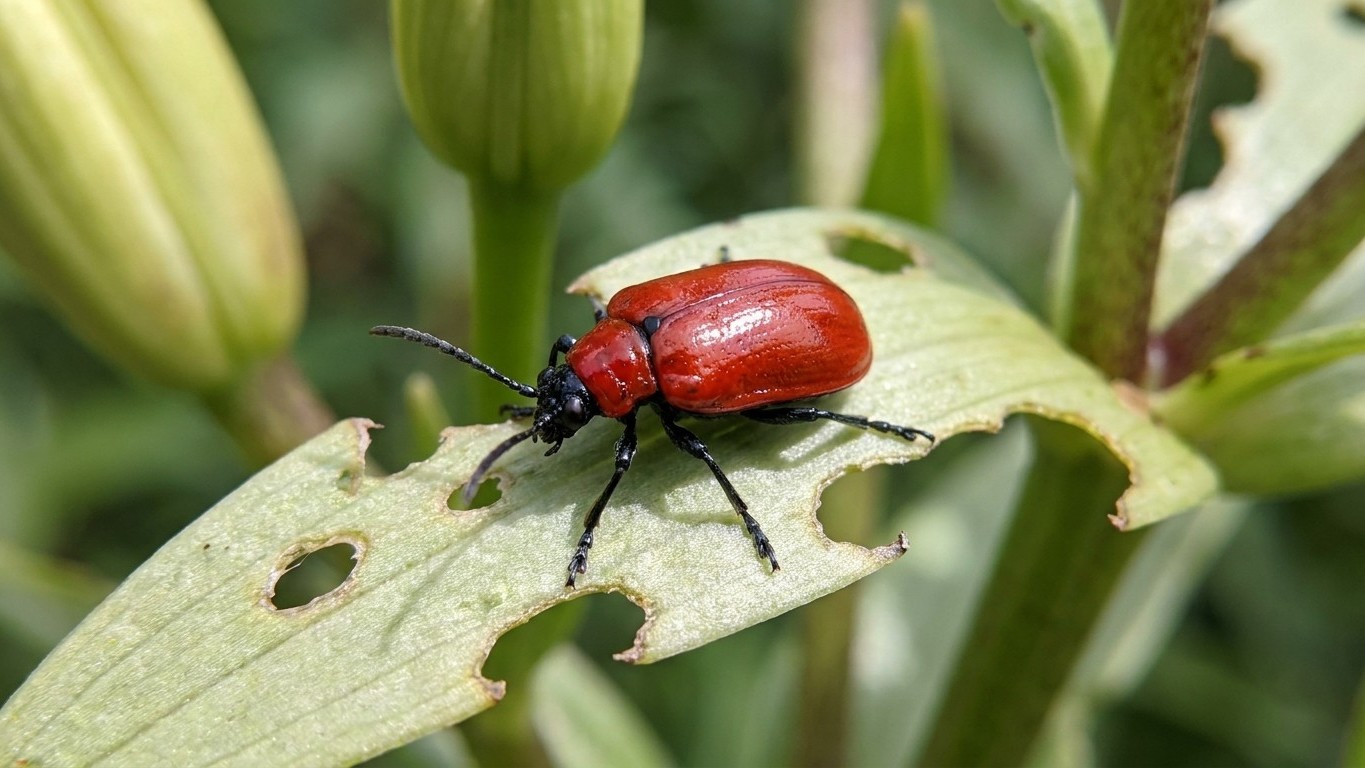

The lily leaf beetle (Lilioceris lilii) is active in New Brunswick from mid-April through late summer, with the heaviest plant damage happening in May and June when both adults and larvae feed at the same time. Cold snaps slow it down but rarely kill enough overwinter adults to matter. The most reliable fix is early, repeated hand removal of eggs and larvae combined with a systemic or contact insecticide applied before populations explode, not after your lilies are already shredded.
A Beetle That Shouldn’t Be This Far North, But Is

This insect isn’t native to Canada. It arrived from Europe, first documented near Montreal in the 1940s, and spent decades creeping outward along garden trade routes and wind-assisted flight. New Brunswick’s climate, cool springs, humid summers, snow cover that insulates overwintering adults, turns out to be perfectly workable for a beetle built for temperate Eurasian winters. Gardeners in Fredericton, Moncton, and Saint John have all reported it, and it shows no sign of retreating.
Adults are hard to miss once you know what you’re looking for: a bright scarlet-red back with a jet-black head, legs, and belly, roughly 3/8 inch long. They’re often mistaken for ladybugs at a glance, which is exactly how a lot of infestations get a two-week head start before anyone notices.
Larvae are the opposite of eye-catching. They’re pale orange or yellowish grubs that cover themselves in their own fecal matter as a defense against predators, a slimy, unappealing shield that also happens to make them nearly invisible against damaged leaf tissue. That camouflage is a big reason infestations look mild one week and defoliated the next.
When It Shows Up: A Season-by-Season Timeline for New Brunswick
Timing matters more with this pest than with most garden insects, because the window for effective intervention is narrow and closes fast once larvae reach full size.
Early Spring (Mid-April to Early May)
Overwintered adults emerge from leaf litter, soil cracks, and nearby perennial beds as soon as ground temperatures climb into the mid-50s Fahrenheit. They head straight for emerging lily shoots, feeding on tender new growth and mating almost immediately. This is the single best window to catch and remove adults before egg-laying starts.
Mid-Spring to Early Summer (May Through Mid-June)
Females lay eggs in tidy rows on the undersides of leaves, anywhere from six to a dozen eggs per cluster, and a single female can lay several hundred eggs over her lifespan. Eggs hatch in one to two weeks depending on temperature. This is when larval feeding ramps up fast, often skeletonizing leaves and stripping flower buds within days.
Midsummer (Late June to Early August)
Mature larvae drop to the soil to pupate, emerging as new adults within two to three weeks. These new adults feed through late summer to build fat reserves, then seek shelter in garden debris, mulch, or nearby woodland edges to overwinter. New Brunswick typically sees one generation per year, unlike warmer regions that occasionally squeeze in a partial second cycle.
By September, feeding activity drops off sharply as beetles settle into diapause, but they’re still present in the garden, just hidden.
What Actually Stops It
Nothing offers a single-treatment cure. Control works as a layered approach, and skipping any one layer usually means the beetle rebounds the following spring.
Hand-Picking and Egg Removal
This remains the most effective non-chemical tool, especially in small residential lily beds. Adults drop to the ground and play dead when disturbed, so the trick is cupping a hand or container underneath the plant before touching it. Checking leaf undersides twice a week from late April through June for the telltale orange egg rows, and simply crushing or removing them, can cut larval numbers dramatically before they ever start feeding.
Insecticide Options and Their Tradeoffs
Contact insecticides containing spinosad or pyrethrin work on both adults and young larvae when applied directly to foliage, but they break down within days and need reapplication after rain. Systemic products containing imidacloprid offer longer protection by making the whole plant toxic to feeding insects, though timing matters: applied too late, after larvae are already large, they’re far less effective, and applied carelessly, they carry real risk to pollinators visiting nearby flowering plants. Many provincial extension guidance sheets recommend avoiding systemic neonicotinoids on plants in active bloom for this reason.
Neem oil and insecticidal soap knock back small larvae but do little against adults or fully grown larvae with their protective coating.
Garden Sanitation and Habitat Disruption
Adults overwinter in leaf litter and mulch near host plants, so clearing dead foliage and debris around lily beds each fall removes a chunk of the overwintering population before it gets a chance to settle in. Rotating where potted lilies sit, and avoiding moving soil or bulbs from an infested bed to a clean one, also slows the beetle’s spread within a property.
Which Plants Are at Risk, and Which Aren’t
The lily leaf beetle is picky in a way that’s genuinely useful for garden planning. It targets true lilies, meaning Lilium species like Asiatic, Oriental, and trumpet lilies, along with fritillaria. Daylilies (Hemerocallis), despite the name, aren’t a preferred host and rarely show significant damage, making them a safer substitute for gardeners in heavily infested parts of New Brunswick who want similar color without the constant battle.
Some gardeners also report light feeding on lily-of-the-valley and Solomon’s seal when beetle populations are dense and preferred hosts are scarce, though damage on these secondary plants tends to be minor and cosmetic rather than plant-threatening.
A Realistic Approach for New Brunswick Gardens
Given the timeline, the practical calendar looks like this: start checking lily shoots the moment they break ground in April, hand-remove any red adults you spot immediately, then shift to twice-weekly egg checks through May and June. If populations are already established from a previous year, a targeted spinosad application in early May, before egg-laying peaks, buys extra protection without the pollinator tradeoffs of systemic products.
Gardeners who’ve dealt with this pest for a few seasons often note that consistency beats intensity. A quick five-minute check twice a week from April through June does more than an aggressive single spray applied once populations have already taken hold. The beetle isn’t going anywhere in New Brunswick’s current climate, but neither is a well-timed pair of gloves and a bit of patience.
Related guides
- Lily leaf beetle in Quebec: When It Shows Up and What Stops It
- Lily leaf beetle in Nova Scotia: When It Shows Up and What Stops It
- Lily leaf beetle in Newfoundland and Labrador: When It Shows Up and What Stops It
- Lily leaf beetle in New Hampshire: When It Shows Up and What Stops It
- Cabbage maggot in New Brunswick
- Seedcorn maggot in New Brunswick
- Winter moth in New Brunswick
- Lily leaf beetle in Prince Edward Island: When It Shows Up and What Stops It