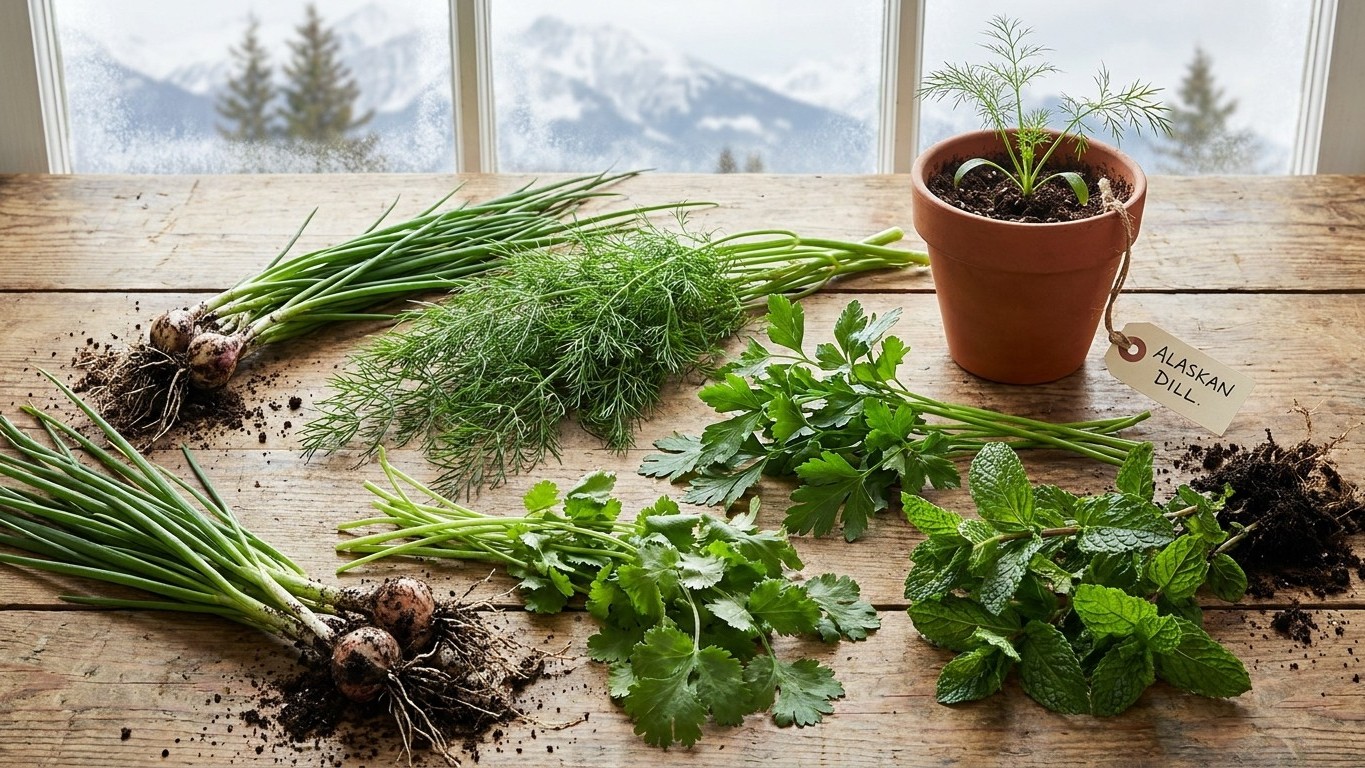

Kansas gardeners get the most reliable herb harvests by matching two things this state actually has: a frost-to-frost window of roughly six and a half months, and a winter cold enough to kill anything not built for a mean minimum of 22.5°F in the coldest month. That points toward thyme, oregano, chives, and sage as reliable perennials, quick annuals like basil, dill, and cilantro for summer, and rosemary or bay laurel grown in containers you bring indoors.
The short answer for Kansas
Start with the numbers from the Wichita reference station: last spring freeze between April 4 and April 18, first fall freeze between October 23 and November 2. Stack those two windows against each other and the usable outdoor season runs somewhere between 188 and 212 days, depending on where the actual frost date lands inside each band in a given year. That’s enough time to grow almost anything sold as a culinary herb from seed, so season length isn’t the limiting factor here. Winter cold is.
The USDA hardiness zone map places Kansas across 5b to 7a, and the coldest-month mean minimum of 22.5°F is the number that actually decides which perennials survive without help. That’s cold enough to kill rosemary and bay laurel outright in an open bed most winters, since both are rated hardy only to about zone 7 or 8 and need temperatures that don’t regularly dip into the low 20s. It’s not cold enough to bother thyme, oregano, sage, or chives, all of which shrug off winters well below zone 5.
Sorting herbs by how they handle this climate
| Herb type | Examples | Fit for Kansas |
|---|---|---|
| Fast annuals | Basil, dill, cilantro | Sown after the last frost window closes, harvested well before the first fall freeze. Easy fit for a 188 to 212 day season. |
| Hardy perennials | Thyme, oregano, chives, sage | Survive the 22.5°F coldest-month minimum outdoors with no winter protection in most Kansas gardens. |
| Marginal woody perennials | Rosemary, bay laurel | Rated for milder winters than this state’s coldest-month numbers support. Grow in a pot and move indoors, or treat as an annual. |
For a Kansas garden, the practical decision is less about which herb tastes best and more about which category it falls into. Fast annuals get planted and forgotten until harvest. Hardy perennials get planted once and left alone for years. Marginal woody perennials need a pot, a sunny window, and someone willing to haul them in and out twice a year.
What will not work here

The clearest failure mode in Kansas is leaving a Mediterranean woody herb outdoors through winter and expecting it to come back. Rosemary is the classic example: garden centers sell it every spring as if it belongs in the ground here, but a coldest-month mean minimum of 22.5°F sits well outside what the plant is built to survive. Some winters it survives in a sheltered spot against a south-facing wall. Most winters, in an open bed, it doesn’t. Bay laurel fails for the same reason, and it’s slower to replace since it takes years to build a plant worth cooking with.
French tarragon runs into a different version of the same problem. It’s hardy enough on paper for parts of zone 5b, but the swing between the coldest pockets of that zone and the milder edges of 7a means a tarragon plant that limps through one winter in a protected yard can die outright a county away with no extra insulation. Treating it as a reliable perennial across the whole state overstates what the hardiness range actually guarantees.
The other failure isn’t about cold at all. It’s about the calendar’s edges. The last spring frost band runs a full two weeks wide, from April 4 to April 18, and that spread matters most for tender annuals. Direct-seeding basil or transplanting it out on April 5 because the calendar says “after last frost” works in a year when the freeze actually falls early in that band. In a year when it falls late, or in a rural garden that typically sees frost a week or two after the airport station does, that same planting date gets hit. The fix isn’t a different herb, it’s a later date, and that’s a distinction worth getting right before you lose a tray of seedlings to a frost the calendar didn’t warn you about.
None of this means Kansas is a hard place to grow herbs. It means the plants that fail here fail for a specific, predictable reason tied to the winter minimum or the frost timing, not because the state is generally inhospitable to herb gardening.
What changes across Kansas
A hardiness range of 5b to 7a is not a small spread. The difference between the coldest part of zone 5b and the mildest part of zone 7a can mean roughly 15 to 20 degrees of extreme minimum temperature across the state in a hard winter, which is the difference between a perennial herb bed that needs no protection and one that needs mulch every year to make it through.
That range doesn’t map neatly onto a compass direction the way it does in some states, since Kansas hardiness zones shift with both latitude and elevation. What it does mean is that a planting decision that’s safe in the milder pockets of the state, like leaving rosemary outdoors year-round or skipping mulch on a young sage plant, is a real gamble in the colder pockets. A reader gardening in a colder zone should assume borderline perennials need winter protection that a reader in a milder zone might be able to skip.
The frost-date bands work the same way. April 4 to April 18 for the last spring freeze isn’t one date, it’s a two-week window measured at a single Wichita station, and the actual date at any given property shifts with local terrain, air drainage, and how far that property sits from the reference station itself. The same logic applies to the October 23 to November 2 fall window.
There’s no way to tell an individual reader which end of the 5b to 7a range their own yard falls into from a state-level page like this one. What can be said plainly is that the spread is wide enough to change real decisions, like whether a perennial herb needs mulch, or how much buffer to add around the frost dates before trusting them. The right move is checking the USDA Plant Hardiness Zone Map directly for a specific address rather than assuming a state average applies.
Where to check this for your own county
K-State Research and Extension is where this general answer gets replaced by one that’s actually calibrated to a specific county.
Two things are worth looking for there specifically. First, a county-level or regional planting calendar, since the frost windows come from a single Wichita weather station and the extension service typically publishes guidance adjusted for local county offices across the state, including the wider frost buffer that rural and suburban gardens usually need beyond what an airport station records. Second, look for herb and vegetable variety trial results specific to Kansas growing conditions, since extension offices regularly test which cultivars actually perform in the state’s heat and wind rather than just which ones are hardy on a nursery tag.
A county extension office recommendation will beat a state-wide answer every time, because it accounts for local soil, local microclimate, and years of trial data gathered from gardens actually in that county. A state-wide answer works from climate normals and a single reference station’s frost dates. Those are useful for understanding the general pattern across Kansas, but they were never meant to substitute for county-specific advice. Anyone serious about timing a herb garden precisely, especially with borderline perennials like rosemary or tarragon, should treat the extension office as the next stop.
Checking this against your own garden
Every frost date and hardiness number describes an average built from decades of records at one weather station. A reader’s own yard will confirm or contradict that average faster than any calendar can, and three simple observations tell most of the story.
Soil warmth by feel is the first and most useful check. Dig a couple of inches down in the bed where herbs are going in and feel whether the soil is still cold and heavy or has started to loosen and warm with the season. Herb seed germinates slowly in cold soil no matter what the frost date calendar says, so a bed that still feels like early spring is a sign to wait, regardless of what date April 18 happens to be this year.
Second, watch how established perennial herbs already in the ground behave. Chives, mint, and oregano that overwintered outdoors will send up new growth as soon as conditions suit them locally, and that resprouting is a better read on the specific yard’s microclimate than any regional average, since it reflects the actual soil, drainage, and sun exposure of that spot.
Third, pay attention to which common weeds are germinating nearby. Weeds respond to the same soil temperature and light cues that herb seeds do, and a flush of new weed seedlings in a bed is a rough but honest signal that the soil has warmed enough to support germination for cultivated herbs as well. None of these three checks require any equipment beyond a hand trowel and a bit of attention, and together they outrank the calendar every time the two disagree.