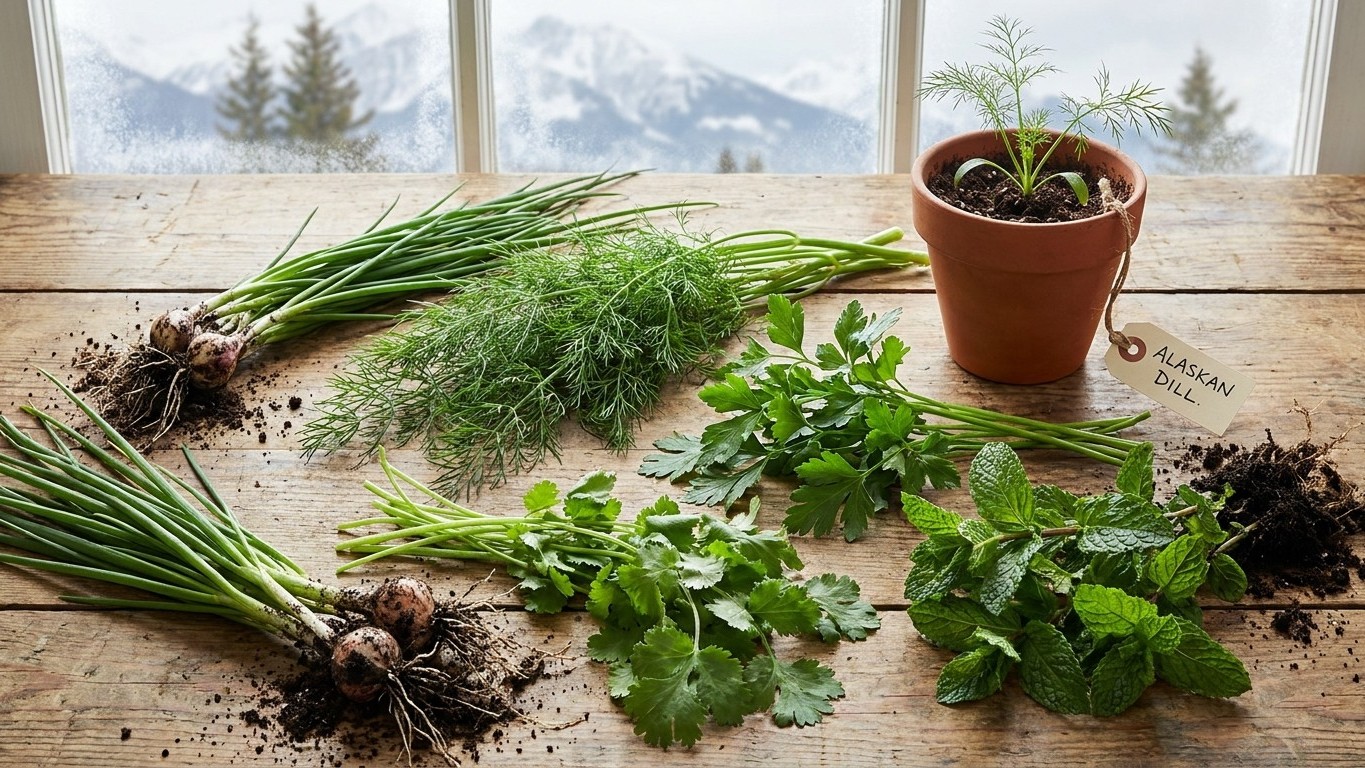

Yukon’s herb garden works on a short clock: chives, dill, cilantro, parsley, and other quick, cold-tolerant herbs handle it well, while basil, rosemary, and other heat-lovers struggle outdoors. The territory’s mean frost-free window runs about 81 days, and winters drop cold enough to kill most tender perennials outright. What follows breaks down which herbs fit that window, which don’t, and how much the picture shifts across the territory.
The short answer for Yukon
Start with the two dates that set the whole calendar: a mean last spring frost of June 5 and a mean first fall frost of August 25, both from the Whitehorse A station. Subtract one from the other and you get roughly 81 days of averaged frost-free growing time. That is the number every herb choice in this territory has to answer to, and it is short by almost any comparison used on this site.
The catch is that “mean” is not a promise. Environment and Climate Change Canada’s normals describe a midpoint, not a guarantee: in one year out of two, frost arrives later than June 5 in spring, or earlier than August 25 in fall. Treat 81 days as the best case, not the safe case, and plan herb choices around a window that could run closer to 60 or 65 days in a rough year.
That reality sorts herbs into three groups. Fast, cool-tolerant annuals, dill, cilantro, chervil, summer savory, and garden cress, mature quickly enough to complete a full life cycle inside that window, and several of them actually prefer the cooler nights Yukon delivers even in midsummer. Cold-hardy perennial herbs, chives, mint, oregano, and some thyme varieties, can survive the winter outdoors if their root hardiness matches the territory’s cold, which is the next number that matters.
That number is the coldest month’s mean daily minimum: -2.6°F, drawn from the same 1981-2010 normals. This is not a record low or a freak cold snap; it is the average low for the coldest month of a typical year. A perennial herb has to shrug that off, every winter, to count as reliably hardy here. Chives and most mints clear that bar. Rosemary, bay, and lemongrass do not, not outdoors, not without heavy protection that most home gardeners won’t maintain year after year.
The third group, heat-loving Mediterranean and tropical herbs, basil above all, is the one to treat as a container or indoor crop rather than a garden bed resident. Basil wants warm nights and a long stretch of real heat to bulk up; Yukon’s frost-free window is short and its summer nights run cool even inside that window. Growing it in pots that can be moved or grown under cover is the workaround, not planting it out and hoping.
What will not work here
Basil is the clearest failure case, and it is worth spelling out why rather than just naming it. Basil typically needs a long run of consistently warm days and nights to bulk up before harvest. Yukon’s mean frost-free window is about 81 days, and that figure already assumes an average year; a late June frost or an early August one shortens it further. Add in nights that stay cool even at the height of summer, and outdoor basil in Yukon spends most of its short season simply recovering from chill rather than growing.
Woody Mediterranean perennials fail for a different, colder reason. Rosemary, bay laurel, and similar shrubby herbs are rated for winters far milder than a mean coldest-month minimum of -2.6°F. That figure is not the occasional deep freeze, it is the average low for the coldest month of a normal Yukon winter. A plant that cannot survive that as its baseline has no realistic path to overwintering outdoors here, no matter how well it’s mulched.
Slow starters lose the season
Herbs with a long time-to-maturity run into the same 81-day ceiling from the other direction. Parsley, a biennial that often takes its time establishing in year one before it’s worth much harvest, and slow bay or sage varieties started from seed rather than cuttings, can spend most of the frost-free window just getting established. In a year where frost arrives on the earlier side of that August 25 mean, a slow starter may never get a real harvest in before the first hard cold shuts things down.
The pattern across all three failure types is the same: the territory’s numbers set a hard ceiling on both ends, warmth needed to grow and cold survived to overwinter, and any herb whose requirements exceed either ceiling is fighting the climate rather than working with it. That doesn’t rule these herbs out entirely; it rules out growing them the way a gardener two or three USDA zones warmer would.
What changes across Yukon
Every hardiness figure on this page, the 1b Canadian zone rating and the frost dates alike, comes from a single reference point: the Whitehorse A weather station. That is standard practice, but it means the numbers describe Whitehorse’s climate specifically, not the territory’s climate as a whole. Yukon is enormous and its terrain varies from river valleys to alpine plateaus, and a Canadian hardiness zone of 1b for one city says nothing certain about conditions a few hundred miles north or a few thousand feet higher.
The Canadian zone system itself is built differently than the more familiar USDA scale used elsewhere on this site: it factors in seven climate variables rather than one, and Natural Resources Canada is explicit that its zones don’t convert cleanly to USDA numbers at all. So treat 1b as a description of Whitehorse’s growing conditions under the Canadian framework, not as a stand-in for the whole territory, and never assume a spot in southern or northern Yukon shares that same rating.
This page does not have a documented zone range for the rest of the territory, and rather than guess at what a neighboring district might carry, it’s more honest to say plainly: Yukon spans meaningfully different growing conditions from south to north and from valley floor to higher ground, and a single reference-station rating can’t capture that spread. A gardener at higher elevation or farther north than Whitehorse should expect a shorter frost-free window than the 81-day mean given here, and colder winter lows than -2.6°F, not milder ones.
The practical move is to check where a specific location actually falls on Natural Resources Canada’s Plant Hardiness Site, which maps zones by municipality rather than by a single territorial average. That map won’t hand over a personal recommendation, but it replaces a territory-wide guess with a number tied to an actual community.
Where to check this for your own county
This page describes Yukon at the territorial level, using one reference station’s frost dates and one reference city’s hardiness zone. That is useful for a broad picture, but it is not a substitute for a local recommendation, and a community-level source will almost always beat a territory-wide one for the simple reason that it’s built from data closer to an actual garden.
The provincial and territorial department’s own site currently blocks automated verification, so the reliable address to use is the federal one: agriculture.canada.ca. From there, look for two specific things rather than browsing broadly. First, a planting calendar built for the local area rather than the territory as a whole, since a community closer to the coast, farther north, or at higher elevation can carry a frost-free window quite different from the 81-day mean used on this page. Second, any list of herb or vegetable varieties that have actually been trialled in the local growing conditions, since a variety proven to mature reliably in a specific community’s short season is a far safer bet than a generic seed-packet estimate.
None of that information is on this page, and it shouldn’t be assumed from what is here. The frost dates and hardiness figure above come from one weather station and one reference city; a local extension or agriculture resource draws on data gathered closer to home, and that is precisely the gap a territorial cluster page like this one cannot close on its own. Use this page to understand the mechanism, why a short season and a cold winter shape herb choices, and use the federal or local resource to pin down the actual dates and varieties worth trusting in a specific community.
Checking this against your own garden
Every date on this page is an average pulled from decades of station data, and averages miss the particular soil, slope, and shelter of an actual garden bed. The most reliable calendar is usually the one a gardener can read by hand, with three simple checks that beat any printed frost date.
Soil warmth comes first. Push a finger a couple of inches into the bed in spring; cold, damp soil that feels barely above the temperature of tap water straight from a cold line means germination will stall even if the calendar says the mean frost date has passed. Warmer, crumbly soil that holds a bit of give is the better signal that seeds like dill or cilantro will actually sprout rather than sit and rot.
First true leaves are the second marker. Herb seedlings emerge first with simple seed leaves, then follow with a set that looks like the mature plant’s actual foliage. That first true-leaf set showing up faster than expected suggests a garden’s microclimate is running warmer than the territorial average this page describes, a slower emergence suggests the opposite, and either way it’s a better guide to that specific bed than a station reading from miles away.
The third check is bolting, particularly on biennials like parsley or fast bolters like cilantro. A plant that throws a flower stalk unusually early is responding to heat or day-length stress specific to that spot, often a sign of a warmer, more exposed microclimate than the territory’s averages suggest. Watching for that early flowering tells a gardener more about their own yard’s real conditions than any frost date ever will.