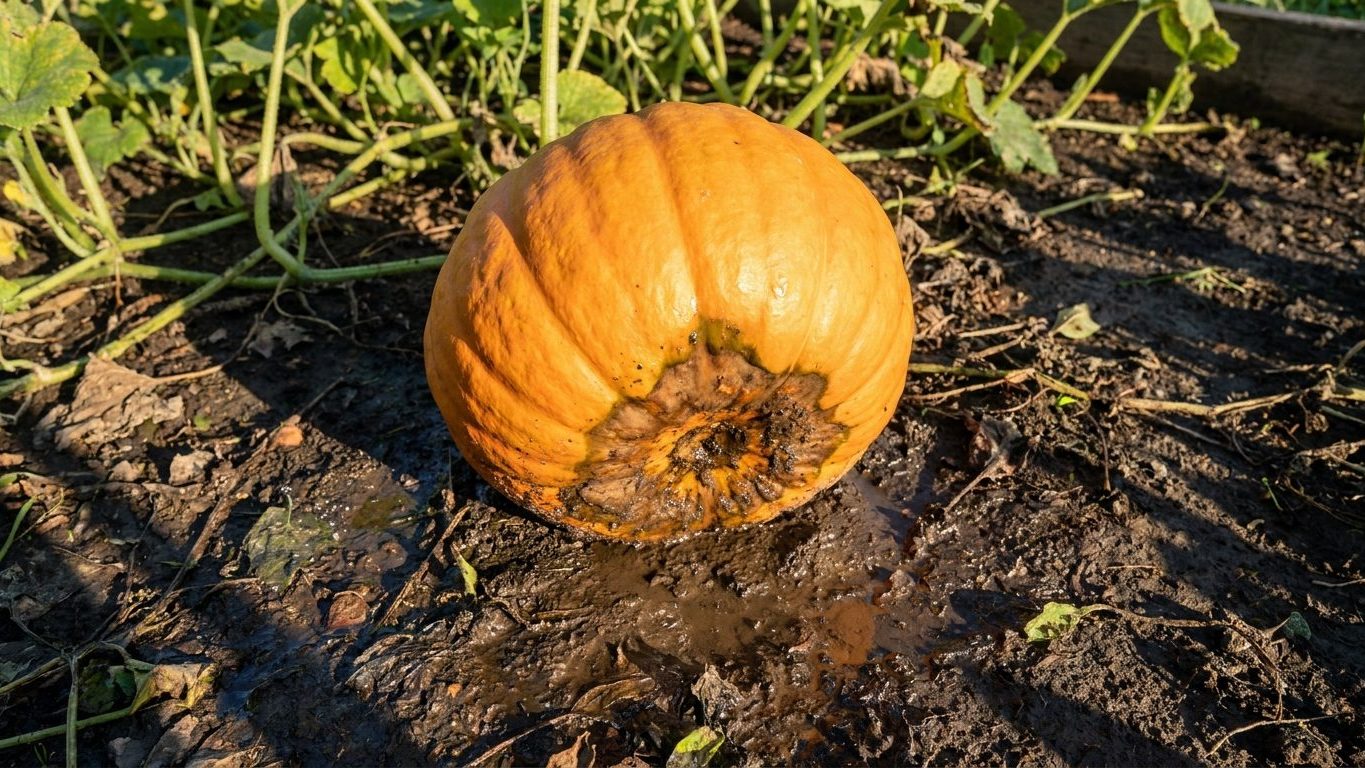

A perfect-looking squash with a soft, dark patch underneath has usually been sitting in the same spot for weeks, quietly losing the fight against the ground beneath it. The rot isn’t random damage. It’s contact moisture: soil traps water against the skin, and the skin can’t dry where it’s pinned down. Lifting the fruit off the dirt, even an inch, changes almost everything.
What is actually going on

Squash skin is a barrier, not a shell. It’s tough enough to resist a light knock, but it still exchanges moisture with whatever it touches. Soil that’s damp from irrigation, rain, or morning dew stays in contact with the same patch of rind hour after hour. That patch never gets the airflow the rest of the fruit gets, so it never fully dries between waterings. Given a few weeks of that pattern, the skin softens, microscopic openings appear, and fungi or bacteria already living in the soil move in. By the time a gardener sees a wet or sunken spot, the process has usually been running for a while underneath.
This is why simply wiping the spot off does nothing. The softening starts from the inside of the skin layer, not the surface, so a clean-looking exterior can already be hiding damage below. Heat and humidity speed the whole thing up, but even in a dry summer, dense soil that holds water at the surface will keep that one patch of rind wetter than the rest of the fruit for longer than it should be.
It helps to know what winter squash actually is at this stage. Unlike a carving pumpkin, which is grown mainly for its shell and its shape, a Winter Squash is grown for the flesh inside and for how well it keeps afterward. That difference matters here: a pumpkin with a soft ground-spot might still be fine to display, but a Winter Squash with the same spot has a compromised interior, because the whole point of the fruit is what’s under that skin. If a reader is dealing with a carving pumpkin specifically, the concerns and the fixes are different enough that the pumpkin section of this guide is the better starting point.
Variety matters more than most gardeners assume, but not in a way this page can name specifically. Some types have thicker, harder rinds that resist ground contact better than thinner-skinned types, and some vine habits naturally lift fruit slightly off the soil while others let it sit flat. Rather than pointing to a specific named variety, the more reliable move is checking which types are trialled and recommended for ground contact resistance through a state or county cooperative extension service, since those trials are done on local soil and local humidity, not in a lab somewhere else.
One thing to be clear on from the start: a soft spot, a patch that’s weeping fluid, or a stem showing mold is not a cosmetic issue to trim away and use anyway. It’s the end of that fruit’s story for the kitchen. No amount of good appearance elsewhere on the squash makes that call for you.
In the garden
The fix isn’t complicated, but it has to happen early, before the fruit has spent real time in contact with wet soil. The goal is simple: break the contact between rind and ground, and keep the air moving under the fruit so any moisture that does reach it can leave again quickly.
| What to do | Why it works | What happens if skipped |
|---|---|---|
| Slide a layer of dry mulch, straw, or a flat board under each developing fruit as soon as it starts to size up | Creates an air gap between rind and soil so moisture can’t sit against the skin | The underside stays damp after every watering or rain, and softening starts within a few weeks |
| Keep that barrier dry and replace it if it gets soaked or starts to break down | A soggy mulch layer holds moisture against the fruit just as badly as bare soil does | Gardeners assume the mulch is doing its job and stop checking, while the rot starts anyway underneath |
| Water at the base of the plant, not overhead, once fruit has set | Reduces the amount of water landing directly on fruit and pooling around it | Overhead watering keeps the same wet patch resupplied daily, undoing whatever barrier is in place |
| Check the underside of each fruit every week or two by gently lifting it, without twisting the stem | Catches early softening while the rest of the fruit and the vine are still fine | Rot spreads unseen until the fruit collapses or the smell gives it away, usually too late to save anything |
| Space vines and thin dense foliage around fruit if the planting is crowded | Improves airflow so humidity doesn’t build up at ground level around each fruit | Still air holds moisture close to the soil surface even on a day that feels dry above the canopy |
Turning the fruit periodically is a piece of advice that circulates a lot, and it’s worth addressing directly: it doesn’t solve the underlying problem. Rotating a squash a quarter turn every so often just moves which patch of rind is in ground contact, and it risks snapping or weakening the stem, which opens its own path for disease. The stem connection matters for how the fruit finishes ripening and for how well it stores later, so it’s not a trade worth making. Lifting the fruit off the ground once, with mulch or a board, does the actual job that turning is trying to fake.
If a soft spot does show up despite all this, the sensible move is to harvest that fruit right away rather than leave it in the garden hoping it holds. It won’t be a keeper, but using it soon after cutting away well clear of any affected area, and only if the rest of the flesh shows no discoloration, softness, or off smell, is a judgment call for that fruit alone. Any doubt, any smell, any dark streaking beyond the visible spot, means it goes in the compost instead.
What it depends on where you are
Ground rot isn’t equally likely everywhere winter squash gets grown, and pretending otherwise would be misleading. Three things shift the odds: how long the growing season runs, how hot and humid the summer gets, and how much rain falls while fruit is developing on the vine. A long, humid growing season with frequent summer rain keeps soil wet at the surface far more often than a short, dry season does, and that difference changes how aggressive a gardener needs to be about mulching and airflow.
Soil type plays into this too, though it’s a garden-by-garden variable rather than a regional one. Heavy clay holds surface moisture longer than sandy or well-drained loam, so two gardens in the same state, on the same rainfall pattern, can still see very different results depending on what’s actually under the mulch layer. The mechanism (contact moisture, airflow, drainage) is the same everywhere, but the timing and intensity of the fix depend on conditions for any individual reader’s yard.
This is exactly the kind of question a state cooperative extension service is built to answer well, because their trials and recommendations are done on local soil, in local humidity, with the varieties actually grown in that state. For a reader trying to figure out how aggressive to be about mulching, how often to check fruit, or which types have shown better resistance to ground contact issues in local trials, that’s a more useful answer than any single number this page could offer. The winter squash guides on this site that cover growing conditions state by state are a good next stop for that local detail, alongside a direct call or search on the local extension office’s site.
None of this changes the basic fix. Wherever the garden is, the same gap of dry air between rind and soil does the work. What changes is how soon in the season that gap needs to go in, and how often it needs checking.
The mistake that costs the most
The single costliest mistake is waiting for a visible problem before doing anything about ground contact. Most gardeners don’t mulch or prop up developing fruit until they’ve already lost one or two to rot the season before, which means the lesson gets learned at the cost of actual harvest rather than in advance of it. By the time a soft spot is visible, the fruit is already gone as a keeper, and the only real question left is whether it’s safe enough to use immediately or better composted.
The fix costs almost nothing and takes very little time: as soon as a fruit is set and starts sizing up, slide something dry underneath it. Straw, a scrap of untreated board, even a folded section of dry mulch, all work, as long as it stays dry and gets checked periodically. This has to happen while the fruit is still small, not after it’s already sitting flat against wet soil for weeks. Waiting until the vine looks fully loaded and the fruit look nearly finished is waiting too long, because the damage that shows up at harvest started long before the fruit reached its final size.
Keeping this simple habit going through the whole growing season matters more than any single perfect intervention. A barrier put down once in July and never checked again is only slightly better than no barrier at all, since it can get buried, soaked, or shifted well before harvest. The gardeners who consistently avoid ground rot aren’t doing anything elaborate. They’re checking the same handful of developing fruit every week or two, keeping the ground under each one dry, and treating any softness they find as a signal to harvest that piece now rather than hope it improves. That single habit, repeated through the season, prevents more losses than any remedy applied after the fact ever could.