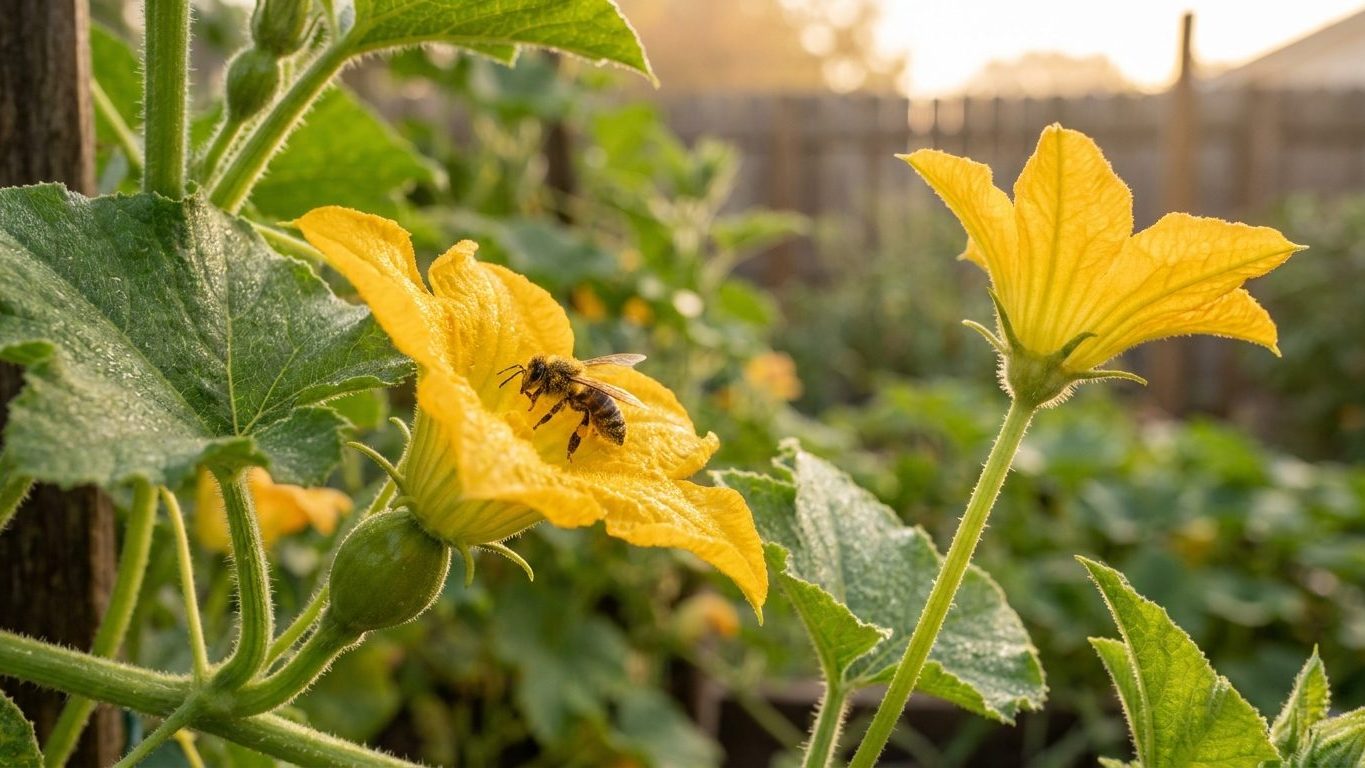

A vine loaded with blossoms that still turns out three squash by October isn’t broken. It’s just how the plant is built. Winter squash needs a female flower pollinated within hours of opening, and if that window is missed, the tiny fruit behind the petals yellows and drops instead of swelling into something that will cure and store through winter.
What is actually going on

The thing to understand here is that the first flush of flowers on a Winter Squash Vine is almost always male. That’s not a flaw, it’s sequencing: the plant spends its early energy attracting pollinators before it has anything worth pollinating. Female flowers show up later, and you can spot one before it even opens by the tiny bulge behind the petals, a miniature squash already formed. That bulge is the ovary, and it only becomes an actual fruit if pollen lands on the stigma inside that flower on the single day it’s open.
Squash flowers, male and female both, open once, usually in early morning, and close by early afternoon, sometimes for good. Pollen stays viable for only a few hours. That’s a tight window, and it’s why a vine can be covered in open blossoms at 6 a.m. and show nothing but closed, spent flowers by lunch. Bees need to move pollen from a male flower to a female one during that same short stretch, and squash pollen is heavy and sticky, not something wind carries. No insect movement, no fertilized ovary, no fruit.
This matters more for winter squash than it does for a summer squash or a zucchini plant. Summer types get picked immature, days after the flower fades, so a missed pollination is a minor loss. Winter squash is grown for a mature, hard-shelled fruit with flesh that’s meant to cure and keep for months, which means every fruit needs the full run of the season from fertilization to hard rind. Lose the pollination window in July and you haven’t just lost one squash, you’ve lost weeks the plant needed to finish that fruit before frost.
It’s worth separating this from pumpkins, since the two get lumped together constantly. A carving pumpkin is bred and grown for its shell and its handle, picked at a size and color that suits a porch step. A winter squash, whether it’s an acorn type, a butternut type, a hubbard type, or a kabocha type, is grown for the flesh inside and its ability to keep in storage. The flower biology is identical, but the goal at harvest is different, and the curing steps diverge too. For anything specific to jack-o’-lantern types, that belongs on this site’s pumpkin guides, not here.
On storage: a squash that made it through pollination and matured on the vine still has to pass an inspection before it goes in the pantry. A soft spot, a weeping patch on the rind, or any mold at the stem end means that fruit doesn’t get a benefit of the doubt. Looking fine from three feet away isn’t the same as being sound.
In the garden
Telling male and female flowers apart takes about five seconds once you know what you’re checking, and it’s the first diagnostic step whenever a vine is flowering heavily but setting nothing.
| Sign | What it means | What happens if you get it wrong |
|---|---|---|
| Flower on a thin, straight stem, no bulge behind the petals | Male flower, pollen source only | Removing these thinking they’re “wasting” the plant’s energy cuts the pollen supply bees rely on for every female flower nearby |
| Flower with a swollen, miniature squash shape behind the petals | Female flower, this is the one that becomes fruit | Mistaking it for a diseased or malformed growth and pulling it off ends that fruit before it had a chance |
| Female flower opens, closes by afternoon, tiny fruit stays green and firm days later | Pollination succeeded | No action needed, but note the date, it tells you when bee activity picked up in your garden |
| Female flower opens and closes, tiny fruit turns yellow, soft, and shrivels within a few days | Pollination failed, most common cause is too few pollinator visits during the flower’s single open window | Assuming it’s a disease and treating for one wastes time and can mean spraying something that also drives off the pollinators you need |
When failure is happening flower after flower, hand-pollination closes the gap while pollinator numbers catch up. Pick a freshly opened male flower in the morning, strip the petals back, and touch the pollen-covered center directly to the center of an open female flower, or use a small, clean paintbrush to transfer pollen between the two. Either works. Do it early, before the flowers close for the day, and repeat it for a few mornings if the vine is still setting poorly.
Timing inside the season matters as much as timing inside the day. A winter squash planting that sets its first fruit late, because early female flowers failed and nobody stepped in, is racing the calendar in a way a summer squash never has to. Every week lost at the front end of fruit development is a week the last fruit on the vine won’t have when frost arrives, which is why a poor set in the first two or three weeks of female flowering deserves more attention than a slow patch later on, once earlier fruit is already sizing up and the plant has settled into a rhythm.
Cutting back on broad insecticide use during flowering, and avoiding any application in the hours around dawn when squash flowers are open and bees are working them, protects the pollinators doing this job for you. That’s a practice worth adopting regardless of which product a gardener might otherwise reach for.
What it depends on where you are
Some of this is universal. The mechanics of a male flower, a female flower, and a pollinator moving between them work the same whether the vine is in a raised bed or a quarter acre. What changes by location is everything around that mechanic: how long the growing season runs, how hot the summer gets, how much rain falls during flowering, and which pollinators are actually active in a given yard.
A shorter growing season leaves less room to recover from a slow start. A gardener who loses the first few weeks of female flowering to poor pollination in a region with an early first frost is in a tighter spot than one gardening where the season runs long past that point. Heat matters too: extended stretches of high daytime temperatures can cause flowers to abort or pollen to lose viability faster than usual, and that heat threshold isn’t the same in every state. Heavy rain during the flowering window keeps bees from foraging and can wash pollen off flowers before it’s transferred, which is a bigger factor in some climates than others.
Pollinator populations shift regionally as well. Native squash bees, which specialize in cucurbit flowers and are often out working before honeybees have even left the hive, are more established in some areas than others, and local bumblebee and honeybee numbers vary by what else is blooming nearby and how much pesticide pressure exists in the surrounding landscape.
None of that is something a general guide can pin down for a specific yard. The state-level pages on this site cover regional timing and conditions in more detail, and a local Cooperative Extension office can speak to what’s actually happening with pollinators and weather in a specific county this season. The USDA Cooperative Extension System is the starting point for finding that office.
The mistake that costs the most
The single costliest mistake is treating early fruit drop as a fertility or disease problem and reaching for a fix that makes the timing problem worse. A gardener sees female flowers opening, closing, and the tiny fruit behind them shriveling within days, assumes the soil is lacking something, and responds with a heavy dose of high-nitrogen fertilizer to “push” the plant.
Nitrogen in that quantity does the opposite of what’s needed. It drives leafy, vegetative growth at the expense of flowering, which delays the next round of female flowers rather than speeding them along. Meanwhile the actual cause, too few pollinator visits during that narrow open-flower window, goes completely unaddressed. The vine ends up bushier, later to flower, and further behind on the calendar than it was before the intervention, which is the one thing a winter squash planting can least afford given how much time it needs between fertilization and a fully cured, hard-shelled fruit ready for storage.
The fix costs nothing and takes five minutes some mornings: confirm it’s a pollination gap by checking whether female flowers are opening at all and whether fruit is aborting specifically in the days right after bloom, then hand-pollinate those flowers directly instead of amending the soil. Leave male flowers in place rather than removing them, since every one left on the vine is a pollen source for the bees that are working the patch. If pollinator activity in the yard seems genuinely low, that’s worth mentioning to a local extension office, since it may point to something in the surrounding landscape rather than anything happening in the bed itself. Fixing the actual mechanism, not the soil, is what gets fruit set back on schedule before the season runs out.