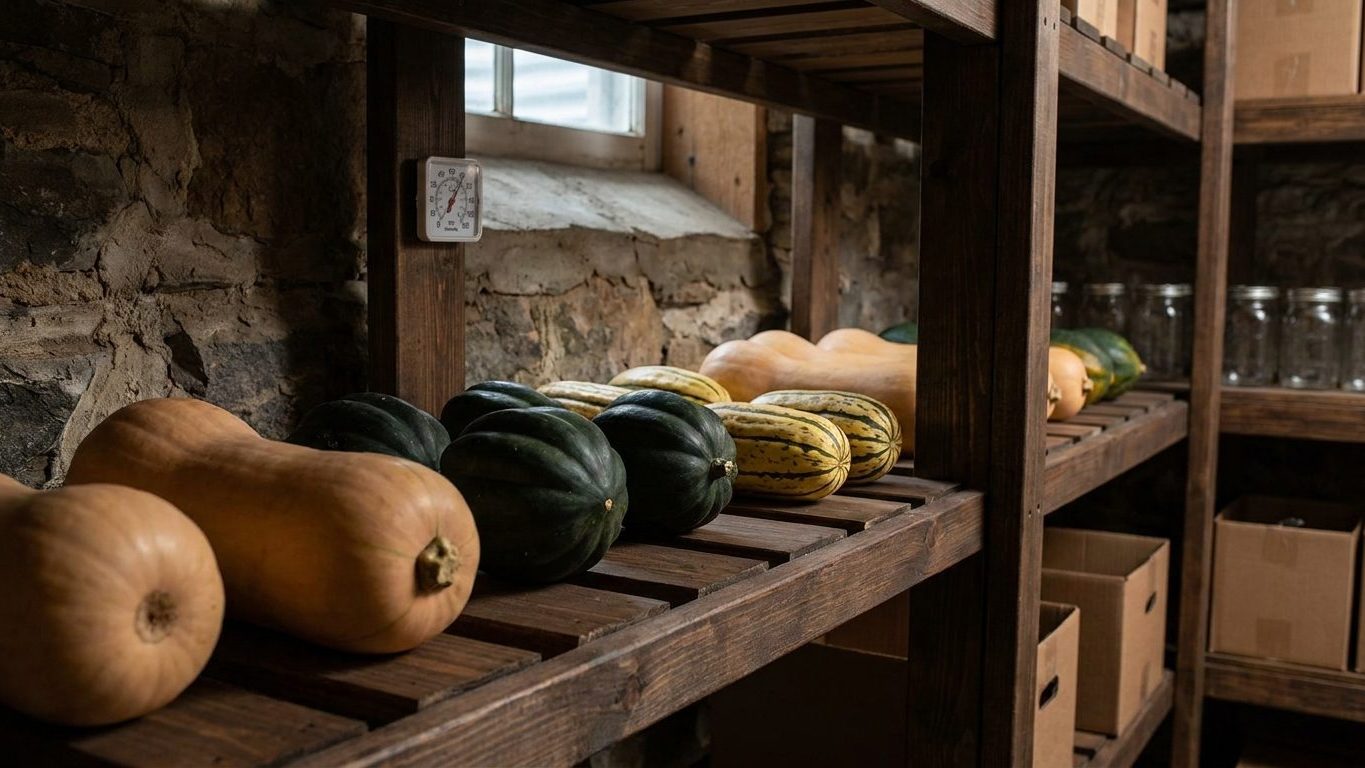

Winter squash keeps best in a cool, dry, dark spot with steady airflow and no direct contact between fruits, generally somewhere between 50 and 55°F with moderate humidity. Before it gets there, it needs a curing period to toughen the skin. Skip either step and even a perfect-looking squash can rot within weeks instead of lasting months.
What is actually going on
Storage failure is rarely about the squash itself. It’s about the room. A winter squash is a living thing that keeps respiring after harvest, slowly using up its own sugars and losing moisture through its skin. Temperature controls how fast that happens. Too warm, and the fruit burns through its reserves and softens early. Too cold, closer to freezing, and the flesh breaks down from chilling injury even though the outside still looks fine. That’s the trap: the damage often starts inside, invisible, before anything shows on the rind.
Humidity works against that but in the opposite direction. A little moisture in the air slows water loss and keeps the flesh from turning fibrous and dry. But too much humidity, especially combined with poor airflow, gives mold and soft rot exactly the conditions they need on the skin, particularly around the stem end where the fruit was cut from the vine. This is why a traditional root cellar, built for potatoes and carrots that want cold and damp, is often the worst possible place for a squash. Potatoes and squash have almost opposite storage needs, and treating them the same is a common and costly assumption.
Type matters here too, though not in the way seed catalogs sometimes suggest. Thick, hard-shelled types built for long keeping, the kind sold as hubbard or kabocha types, tolerate a longer storage window than thinner-skinned types like delicata or acorn, which are better used up within a couple of months. None of that is a guarantee tied to a specific variety name. Local trials through a state extension service are the only reliable way to know how a particular seed line performs in a given climate, and that’s worth checking before assuming any two squash of the same general type behave identically.
A carving pumpkin is bred and grown for its shell, its size, and how it looks on a porch. Winter squash is grown for the flesh inside and for how well that flesh keeps. Some pumpkin types are edible and some winter squash types get carved, but the goals diverge enough that pumpkin storage and curing deserve their own treatment, covered in this site’s pumpkin section rather than repeated here.
None of this is about appearance alone. A squash can look completely sound on the outside while something has already gone wrong underneath, which is why storage is really about ongoing inspection, not a one-time check at harvest.
In the garden
Getting a storage space right is less about finding a perfect room and more about controlling a handful of specific conditions. Each one has a failure mode worth knowing, because recognizing the symptom early is what saves the rest of the batch.
| Condition | What to aim for | What goes wrong if you don’t |
|---|---|---|
| Curing period | About a week to ten days in a warm, well-ventilated spot (roughly 80–85°F) right after harvest, before moving squash to long-term storage | Skin stays soft and thin, cuts and bruises never seal over, and the squash rots from the stem end within days of storage |
| Storage temperature | A steady cool range, generally 50–55°F, away from freezing and away from a heated part of the house | Too warm and the squash softens and sprouts early; too cold and the flesh suffers chilling injury that shows up as sunken, water-soaked patches weeks later |
| Humidity | Moderate, not damp, with the air able to move around each fruit | Too dry and the flesh shrivels and turns stringy; too damp with poor airflow and mold takes hold, especially at the stem scar |
| Spacing and contact | Fruits stored singly, not touching, ideally on a slatted shelf rather than piled in a bin | One soft spot spreads to whatever it’s touching, turning a single bad squash into a lost shelf |
| Light | Dark or dim storage | Light exposure speeds sprouting and can encourage greening near the surface |
| Stem handling | A short length of stem left attached, handled without snapping it off | A broken or missing stem leaves an open wound that mold and bacteria enter through first |
Inspection matters as much as the conditions themselves. Check stored squash every few weeks, not just once. A soft spot anywhere on the shell, a weeping or discolored patch, or a moldy stem end means that squash comes out of storage and gets used or discarded immediately; it does not get judged on how the rest of it looks. Squash doesn’t fail all at once. It fails from one point outward, and catching that point early is what protects everything stored near it. No amount of good appearance elsewhere on the fruit overrides a soft spot, and no fixed number of weeks or months should be treated as a promise, since the same variety can behave differently depending on how it was cured and where it’s kept.
What it depends on where you are
Some of this is universal. Winter squash respiring, needing to cure before cold storage, being vulnerable to chilling injury, all of that holds true regardless of zip code. What changes by region is everything upstream of storage: how long the growing season ran, how much summer heat and rainfall the plant got, and how mature the squash was when it came off the vine, all of which affect how well it cures and how long it can be expected to hold up afterward.
A squash grown in a short, cool season and pulled before it fully matured cures more slowly and keeps less predictably than one grown through a long, warm summer with time to harden its shell naturally on the vine. Humid regions bring a higher background load of mold spores into any storage space, which makes airflow and spacing matter even more than the numbers alone suggest. Dry western climates tend to make the opposite mistake easier: storage spaces that dry squash out faster than expected, even at otherwise reasonable humidity levels.
Season length, average summer temperatures, and typical fall humidity are all regional facts, and this site’s state-level guides are built to fill in exactly that gap rather than repeat generic ranges that don’t hold everywhere equally.
A state extension service is the other resource worth using directly, since many publish storage guidance tested against local growing conditions and even trial results for specific squash types grown in that state. That local data, gathered on-site rather than assumed from a national average, is usually a better guide than any single number repeated across the country.
The mistake that costs the most
The single costliest mistake is skipping the cure and moving squash straight from garden to cool storage, assuming a hard-looking shell means the job is already done. It doesn’t. Curing is what actually hardens and seals the skin, closing off the small cuts and stem wounds that happen during harvest. A squash that looks tough on the outside but hasn’t cured is still, underneath, an open door for mold and rot, and it will often fail in storage within days or a couple of weeks, well before anyone expects trouble.
The fix is straightforward and doesn’t require special equipment. After harvest, set the squash somewhere warm and airy, out of direct sun, for roughly a week to ten days before it goes into cooler long-term storage. That warmth is what drives the curing process. A garage, a sunporch, or even a warm corner of a kitchen counter can work, as long as air moves around the fruit rather than trapping humidity against it.
This step gets skipped most often simply because it feels like an unnecessary delay when the harvest is already sitting there, ready to be put away. But that delay is the entire difference between a squash that lasts through winter and one that has to be used within days because it’s already softening. It applies across types, whether it’s a thin-skinned squash meant to be eaten within a couple of months or a thick-shelled type meant to keep much longer. Skip curing on either, and the storage advice won’t have much to work with.