
Louisiana’s biggest challenge for winter squash isn’t frost, it’s heat. South Louisiana freezes so rarely that roughly one year in seven sees no freeze at all, so growers there are managing summer heat stress and humidity-driven disease far more than cold. North Louisiana behaves more like a traditional squash climate, with a real, if short, dormant season.
When the soil is warm enough in Louisiana

Gardeners always want a date. Here’s the honest one: at the reference station used for these normals, the last spring frost falls somewhere between January 18 and February 8 (NOAA NCEI 1991-2020 Climate Normals, 30-70% freeze-probability band). That’s the window where a 32°F freeze has a real but declining chance of showing up.
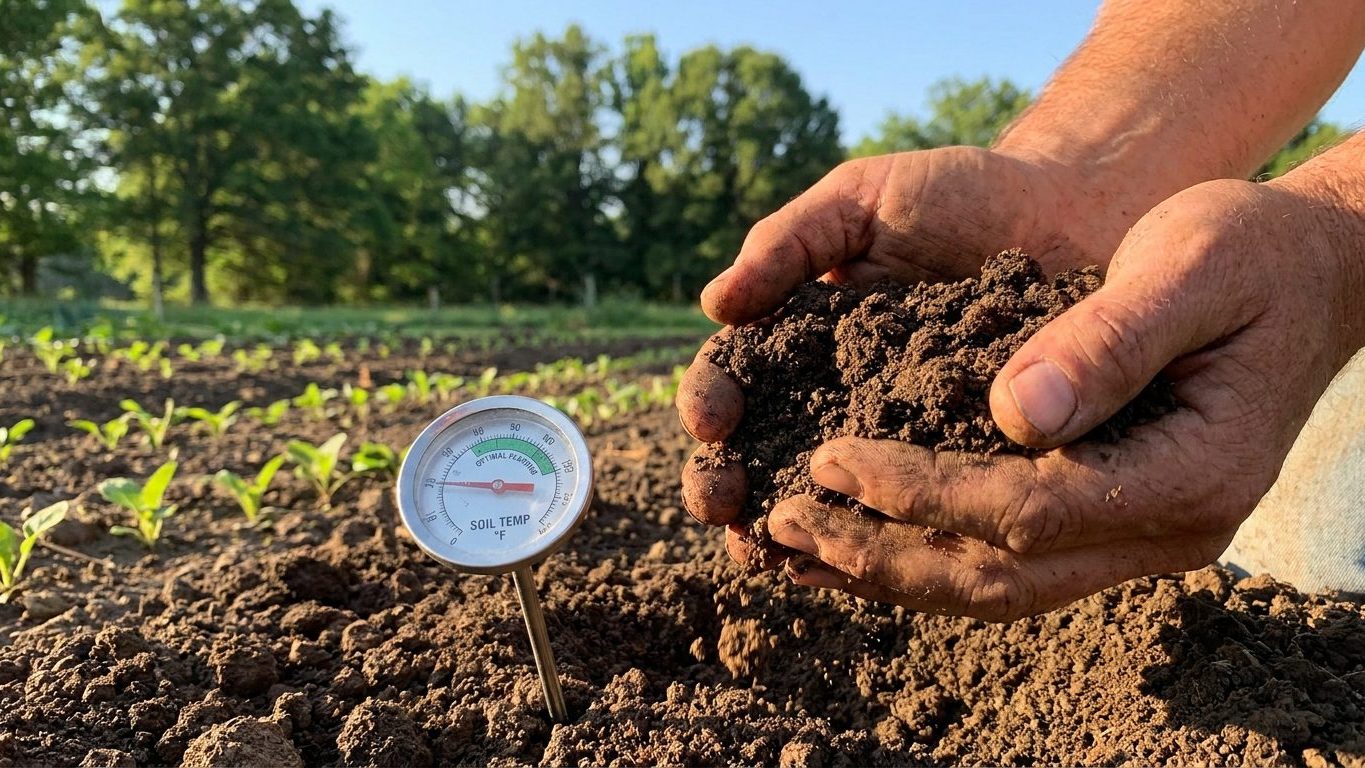
But that date is a proxy, not the answer. Winter squash doesn’t care about frost directly, it cares about soil temperature, and soil takes time to catch up once the air stops threatening to freeze. Seeds sown in cold, wet soil rot before they sprout regardless of what the calendar says. So the practical rule is to let the soil itself confirm the frost date rather than the other way around, waiting until the top few inches feel consistently warm to the hand, not just frost-free by the calendar.
The caution behind that January-to-February range matters more than the range itself. At this station a 32°F freeze occurs in only 86.8 percent of years. That means roughly one winter in seven brings no hard freeze at all, and the fall side of the same freeze window actually straddles New Year’s Day. This is not a place where a grower can pencil in “plant two weeks after last frost” and trust it the way a gardener in Ohio or Minnesota might. South Louisiana’s climate is mild enough that frost becomes background noise, an occasional event rather than a hard seasonal gate.
North Louisiana is a different story. Freezes there are more frequent and more reliable, which actually simplifies planning: the frost date carries more weight as a planning tool the farther north in the state a garden sits. That regional split is worth remembering before leaning on any statewide date, because a single frost window drawn from one reference station will undersell how mild the coast is and oversell how mild the northern parishes are.
A frost date, wherever it falls, is a probability built from thirty years of data, not a guarantee for any single spring. The safest approach pairs the date with a soil check, and with a call to a local extension office if the timing still feels uncertain.
How long the season lasts here
Run the numbers from both ends of the year and the length of Louisiana’s frost-free window becomes clear. The last spring frost sits between January 18 and February 8, and the first fall frost doesn’t return until December 17 to January 8. Taking the more conservative edges, that means a garden could theoretically stay frost-free from early February all the way to mid-December, a stretch approaching ten months.
That’s an unusually long window by American standards, and it changes the whole calculus of how to grow winter squash here. In a region with a short frost-free season, a gardener gets one shot: seeds go in the moment the soil allows, and every week lost to a cool spring or a late transplant eats directly into the harvest. Louisiana’s growers, at least in the southern half of the state, don’t face that squeeze. A long window opens the door to a second sowing, staggered a few weeks behind the first, so that if humidity or pests take out an early planting there’s a backup already coming along behind it.
It also changes how transplants get treated. With a short season, every transplant needs a careful root check before it goes in the ground, because a stunted or circled root ball can cost precious weeks that don’t exist to spare. With Louisiana’s extended window, there’s more slack to replant if a transplant fails to establish, though winter squash generally prefers direct seeding anyway since its roots resent disturbance.
The real constraint on that long window isn’t frost at either end, it’s the brutal stretch of summer sitting in the middle of it. A ten-month frost-free calendar doesn’t mean ten months of good growing conditions, and that’s exactly where the next section picks up. For gardeners weighing whether to use that extra room for a true second planting, the site’s succession sowing guide walks through how to stagger sowings without overlapping harvests or overwhelming the garden.
Heat and water in Louisiana

Winter squash is a crop where timing is everything: the fruit has to finish maturing and developing its tough skin while still attached to the vine, because an immature squash pulled early neither cures properly nor stores well afterward. In most of the country, the question is whether the season is long enough for that to happen before frost. In Louisiana, frost isn’t the threat. Heat is.
At the New Orleans reference station, the average year logs 70.7 days at or above 90°F. That’s not a description of how hot the whole state gets, since it applies specifically to that station, but it’s a solid measure of the heat load a squash vine has to tolerate across a typical summer. Seventy days above 90°F means extended stretches where blossoms drop before pollination, where pollen itself can become less viable, and where a plant spends more energy just surviving the afternoon than filling out fruit.
Rainfall complicates the picture rather than solving it. Summer rain across June, July and August totals about 21.3 inches, with July running driest at 6.79 inches, June at 7.62, and August at 6.91. On paper that’s a generous amount of water, more than plenty of squash-growing regions see all summer. But that rain rarely arrives as a gentle, steady soak. It comes as thunderstorms, often dumping an inch or more in an hour, and a lot of that runs off rather than sinking into the root zone, especially on clay soils that seal over in a downpour.
The combination of heavy heat and humid, storm-driven rain is the real signature of a Louisiana summer garden, and it cuts against squash in two separate ways. The heat drives water demand and stresses the plant directly. The humidity that comes with all that rainfall keeps foliage wet longer after each storm, which is exactly the condition that lets powdery mildew and other fungal diseases take hold on squash leaves. A gardener here isn’t choosing between watering less and watering more, the way someone in a dry climate might; they’re managing both heat stress and disease pressure at the same time, which usually means watering at the soil level rather than overhead, and giving plants enough spacing that air can move through the foliage and dry it out between storms.
Which winter squash suit Louisiana
Given all that, the type of winter squash matters more here than the exact sowing date does. Louisiana’s frost-free window is long enough that season length itself rarely eliminates a type outright, the way it would in a northern climate with a genuinely short summer. What eliminates a type here is its tolerance for heat and its resistance to the fungal diseases that thrive in humid, storm-fed summers.
That points toward squash types bred or selected for good airflow habit and some natural disease resistance, since a vine that stays drier after a thunderstorm and resists mildew has a real advantage over one that doesn’t. It also favors types known to hold up under sustained heat rather than folding during the stretch of 90-plus-degree days that runs through most of a Louisiana summer. Root-zone shading, whether from mulch or a companion planting, helps regardless of type, since Louisiana’s soil temperatures under direct summer sun can stress roots even when the vine above ground looks fine.
This page won’t name a specific variety, and that’s a deliberate choice rather than an oversight. Extension services test dozens of squash varieties every year under real regional conditions, tracking which ones actually resist local disease pressure and produce reliably in local heat, and that trial data is the only recommendation worth trusting. A variety that performs well in a seed catalog description or in a different state’s garden may perform very differently once it meets a Louisiana August.
The LSU AgCenter, the state’s land-grant extension service, publishes exactly that kind of regionally tested guidance, and it’s worth checking before buying seed. Their recommendations account for the split this page has already flagged, the real difference between the barely-freezing coast and the more temperate northern parishes, in a way no single statewide article can. For anyone gardening near New Orleans specifically, keep in mind the USDA Plant Hardiness Zone Map lists the state’s range as 8a to 10a, with the milder end concentrated along the coast and the reference city sitting toward the warmer side of that range. That number describes winter minimums, not summer stress, so it’s a starting point for zone-appropriate planning rather than the deciding factor in which squash type wins here.