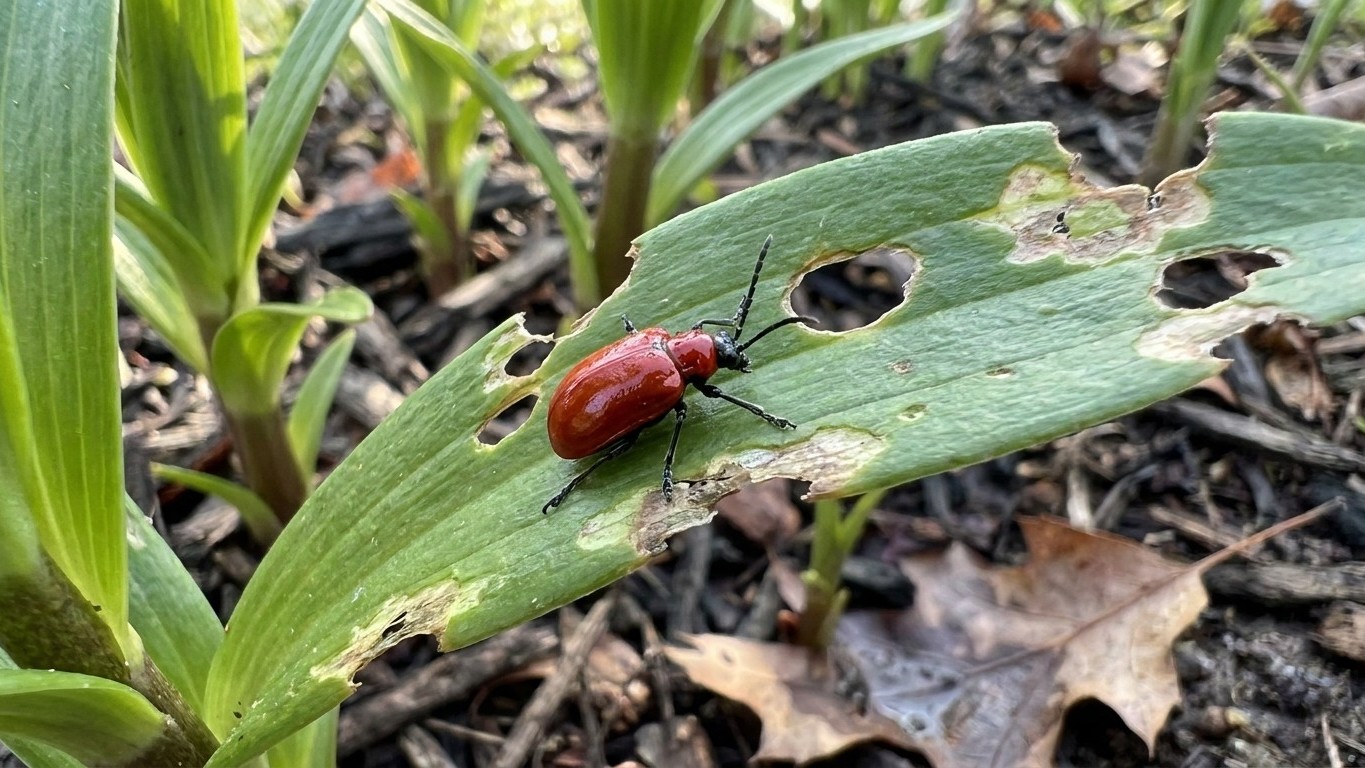

Lily leaf beetle typically appears in Maine gardens in early to mid-May, right when true lily shoots push up two to four inches out of the soil. The bright red adults survive Maine winters buried in leaf litter and soil near where lilies grew the year before, and they start moving as soon as spring temperatures hold steady in the 50s. Once they emerge, both the beetles and the larvae that follow can strip a lily bed bare within weeks if nobody intervenes.
The weeks to watch

This insect isn’t native to North America. It arrived in Montreal in the 1940s, likely on imported lily bulbs, and spent decades creeping south and east. By the early 2000s it had settled firmly into New England, and Maine now sits inside the heart of its established range, alongside New Hampshire, Vermont, Massachusetts, and Connecticut. Cold winters don’t slow it down much. The adults tuck themselves under mulch, in perennial beds, or along the edges of stone walls near lily plantings, and Maine’s snow cover actually insulates them rather than killing them off.
Statewide, gardeners from Aroostook County down to York County report the same pattern: adults appear as soon as lily foliage emerges, feed for a few weeks, then mate and lay eggs. Coastal areas with milder spring temperatures sometimes see activity in late April, while inland and northern counties usually don’t see beetles until closer to mid-May. One generation per year is standard in Maine’s climate. Warmer states father south sometimes get a partial second generation, but Maine’s shorter growing season generally limits the pest to a single life cycle.
Which Plants Are at Risk
True lilies, meaning plants in the genus Lilium, are the primary target. That includes Asiatic lilies, Oriental lilies, tiger lilies, and Turk’s cap lilies, along with fritillaria. Daylilies (Hemerocallis), despite the similar name, are not a preferred host. Occasional light feeding on daylily foliage happens, but it’s minor compared to the damage on true lilies, and beetles rarely reproduce successfully on them. If a Maine garden has both types planted together, the true lilies will almost always take the brunt of the damage.
How to Identify It at Each Stage
Confusing this pest with something harmless is easy at first glance, since Maine gardens host several red or orange beetles. Knowing the specific markers saves time and prevents overreacting to a beneficial insect.
- Adults: About 3/8 inch long, with a shiny scarlet-red body and a black head, legs, and underside. They fly readily when disturbed and often drop to the ground and play dead, landing on their black backs to blend into soil.
- Eggs: Deposited in irregular rows on the undersides of lily leaves, close to the leaf’s midrib. They start out orange-red and darken slightly before hatching, usually within a week to ten days.
- Larvae: Soft-bodied, orange to yellowish grubs that cover themselves in their own dark excrement as a defense against predators. This slimy, olive-black coating is one of the clearest identifiers in the field, since few other garden pests do this.
Larvae do the most damage. They feed voraciously on leaf tissue, flower buds, and even flower petals for three to four weeks before dropping into the soil to pupate. A heavily infested lily can go from healthy to skeletonized stems in under a month, with plants sometimes failing to bloom at all that season.
What Actually Stops It
No single method eliminates lily leaf beetle completely, but combining a few approaches keeps populations low enough that lilies still bloom well.
Hand-Picking and Physical Removal
This remains the most reliable method for small home gardens, especially in early spring before populations build. Adults are easiest to catch first thing in the morning when temperatures are cool and they’re less likely to fly off. A container of soapy water underneath the plant works well: knock the beetle in rather than trying to grab it, since they drop and scatter the instant they sense a hand approaching. Checking leaf undersides weekly starting in early May for egg clusters and scraping them off before they hatch cuts the larval population dramatically. Squishing larvae by hand is unpleasant given their fecal coating, but gloves make it manageable, and it’s far more effective than most gardeners expect.
Biological Control
Researchers at the University of Rhode Island have spent years releasing a parasitic wasp, Tetrastichus setifer, that specifically targets lily leaf beetle larvae. These releases have taken hold in parts of New England, including sites in Maine, and where established, the wasp can noticeably reduce larval survival over several seasons. This isn’t a quick fix. Parasitoid populations take years to build to levels that provide consistent control, and coverage across Maine remains uneven. Gardeners shouldn’t count on wasps alone to solve an active infestation this season, but the long-term trend in areas with established wasp populations has been encouraging.
Row Covers and Timing
Floating row covers placed over lily beds before shoots emerge in early spring can block adults from finding the plants at all. This works best on small plantings where covers can stay on until the main adult emergence window passes, typically through late May in most of Maine. The tradeoff is that pollinators can’t reach the flowers either, so covers need to come off once lilies are ready to bloom, which does open a short window for beetles to move in. Timing the removal for just after peak adult activity, rather than right at bud break, reduces that risk.
Insecticide Options
For gardeners dealing with heavier infestations, a few insecticide categories show real results, though each comes with tradeoffs worth weighing.
Neem oil and insecticidal soap work best against young larvae and require direct contact, meaning thorough coverage on leaf undersides matters more than the product itself. These break down quickly and need reapplication every five to seven days during active feeding periods. Spinosad, derived from a soil bacterium, has shown effectiveness against both adults and larvae and carries a lower risk profile for bees when applied in the evening after pollinators have finished foraging for the day.
Systemic neonicotinoid products, such as those containing imidacloprid, offer longer-lasting control since the plant absorbs the chemical and any beetle that feeds on it gets a dose. The catch is that systemics move into pollen and nectar too, raising real concerns for bees and other pollinators visiting lily flowers. Given how attractive lily blooms are to native bees in Maine, many extension specialists recommend skipping systemics on flowering ornamentals altogether and reserving them, if at all, for situations where blooms are removed before pollinators arrive.
Reducing Problems Next Season
Fall cleanup matters more than most gardeners realize. Since adult beetles overwinter in plant debris and soil right around the base of lilies, clearing away dead foliage and mulch in late autumn removes some of their winter shelter. It won’t eliminate the population, since beetles also hide in surrounding leaf litter and garden edges, but it does reduce the number that survive close to the plants they’ll target come spring.
Crop rotation isn’t practical for perennial lily beds the way it is for vegetables, but spacing plantings farther apart, or interplanting lilies with unrelated perennials, can slow beetles from moving easily from one lily clump to the next. Gardeners in southern Maine who’ve dealt with this pest for over a decade often report that a consistent early-spring hand-picking routine, kept up for just the first three weeks after shoots emerge, prevents the kind of late-season defoliation that ruins bloom displays.
One detail that surprises a lot of first-time lily growers: the adult beetles that show up in May aren’t necessarily the ones that damaged plants last summer. They’re the offspring, having pupated in the soil the previous fall and waited out winter as adults just below the surface. Breaking that cycle even partway, through egg removal or larval control, pays off directly in how many beetles return the following spring.