
Root-knot nematodes show up in Texas soil the moment ground temperatures climb past roughly 64°F, and they stay active straight through the hottest stretch of summer when soil temps sit between 80°F and 90°F. That window covers most of the growing season across the state, from the Rio Grande Valley to the Blackland Prairie, which is exactly why Texas gardeners and row-crop farmers deal with this pest more than almost anywhere else in the country.
Stopping them isn’t about a single spray or one good year of rotation. It’s a combination of soil management, resistant plant varieties, and timing that has to repeat season after season. Skip a step and populations rebound fast.
What Root-Knot Nematodes Actually Do

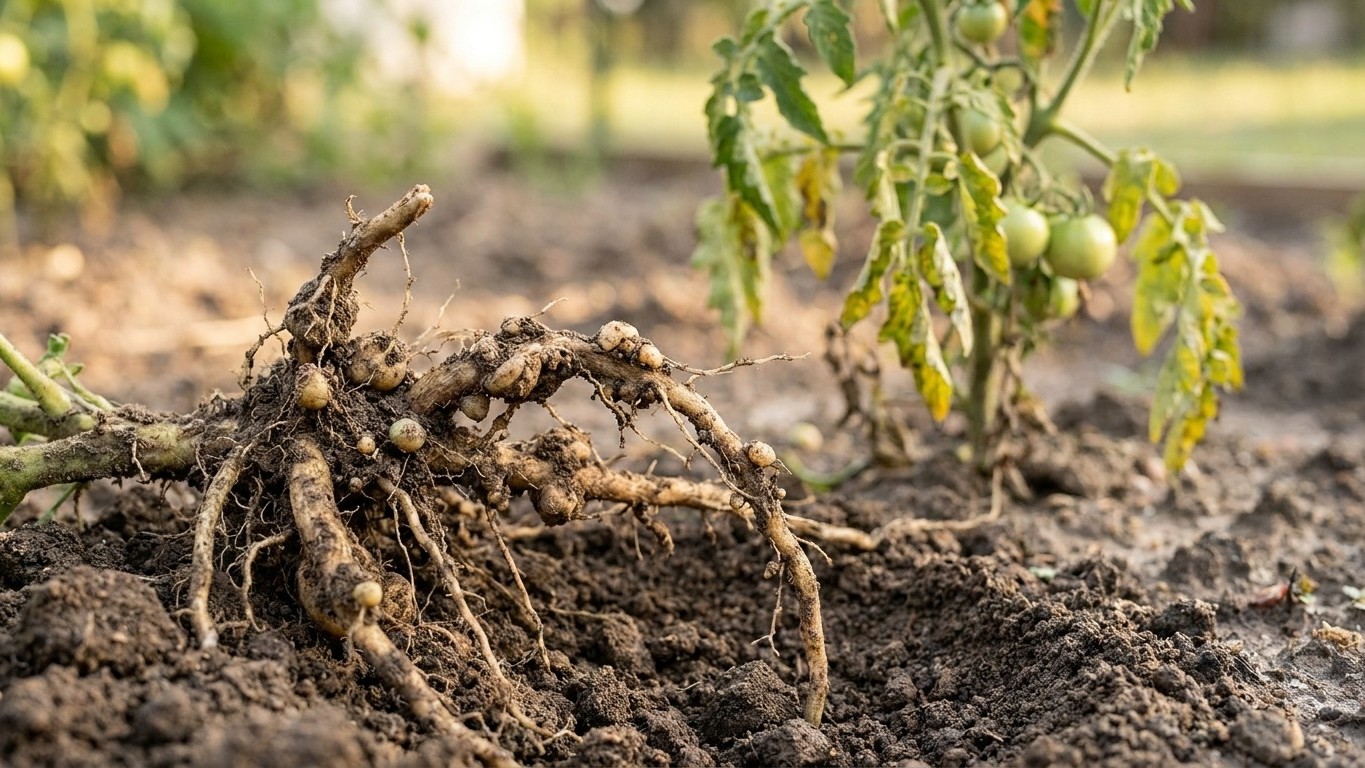
These are microscopic roundworms, not insects, and they live almost their entire life cycle inside plant roots. The species most common in Texas is Meloidogyne incognita, though M. arenaria and M. javanica turn up in warmer coastal counties too. A female nematode burrows into a root, feeds, and triggers the plant to form swollen, knot-like galls around her body. Those galls aren’t cosmetic damage. They physically block the root’s ability to move water and nutrients up into the plant.
Above ground, the symptoms look like nothing specific at all, which is part of the problem. Plants wilt on hot afternoons even when soil moisture seems fine. Growth stalls. Leaves yellow in patches rather than uniformly. A tomato plant might produce a normal-looking top half while the root system underneath is a tangle of swollen knots the size of peas or marbles. Because the symptoms mimic drought stress, nutrient deficiency, and even herbicide injury, a lot of Texas gardeners spend a full season blaming the wrong cause before pulling a plant and finding the galled roots.
Yield loss is the real cost. Texas A&M AgriLife research on cotton, one of the state’s largest row crops, has documented root-knot nematode damage reducing yields by double-digit percentages in heavily infested fields, particularly in the sandy soils of the Rolling Plains and parts of the Coastal Bend. Vegetable growers see similar losses in tomatoes, okra, squash, and sweet potatoes, all of which rank among the nematode’s preferred hosts.
Where and When They Show Up in Texas
Sandy and sandy loam soils are the biggest risk factor, because loose soil particles let the microscopic worms move freely between roots. That puts East Texas, the Rio Grande Valley, and much of the Coastal Plain squarely in the danger zone. Heavy clay soils, common in parts of North Central Texas, slow nematode movement considerably, though they don’t eliminate the risk entirely, especially where compost or sand has been added over the years to improve drainage.
Seasonally, egg hatching accelerates once soil temperatures pass that 64°F mark, which in most of Texas happens sometime in March or early April. Populations build through late spring and peak during the hot months of June through September, when soil temps regularly sit in the optimal 80-90°F range for reproduction. A single female can lay several hundred eggs in one egg mass, and a full life cycle from egg to egg-laying adult can complete in as little as three to four weeks under those warm conditions. That means a light infestation in April can become a serious problem by July, with multiple overlapping generations feeding at once.
Winter doesn’t kill them off in most of the state. Eggs and juveniles survive in soil and plant debris through mild Texas winters, particularly in the southern two-thirds of the state where hard freezes are inconsistent. Only sustained freezing temperatures reaching several inches into the soil profile knock populations down significantly, which is one reason infestations tend to be worse and more persistent in South Texas than in the Panhandle.
Confirming You Have Root-Knot Nematodes, Not Something Else
Galls on roots are the giveaway, but they’re easy to miss because they look a bit like the beneficial nitrogen-fixing nodules found on legume roots such as peas and beans. The difference matters. Nitrogen nodules can be gently rubbed off the root without damaging the root tissue underneath. Nematode galls are fused into the root itself; cutting one open often reveals the swollen female nematode or a mass of tiny eggs inside.
Because visual inspection only tells part of the story, and because populations can be building in soil before any plant symptoms appear, a soil sample sent to a diagnostic lab is the only reliable way to know what you’re dealing with before planting. Texas A&M AgriLife’s plant pathology diagnostic services process nematode soil samples from across the state, and results typically report population counts per unit of soil along with species identification. For anyone planning a vegetable garden or a new orchard block on a property with a history of stunted plants, that test is worth doing before investing in a season’s worth of transplants.
Crops and Plants Most at Risk
Not every plant is equally attractive to root-knot nematodes. Tomatoes, okra, squash, cucumbers, sweet potatoes, carrots, and southern peas rank among the most susceptible in Texas gardens. Cotton, soybeans, and peanuts carry the heaviest commercial impact statewide. On the other end, small grains like wheat and oats, along with corn and sorghum, tolerate or resist most root-knot species reasonably well, which is exactly why they show up in nematode-focused rotation plans.
What Actually Stops Root-Knot Nematodes
No single tactic clears an infested field or garden bed permanently. Effective control in Texas relies on stacking several approaches across multiple seasons.
Resistant varieties are the fastest win for home gardeners. Many modern tomato cultivars carry the “N” gene, marked with an “N” on seed packets and plant tags, which confers resistance to the most common root-knot species. Certain sweet potato and pepper varieties offer similar built-in protection. Choosing resistant stock doesn’t eliminate nematodes from the soil, but it keeps the plant productive despite their presence.
Crop rotation works, but only with the right non-host plants and enough time. Rotating into corn, sorghum, or small grains for at least one full season, ideally two, starves the nematode population down because those crops don’t support reproduction. The mistake a lot of home gardeners make is rotating tomatoes with peppers or okra, thinking they’ve switched crops, when all three are susceptible hosts that let the population keep climbing.
Soil solarization takes advantage of the Texas sun directly. Covering moist, tilled soil with clear plastic sheeting during the hottest weeks of summer, typically June through August, raises soil temperatures high enough to kill a substantial share of nematode eggs and juveniles in the top several inches of soil. It works best on smaller garden beds rather than large acreage, and it needs four to six weeks of uninterrupted sun exposure to be effective.
Organic matter changes the soil environment in ways that work against nematodes over time. Compost and well-rotted manure encourage populations of nematode-trapping fungi and predatory soil organisms that naturally suppress root-knot numbers. It’s a slower fix than plastic or chemicals, usually taking a couple of seasons to show a measurable difference, but it improves soil health broadly in the process.
Certain marigold varieties, specifically French marigolds (Tagetes patula), release compounds from their roots that suppress some root-knot species when grown as a dense cover crop for a full season before the target crop goes in. The effect is real but limited: marigolds need to occupy the bed exclusively, not just be planted alongside vegetables, to make a meaningful dent in nematode populations.
For agricultural operations dealing with heavy infestations in cotton, peanuts, or other row crops, nematicide seed treatments and in-furrow products remain part of the toolkit, applied according to label rates and typically timed at planting. Home gardeners have far fewer chemical options available, which is part of why resistant varieties and rotation carry more weight in residential settings.
Building a Season-by-Season Plan
Testing soil in late winter, before the 64°F threshold hits, gives the clearest baseline reading since populations haven’t started climbing yet. If counts come back high, solarizing through the summer months followed by a fall planting of a resistant or non-host crop sets up a much cleaner spring. Gardeners who’ve fought root-knot nematodes for multiple years in the same raised bed often find that raised beds filled with fresh, nematode-free soil or heavy compost amendments outperform in-ground plots, simply because the barrier and the soil quality both work in their favor.
None of this happens in one season. Root-knot nematode populations that have built up over several years of continuous host cropping, common on properties that have grown tomatoes or okra in the same spot for a decade, need at least two to three years of consistent rotation and resistant varieties before counts drop to a level where damage becomes minor rather than season-defining.