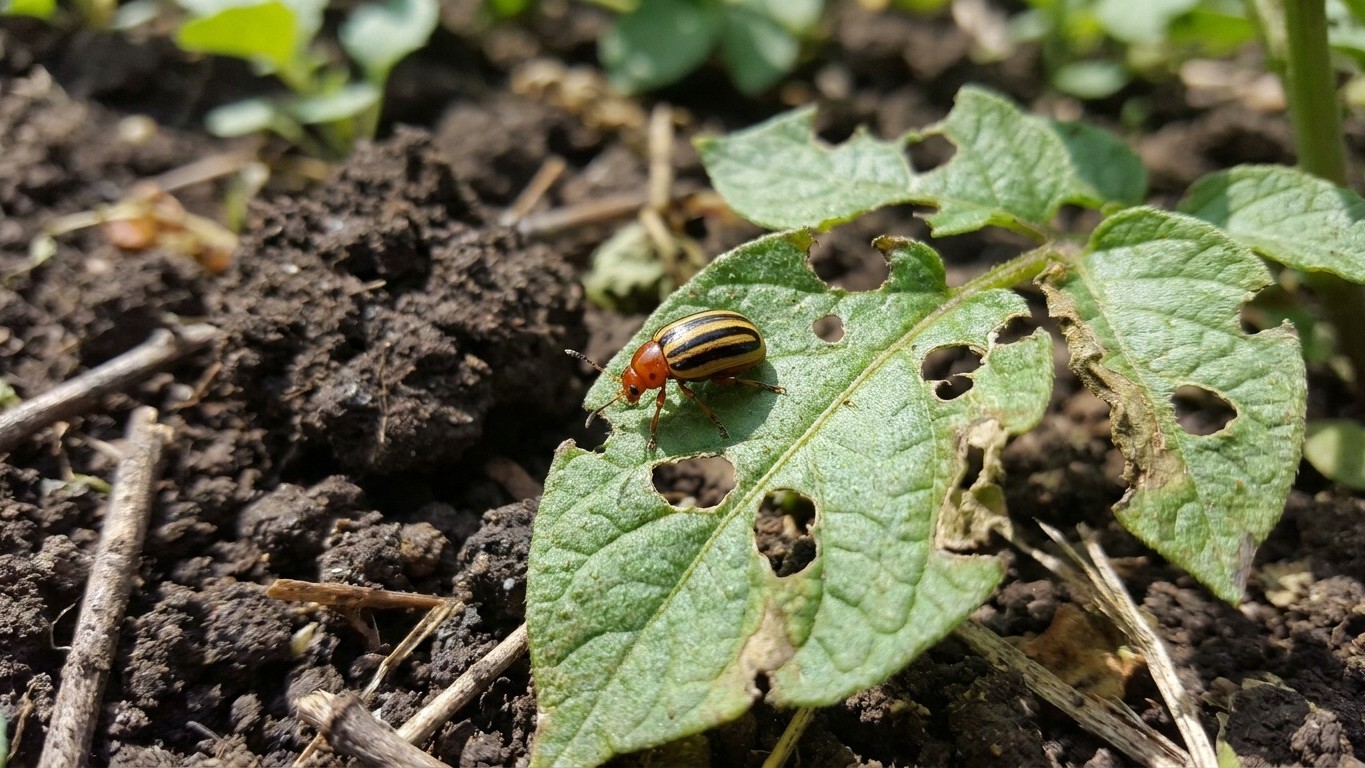

The three-lined potato beetle turns up in Ontario gardens between late May and late June, right around the time soil temperatures climb past 50°F and overwintering adults dig their way out of the ground. If you’re seeing small yellow-orange beetles with black stripes chewing holes in your potato leaves, tomatillos, or groundcherry plants this time of year, that’s almost certainly what you’re dealing with. The good news: it’s rarely as destructive as its more famous cousin, the Colorado potato beetle, and a handful of straightforward habits keep populations from getting out of hand.
When the Beetle Shows Up in Ontario

This insect (scientifically Lema daturaphila, though many older references still call it Lema trilineata) overwinters as an adult, tucked into leaf litter, loose soil, or garden debris. It doesn’t migrate or hitch a ride on wind currents the way some pests do. It simply waits out the winter a few inches underground in the same bed where it fed the previous year.
Once the ground warms in spring, adults crawl out and start looking for food almost immediately. In southern Ontario, that first wave typically appears in the last two weeks of May. Farther north, toward Sudbury or Thunder Bay, expect a delay of two to three weeks as the soil takes longer to reach the threshold that triggers emergence. Females begin laying eggs within days of feeding, so the window between “first sighting” and “first larvae” is short, often under two weeks.
Southern Ontario’s longer, warmer season sometimes allows a partial second generation to develop by August, especially in years with an early spring. Central and northern regions almost always stick to a single generation, with adult activity tapering off by early September as beetles head back underground to overwinter.
Identifying It: Adult, Egg, and Larva Look Nothing Alike
Confusion with other striped beetles is common, so it helps to know exactly what each life stage looks like.
Adults measure about a third of an inch, roughly the size of a watermelon seed. Their wing covers are a warm yellow-orange, marked with three bold black stripes running lengthwise, and the head and legs are solid black. That black head is a useful tell: the Colorado potato beetle, which shares similar coloring, has a tan or orange head instead.
Eggs are laid in tidy rows on the underside of leaves, usually in clusters of five to fifteen, colored bright orange-yellow. Find a row of neatly aligned orange dots on the back of a leaf and you’ve caught the problem before it hatches.
The Larva’s Strange Defense Trick
The larval stage is the part gardeners find genuinely off-putting. The grubs themselves are pale yellow, but they cover their own bodies with a coating of dark, wet fecal matter, essentially wearing their own waste as a shield against predators and sunburn. Under that grimy coating, the larva does most of the actual leaf damage, skeletonizing foliage from the underside outward while remaining camouflaged as a smear of dirt. It’s an effective disguise: plenty of gardeners scrape off what looks like a bit of mud and don’t realize it was alive.
Why It Targets Certain Plants and Not Others
This beetle feeds almost exclusively on plants in the nightshade family, and its preferences explain a lot about where infestations start. Potato and eggplant are common garden targets, but its真正 favorite hosts are wild relatives: horsenettle, jimsonweed (Datura stramonium, which gives the species its name), and groundcherry (Physalis species). Tomatillos, a close relative of groundcherry increasingly grown in home gardens, are also a magnet.
That preference matters for anyone trying to figure out why the beetle keeps returning to the same bed. A patch of horsenettle growing along a fence line or a few volunteer groundcherry plants at the edge of the yard can function as a year-round nursery, letting the population build up on wild hosts before it ever moves to cultivated crops. Removing those reservoir weeds within 50 feet of a vegetable garden is one of the single most effective things a homeowner can do, and it costs nothing but an afternoon of pulling weeds.
Tomato plants are eaten, but they rank lower on the beetle’s preference list than potato, eggplant, or groundcherry. In gardens where several nightshade relatives grow side by side, the beetles will usually concentrate on potato and groundcherry first, leaving tomato foliage comparatively untouched until other options run out.
What Actually Stops It
Unlike aphids or spider mites, this beetle doesn’t reproduce fast enough to overwhelm a garden overnight, which means low-effort, low-chemical strategies usually work.
Hand removal is the first line of defense and, for most backyard-scale plantings, the only step needed. Adults are slow-moving and easy to knock into a jar of soapy water. Checking the undersides of leaves twice a week during the May-to-June emergence window catches egg clusters before they hatch; crushing or scraping off the orange egg rows takes seconds and prevents an entire generation of larvae.
Floating row covers, the lightweight fabric used to protect early-season crops from frost, do double duty by physically blocking adults from reaching young potato and eggplant transplants. They need to go on before the late-May emergence window and come off once plants start flowering, since many nightshade crops need pollinator access at that stage.
Crop rotation helps but has limits, because adults can fly and will search out host plants across a modest distance. Rotating potatoes and eggplant to a bed at least 30 feet from the previous year’s planting site, combined with the reservoir-weed removal mentioned earlier, reduces the odds of a quick reinfestation far more than rotation alone.
Natural predators do a fair amount of unpaid work. Ground beetles, lady beetles, and several parasitic wasp species prey on eggs and larvae, and avoiding broad-spectrum insecticides preserves that free pest control. Birds also pick off adults and larvae from open ground, one more reason to think twice before reaching for a chemical spray on a problem that’s usually cosmetic rather than crop-threatening.
When populations are heavy enough to justify a spray, insecticidal soap and neem oil applied directly to larvae give reasonable knockdown with minimal impact on beneficial insects, as long as they’re applied when bees aren’t actively foraging on the plant. Spinosad-based products, available at most garden centers, offer another option that’s less disruptive to pollinators than synthetic pyrethroids. Bacillus thuringiensis products marketed for caterpillars don’t work here, since this is a beetle, not a moth or butterfly larva, and the standard Bt strains sold for garden use target a completely different insect group.
Diatomaceous earth, dusted around the base of plants and reapplied after rain, adds a mechanical barrier that damages the exoskeleton of crawling adults without introducing any residual chemical to the soil. It works best as a supplement to hand-picking rather than a stand-alone fix, since wind and moisture wear it away within days.
How Much Damage to Actually Expect
Most Ontario gardeners who deal with this beetle describe scattered, ragged holes in leaves rather than total defoliation. On potato and eggplant, established plants generally tolerate moderate feeding without a meaningful yield drop, since the damage tends to concentrate on older, lower leaves rather than new growth. Young transplants and container-grown tomatillos are more vulnerable simply because they have less leaf area to spare.
The exception is a heavy, unmanaged infestation on groundcherry or eggplant in a small backyard bed, where a handful of larvae feeding for two to three weeks can strip enough foliage to stunt the plant. That’s the scenario worth watching for, and it’s exactly why checking leaf undersides every few days during the six-week window after adults emerge pays off more than any single treatment applied later in the season.