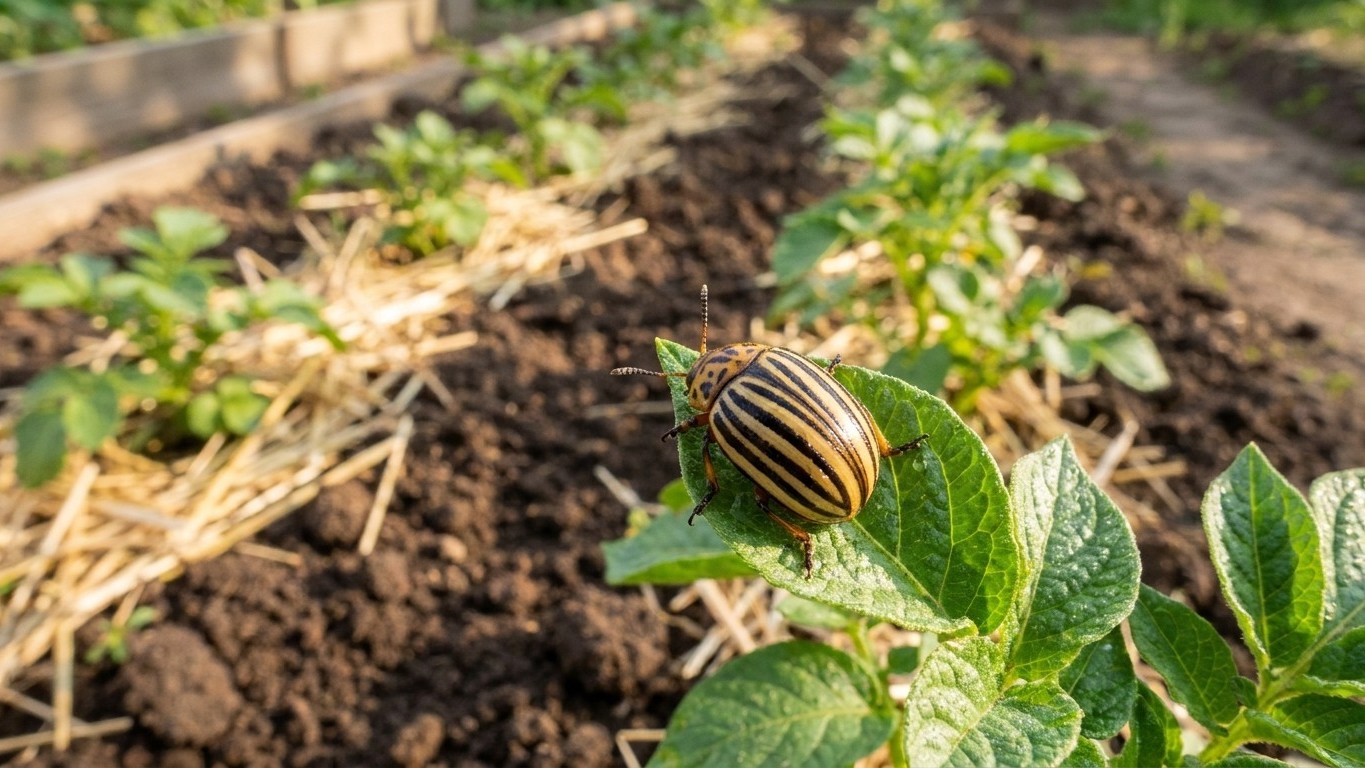

Colorado potato beetles show up in Virginia gardens as soon as soil temperatures climb into the low 50s, which usually lands somewhere between mid-April in the Coastal Plain and late May in the mountains of southwest Virginia. Once they’re active, the fastest way to stop them is a combination of early-season row covers, straw mulch that disrupts their movement from the soil, and rotating nightshade family crops far enough away that overwintered adults can’t find them by scent alone.
When Colorado Potato Beetles Appear in Virginia

These beetles spend winter as adults buried six to eight inches deep in soil, usually right at the edge of last year’s potato patch. They don’t fly much in fall. They walk, then dig in. That’s why the same corner of a garden gets hit year after year if nothing changes about how it’s planted.
Virginia’s climate splits into three rough bands for beetle activity. Along the Coastal Plain and Tidewater region, where soil warms fastest, adults emerge as early as the second or third week of April. In the Piedmont, from Richmond through Charlottesville, emergence typically runs late April into early May. West of the Blue Ridge, in the Shenandoah Valley and the mountains, gardeners usually don’t see the first adults until mid-May, sometimes later in a cold spring.
The trigger isn’t the calendar. It’s soil temperature. Once the top few inches of ground hold steady at 50 degrees Fahrenheit for several days, beetles start digging out. A stretch of unseasonably warm weather in early April can pull them out ahead of schedule, and a late cold snap can push emergence back by two or three weeks even in the same county.
Virginia’s growing season is long enough that the beetle usually completes two full generations, and in warmer years along the coast, a partial third generation can appear by late August. That’s the detail most gardeners miss: the beetles you knock back in May aren’t the only wave coming. Their offspring, hatching from egg clusters laid on the undersides of leaves, become a second larval surge by mid-July, right when many home gardens are already stressed by summer heat.
What They Look Like at Each Stage
Adults are hard to mistake for anything else once you’ve seen one: about three-eighths of an inch long, with a rounded orange-yellow body and five bold black stripes running lengthwise down each wing cover. The larvae look completely different, which trips up a lot of first-time growers. Young larvae are dark red with black heads, growing plumper and turning more orange-pink as they mature, with two rows of black dots along their sides. Egg clusters are bright yellow-orange, laid in tight groups of a dozen or more on the underside of potato, tomato, and eggplant leaves.
What Actually Stops Colorado Potato Beetles in a Virginia Garden
Nothing works as a single fix. Colorado potato beetle is one of the most pesticide-resistant insects in North American agriculture, according to research tracked by land-grant universities across the potato belt, so relying on one spray or one trick tends to fail within a season or two. Layering a few tactics gets much better results.
Crop rotation is the cheapest and most effective long-term move. Because overwintered adults walk to find host plants rather than fly in from a distance, moving nightshade crops (potatoes, tomatoes, eggplant, peppers) at least 200 to 300 feet from last year’s location cuts early infestation dramatically. In a typical suburban lot that’s rarely possible at full distance, but even shifting a raised bed to the opposite side of a quarter-acre yard reduces the beetle’s ability to find plants during that critical first week after emergence.
Straw mulch does double duty. A three to four inch layer around potato plants makes it physically harder for emerging adults to walk to the stems, and it also seems to favor ground beetles and other predators that eat beetle eggs and small larvae. Virginia Cooperative Extension research on Colorado potato beetle management has repeatedly flagged mulching as one of the few cultural practices with measurable impact on early-season populations.
Floating row covers placed over young plants right at emergence, and sealed at the edges with soil, block adults from ever reaching the foliage. The catch: covers need to come off before flowering if the crop requires pollination, which means the window of protection is really just the first three to four weeks. That’s usually enough to get past the first wave of overwintered adults, though.
Hand removal still matters more than most gardeners expect. Checking the undersides of leaves twice a week during May and June, and crushing egg clusters or dropping larvae into a bucket of soapy water, can keep small plantings (anything under a few dozen plants) under control without a single spray. It’s tedious. It also works, especially against the first generation before numbers explode.
Biological and Targeted Chemical Options
Spinosad-based products and Bacillus thuringiensis var. tenebrionis (a strain specific to beetle larvae, different from the more common Bt used against caterpillars) both target young larvae effectively with low impact on bees and other pollinators, as long as they’re applied when larvae are still small. Once larvae reach their final growth stage, they’re much tougher to kill with any product, biological or synthetic.
Neem oil and pyrethrin sprays offer some knockdown on adults and small larvae but break down fast in sunlight and heat, so they need reapplication every five to seven days during an active outbreak. That reapplication schedule is where a lot of home treatment plans fall apart. People spray once, see a few dead beetles, and stop, not realizing the next hatch is already climbing the stems.
Natural predators do help, even if they rarely provide full control on their own. Spined soldier bugs and certain ground beetle species prey on eggs and young larvae, and a fungal pathogen called Beauveria bassiana occurs naturally in some Virginia soils and can suppress populations during humid stretches. Avoiding broad-spectrum insecticide sprays that also kill these predators is part of why an integrated approach outperforms a chemical-only one over multiple seasons.
Why Resistance Makes Timing the Real Strategy
Colorado potato beetle populations in the mid-Atlantic have developed resistance to multiple insecticide classes over the past few decades, a pattern documented across potato-growing regions from Long Island to the Eastern Shore. That history is exactly why Virginia extension guidance leans so heavily on rotating control methods rather than repeating the same spray.
The practical takeaway for a home garden: treat the first-generation larvae hard and early, when they’re small and vulnerable, rather than waiting until adults are visible everywhere. A garden that gets ahead of the May hatch usually has a much lighter second generation to deal with in July, because fewer beetles survive to reproduce. Wait until populations are already large and visible, and every tool, from hand-picking to spinosad, becomes less effective simply because there’s more to kill and less time before damage sets in.
Potato foliage can tolerate some feeding without yield loss, which is worth remembering before reaching for a spray at the first sighting. Research from extension programs generally puts the damage threshold at around 20 to 30 percent defoliation before tuber yield takes a meaningful hit. A few chewed leaf edges in early May usually aren’t worth a chemical response. A stripped plant in July is a different story.
Gardeners growing tomatoes or eggplant alongside potatoes should watch those crops just as closely. Colorado potato beetle isn’t picky within the nightshade family, and a heavily infested potato bed sitting next to tomato plants often means the beetles simply migrate over once the potato foliage thins out. Separating these crops, even by a modest distance, removes one more bridge for the population to survive between generations.
For a broader look at how this pest behaves in home gardens beyond Virginia’s specific climate patterns, the complete Colorado potato beetle guide covers identification details and control methods that apply across regions, while the step-by-step identification guide walks through distinguishing beetle stages from similar-looking garden insects that sometimes get misidentified as the culprit.
Related guides
- Colorado potato beetle in Maryland: When It Shows Up and What Stops It
- Colorado potato beetle in West Virginia: When It Shows Up and What Stops It
- Colorado potato beetle in Washington: When It Shows Up and What Stops It
- Colorado potato beetle in Wisconsin: When It Shows Up and What Stops It
- Colorado potato beetle in Tennessee: When It Shows Up and What Stops It