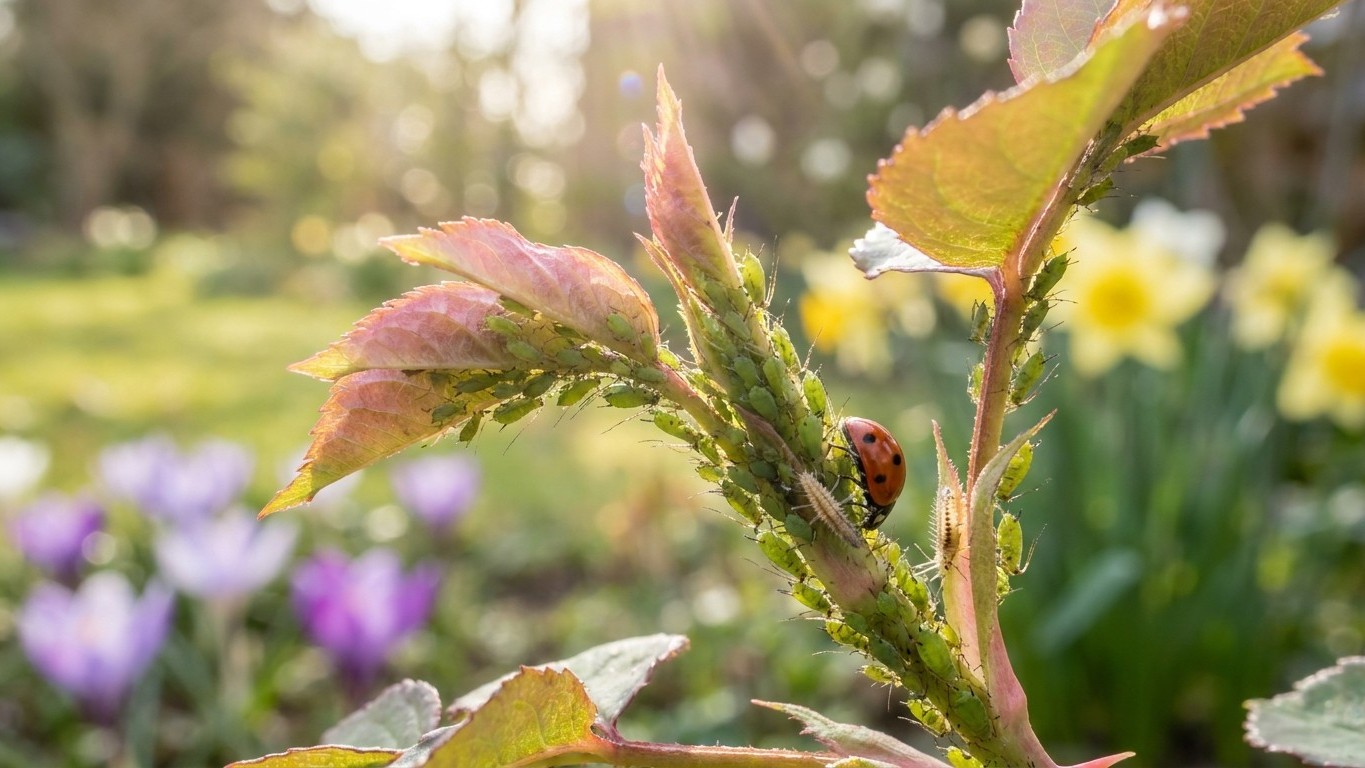

Aphids show up in Ontario as soon as nighttime temperatures hold steady above 50°F, which usually lands somewhere between mid-April in the Windsor-Essex region and late May up around Sudbury and North Bay. They stick around clear into October in a mild fall. What actually stops them isn’t a single spray, it’s a combination: knocking down the first wave before it multiplies, keeping natural predators around, and interrupting the ant partnerships that protect aphid colonies from getting eaten.
When Aphids Arrive in Ontario Each Year

Ontario’s aphid season tracks growing degree days, not the calendar. Southern counties near Lake Erie and the Niagara Peninsula warm up first, so aphids on roses, viburnum, and early vegetable transplants can appear by the last week of April. Central Ontario, including the Greater Toronto Area and the Kawarthas, typically sees the first colonies form in early to mid-May, right around when apple trees finish blooming. Farther north toward Sault Ste. Marie or Timmins, the season compresses into June through September because the frost-free window is shorter.
Two population spikes matter most for homeowners. The first hits new growth on shrubs and perennials in late spring, when soft green shoots are exactly the tender tissue aphids prefer. The second, often the bigger one, arrives in late summer as winged females migrate between summer host plants and the woody plants where eggs overwinter. That fall flight is why people notice sticky honeydew on cars and patio furniture parked under maples and lindens in September, sometimes well into early October if the weather stays warm.
Why Rain and Wind Change the Timeline
A wet spring slows aphids down more than a cold one. Heavy, repeated rainfall physically knocks nymphs off leaves and disrupts the light drizzle of honeydew that ants use to find and defend colonies. Drought does the opposite. Stressed plants pull nitrogen into their tissue in a way that makes sap more attractive to aphids, so a dry June in southwestern Ontario tends to produce heavier infestations by July than a normal-rainfall year.
Which Aphid Species Turn Up Most in Ontario
Not every aphid behaves the same way, and Ontario hosts several species with different habits and different plant targets.
- Green peach aphid – the most common species on vegetable gardens and greenhouse crops, active from early spring through fall, and a known vector for several plant viruses in potatoes and peppers.
- Soybean aphid – an agricultural pest that arrived in North America in the early 2000s and now cycles between buckthorn (its winter host) and soybean fields across southwestern and eastern Ontario each summer.
- Potato aphid – larger and pinkish-green, common on tomatoes and potatoes, tends to show up a bit later in the season than green peach aphid.
- Woolly aphid – covers itself in a white, cottony wax and clusters on apple, elm, and beech bark, more of a cosmetic nuisance than a serious threat on established trees.
- Rose aphid – reliably the first visible aphid of the year on backyard rose bushes, forming dense clusters on new buds by early May in southern Ontario.
The soybean aphid case is worth a second look because it shows how one insect’s arrival reshaped pest management across the province. Before 2000, soybean aphid wasn’t even on the radar in Ontario. Within a few years it became one of the top yield-reducing pests in the province’s soybean acreage, according to research tracked by the Ontario Ministry of Agriculture, Food and Rural Affairs, which now issues seasonal monitoring updates so growers know when populations cross the threshold that justifies treatment.
What Actually Stops Aphids
Chemical sprays get the attention, but they’re rarely the most effective tool on their own, and overusing broad-spectrum insecticides tends to backfire by killing off the predators that would otherwise keep aphids in check.
Natural Predators Do Most of the Work
Lady beetle larvae are the workhorses of aphid control in Ontario gardens. A single larva can eat several hundred aphids before it pupates, and a healthy population usually catches up with an aphid outbreak within two to three weeks if left undisturbed. Lacewing larvae, hoverfly larvae, and parasitic wasps round out the natural defense. The parasitic wasps are especially efficient: they lay an egg inside a live aphid, and the aphid’s body turns into a hardened, papery “mummy” as the wasp larva develops inside it. Finding these brown, swollen aphid shells on a leaf is actually good news, since it means the population is already collapsing on its own.
Ants complicate this picture. Several ant species farm aphids for their honeydew and actively fight off lady beetles and lacewings to protect their food source. Breaking that relationship, often just by wrapping a sticky barrier band around a tree trunk to block ant traffic, lets predators back in and speeds up natural control considerably.
Cultural and Mechanical Controls
A strong jet of water from a garden hose, aimed at the undersides of leaves, physically removes aphids and most don’t climb back up. Doing this every two or three days during the first week of an infestation often prevents the population from establishing at all. Pruning out heavily colonized shoot tips and disposing of them (not composting them nearby) removes a big chunk of the population in one pass, especially useful on roses and hibiscus where new growth attracts the heaviest clusters.
Overfertilizing with nitrogen is a common, avoidable mistake. Lush, fast-growing foliage is exactly what aphids seek out, so backing off high-nitrogen fertilizer on ornamentals during peak aphid months reduces the food supply that fuels rapid reproduction. Aphids can produce a new generation in as little as seven to ten days under warm conditions, so a plant that keeps pushing soft new growth all summer stays vulnerable longer.
When Treatment Makes Sense
Insecticidal soap and horticultural oil work by disrupting the aphid’s outer coating on contact, and they break down quickly without leaving lasting residue that harms bees or predatory insects, provided they’re applied in early morning or evening when pollinators aren’t active. These products only work on direct contact, so thorough coverage of leaf undersides matters more than the product choice itself.
Systemic insecticides move through plant tissue and kill aphids as they feed, which makes them effective on heavy infestations that soap sprays can’t fully reach. They’re also the least selective option, and repeated use on flowering plants raises real concerns for pollinator health. Reserving them for severe cases, rather than routine prevention, keeps the beneficial insect population intact for the following season.
Preventing Aphids From Coming Back
Companion planting shifts the odds before a colony ever forms. Nasturtiums, calendula, and dill draw aphids away from vegetable crops and double as a magnet for hoverflies and parasitic wasps. Planting yarrow, fennel, or sweet alyssum nearby gives those beneficial insects a nectar source to stick around even when aphid numbers are low.
Weekly inspection during the two peak windows, late spring and late summer, catches colonies while they’re still small enough to manage by hand. Checking the undersides of new leaves and the tips of soft stems takes less than five minutes per plant and is the single most reliable way to avoid a full-blown outbreak. Waiting until honeydew and sooty mold appear on nearby surfaces means the colony has already been established for a while.
For fruit trees and larger woody plants, a dormant oil application in early spring, before buds break, smothers overwintering aphid eggs and reduces the size of the first spring generation. This timing matters in Ontario specifically because the eggs of species like woolly apple aphid and rose aphid survive the winter on bark and twigs, hatching right as temperatures cross that 50°F threshold that kicks off the whole cycle again.
Related guides
- Aphids in Oregon: When It Shows Up and What Stops It
- Aphids in Pennsylvania: When It Shows Up and What Stops It
- Cabbage maggot in Ontario
- Emerald ash borer in Ontario
- Spotted wing drosophila in Ontario
- Aphids in Idaho: When It Shows Up and What Stops It
- Aphids in Alaska: When It Shows Up and What Stops It