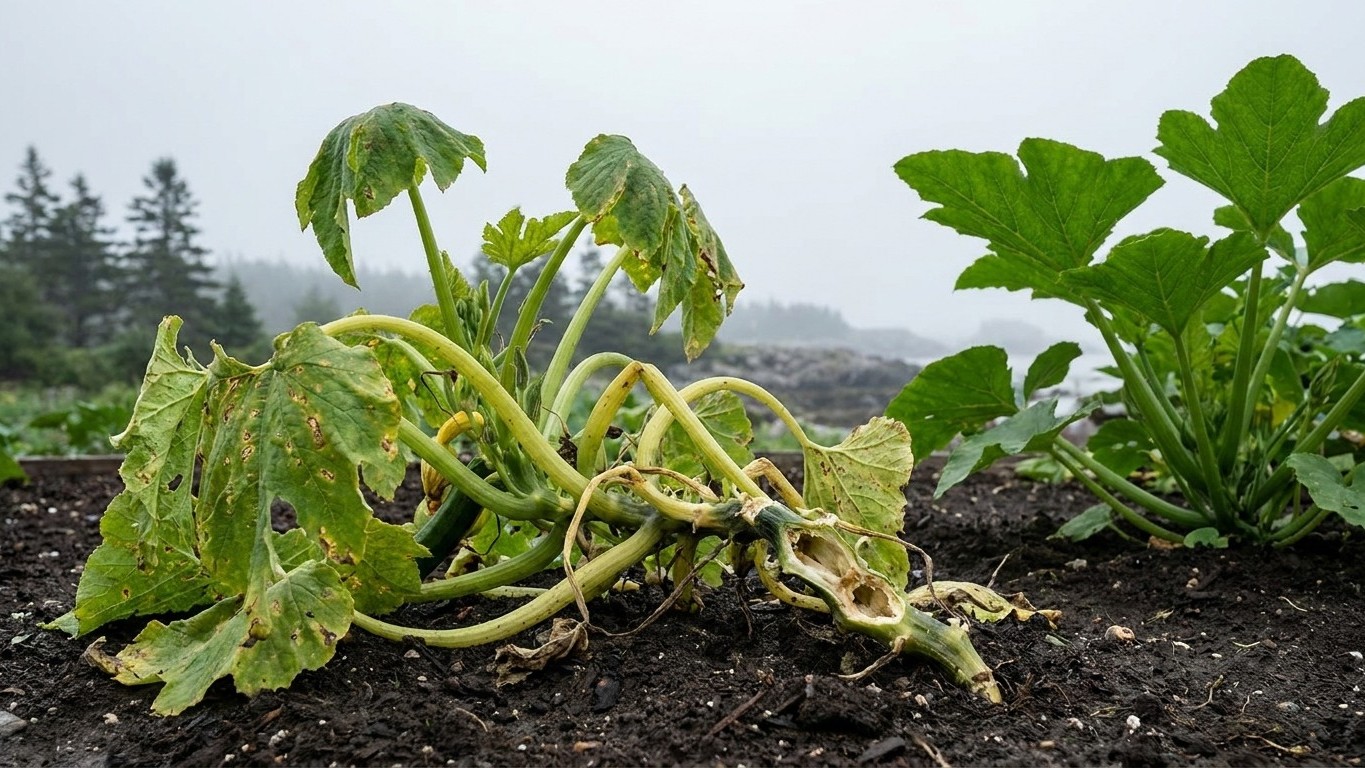

Short answer: the squash vine borer almost never establishes itself in Newfoundland and Labrador. The province’s cool, short growing season doesn’t give this moth the heat units it needs to complete a life cycle, and confirmed outbreaks on the island or in Labrador are exceptionally rare. If your zucchini or pumpkin vines are wilting suddenly in July or August, something else is far more likely to blame, and it’s worth knowing what that something else usually is before you spray for a pest that probably isn’t there.
Is the squash vine borer actually present in Newfoundland and Labrador?

Squash vine borer (Melittia cucurbitae) is a native North American moth whose range historically runs from the eastern seaboard west to the Rockies, thriving where summers are long and warm. It’s a routine headache for gardeners in southern Ontario, Quebec’s St. Lawrence lowlands, and most of the northeastern United States. Newfoundland and Labrador sits well outside that comfort zone. Average summer temperatures on the Avalon Peninsula rarely climb into the range this insect needs for sustained activity, and the growing season across most of the province runs three to four weeks shorter than in the Maritimes.
Provincial and university extension pest surveys for Atlantic Canada consistently list squash vine borer as a minor or absent concern for Newfoundland, compared with steady pressure in Nova Scotia and parts of New Brunswick. That doesn’t mean zero risk forever. It means the odds are low enough that vine collapse in an NL garden should trigger a checklist of other suspects first, not an automatic borer diagnosis.
Why the climate keeps this pest out
The moth needs a specific number of warm days to move from egg to larva to the stage that overwinters in soil. In regions with two generations a year, like much of the mid-Atlantic states, damage stacks up fast because a second wave of larvae attacks vines already weakened by the first. Newfoundland rarely accumulates enough degree days for even one full generation to reliably survive winter in the soil. Cold, wet spring soil also slows or kills overwintering pupae before adults emerge, which is a second layer of natural suppression the province gets for free, courtesy of its maritime climate.
Labrador’s climate is even less hospitable. Shorter frost-free windows and colder soil temperatures make the interior essentially a non-starter for this species. Coastal fog and wind on the Avalon and Bonavista peninsulas add another barrier, since the adult moth is a strong flier but still needs calm, warm afternoons to mate and lay eggs efficiently.
What’s actually killing your squash vines in NL
When a vine wilts fast, gardeners jump to squash vine borer because it’s the internet’s favorite squash villain. In Newfoundland, four other causes are statistically more likely, and each looks similar enough at first glance to cause confusion.
- Bacterial wilt, spread by cucumber beetles, which are present in parts of the province and cause the same sudden, whole-vine collapse people associate with borer damage.
- Squash bugs, whose feeding causes leaves to yellow, dry, and die back from the edges before the whole plant weakens.
- Slug damage at the base of stems, especially common in the province’s damp summers, which can girdle young transplants and mimic stem tunneling.
- Cold-stress dieback after a chilly, wet stretch, which stunts growth and can cause partial vine death that gardeners mistake for pest injury.
Slugs deserve special mention because Newfoundland’s high humidity and frequent overcast days create ideal slug conditions almost every summer. A hollowed-out stem base with slime trails nearby is a slug problem, not a borer problem, and the fix (diatomaceous earth barriers, beer traps, hand removal at dusk) is completely different from anything used against a boring insect.
How to actually confirm squash vine borer if you suspect it
If you’ve ruled out slugs, cucumber beetles, and cold stress, and you still suspect the borer, three signs confirm it rather than guess at it. First, look for a small pile of sawdust-like frass pushed out of a hole near the base of the stem, usually within the first foot above soil level. Second, split the stem carefully at that spot; a genuine infestation reveals a cream-colored larva, up to an inch long, tunneling through the pith. Third, check for the adult moth itself in late June or July: it’s unusually showy for a moth, with an orange abdomen and clear-and-black wings, often mistaken for a wasp when it’s active during daylight hours.
Confirming the larva inside the stem is the only way to be certain, since frass alone can sometimes be produced by other stem-boring insects that occasionally show up in cooler regions. Gardeners who skip this step and spray broad insecticides on the assumption of borer damage often end up killing pollinators for nothing, since squash flowers depend heavily on bees for fruit set.
If it does show up: prevention that works anywhere
Because a warming trend could eventually extend this pest’s range northward, and because transplants or soil brought in from infested regions can occasionally carry eggs or pupae, it makes sense for NL gardeners to build in cheap prevention rather than assume permanent immunity.
Floating row covers over young squash plants block adult moths from laying eggs at the stem base, the single most effective non-chemical tactic anywhere this insect is a concern. Covers need to come off once flowers open, though, so bees can reach the blossoms; timing that removal for early morning, right when the first female flowers appear, keeps both protection and pollination intact.
Wrapping the lower 6 to 8 inches of stem in foil or a nylon stocking at transplant time creates a physical barrier the moth’s ovipositor can’t penetrate, a trick borrowed from gardeners in Ontario and the northeastern U.S. who deal with heavier pressure every season. Crop rotation matters less here than in warmer zones, since NL rarely has enough overwintering pupae to build up soil populations, but it’s still good general practice against the bacterial and fungal issues that are far more common locally.
Gardeners who bring in transplants from garden centers supplying stock grown in warmer provinces should give plants a quick visual check at the stem base before planting. It’s a thirty-second habit that catches the rare imported problem before it ever reaches the soil.
The bigger picture for NL vegetable gardens
Newfoundland and Labrador’s real squash-growing challenges have almost nothing to do with borers. Short seasons mean many gardeners start zucchini and pumpkin indoors under lights in April, transplanting only after the last frost risk passes, often not until early June on the Avalon and later in Labrador. Cool nights slow fruit set even when the plants look healthy, and blossom drop from inadequate pollination is a far more common source of frustration than any insect.
Choosing shorter-season squash varieties bred for 55 to 70 days to maturity, rather than 90-day southern varieties, does more for a successful harvest than any pest treatment. Black plastic mulch to warm soil, and siting plants against a south-facing wall or fence for extra heat retention, address the province’s actual limiting factor: not bugs, but degree days.
For gardeners who’ve gardened in warmer provinces before moving to Newfoundland, the mental shift is usually the hardest part. Habits built around fighting squash vine borer every July don’t transfer well to a climate where the bigger enemy is a cold, foggy August that never quite lets the fruit finish sizing up.
Related guides
- Squash vine borer in Quebec: When It Shows Up and What Stops It
- Squash vine borer in New Hampshire: When It Shows Up and What Stops It
- Squash vine borer in New York: When It Shows Up and What Stops It
- Squash vine borer in Prince Edward Island: When It Shows Up and What Stops It
- Squash vine borer in Delaware: When It Shows Up and What Stops It