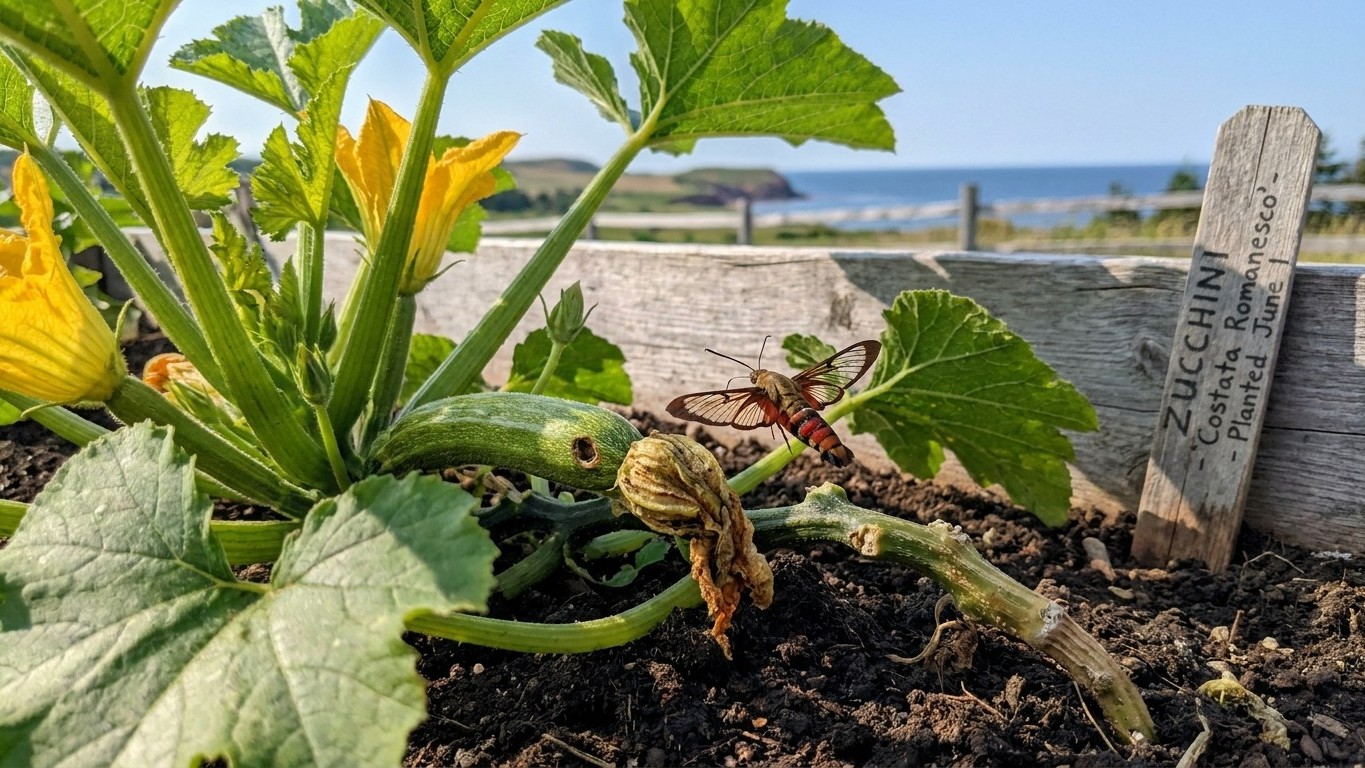

If you’re gardening in Prince Edward Island, the squash vine borer is a real threat, but a delayed and inconsistent one compared to warmer parts of North America. The moth needs sustained soil warmth to pupate and emerge, and PEI’s maritime climate slows that clock down. Expect activity, if it happens at all, from mid-July into August rather than the June emergence common in the mid-Atlantic states, and expect it to hit hardest in sheltered, sun-baked garden beds rather than open, wind-exposed plots near the coast.
Does This Pest Actually Live on Prince Edward Island?

Squash vine borer (Melittia cucurbitae) is native to North America east of the Rocky Mountains, and its range extends north into southern Canada, including parts of the Maritimes. It’s not a phantom threat invented for garden-supply marketing. But PEI sits mostly in Canadian Plant Hardiness Zones 4b to 5b, and the surrounding water moderates temperatures in both directions, which means soil warms more slowly in spring than it does even a few hundred miles south in New England.
That matters because the borer overwinters as a mature larva or pupa in a cocoon just an inch or two below the soil surface. Adults need consistent warm soil temperatures, generally in the range of 60°F and climbing, to complete pupation and emerge as moths. On PEI, that threshold gets reached later and less reliably than in Ontario’s Niagara region or the U.S. Corn Belt, where this insect is a headline pest. The practical result: island gardeners see pressure, but it’s patchy, tends to show up later in the season, and some years pass with barely a trace.
Home gardeners who’ve grown squash for years without issue shouldn’t assume immunity forever. Warmer-than-average summers, increasingly common across Atlantic Canada, shift emergence earlier and can produce heavier populations. A single mild June followed by a hot July is enough to change the math for an entire growing season.
What the Moth and Larva Actually Look Like
This is one of the few garden moths that flies during the day, which throws people off since most moth damage gets blamed on nighttime visitors. The adult is about 1 to 1.5 inches long, with metallic olive-brown forewings and bright orange hindwings marked with black spots. Its hind legs carry fringes of orange and black scales that make it look, at a glance, like a wasp rather than a moth. That mimicry is deliberate camouflage against predators, and it also means gardeners often dismiss the adult as a beneficial insect when they spot it hovering near the base of squash plants.
The larva is the actual damage-doer, and you rarely see it until it’s too late. It’s a cream-white grub with a brown head, growing up to an inch long as it tunnels through stem tissue. The telltale sign isn’t the insect itself but what it leaves behind: a small entry hole near the base of the stem, oozing a wet, greenish-yellow frass that looks like coarse, damp sawdust. If you see that material collecting at the soil line around a squash or pumpkin plant, the larva is already inside feeding.
Squash Bug and Cucumber Beetle Look Similar Enough to Confuse People
Squash bugs and striped cucumber beetles also attack cucurbits on PEI, and both are more consistently present than the vine borer. Squash bugs cause wilting through sap-sucking rather than stem tunneling, and their damage spreads leaf-by-leaf rather than collapsing an entire vine overnight. Cucumber beetles chew visible holes in leaves and can transmit bacterial wilt. Neither produces the frass pile at the stem base that marks a borer infestation, so that single visual cue is the most reliable way to tell them apart in the field.
A Realistic Timeline for PEI Gardens
Squash planted outdoors on PEI typically goes in after the last frost risk passes, usually late May through early June depending on the specific microclimate. Vine borer moths, if present locally, tend to emerge weeks after soil has consistently warmed, which on the island often lands somewhere between the first and third week of July. Egg-laying follows shortly after emergence, with females depositing small brown eggs individually at the base of stems and on leaf stalks near the soil.
Larvae hatch roughly one to two weeks after eggs are laid and immediately begin boring into the stem, where they feed for four to six weeks before dropping into the soil to overwinter. That feeding window, mid-to-late July through early September on a PEI timeline, overlaps almost exactly with the period when squash plants are setting and sizing their main fruit crop. A vine that collapses in mid-August after weeks of healthy growth is the classic signature, and it’s frustrating precisely because it happens right when the harvest looked promising.
Only one generation per year is typical this far north. Warmer regions of the continental U.S. can see two generations, but PEI’s shortened heat season generally doesn’t allow enough time for a second cycle to mature before fall temperatures shut things down.
Signs of an Infestation Before the Vine Collapses
Sudden, dramatic wilting of a single vine, while neighboring plants stay green and turgid, is the biggest red flag. Squash vine borer damage rarely affects an entire bed evenly; it targets individual stems, one plant collapsing while the one eighteen inches away looks fine. Splitting open a wilted stem near the base, something worth doing on any plant showing unexplained wilt during July or August, will usually reveal the tunnel and, often, the larva itself.
Frass at the stem base is the earliest external clue, appearing before the plant shows any wilting stress. Checking the base of each squash and pumpkin plant weekly starting in mid-July, looking specifically for that greenish sawdust-like residue, catches the problem while there’s still time to act. Waiting for wilting to appear means the stem’s internal water-carrying tissue is already compromised, and recovery odds drop sharply.
What Actually Stops It
Prevention works better than treatment once larvae are established inside the stem, because insecticides can’t reach a borer that’s already tunneled in. The most effective approach on PEI combines timing, physical barriers, and variety selection rather than relying on any single tactic.
- Floating row covers placed over young plants at transplant and kept sealed at the edges block egg-laying females entirely, but must come off once flowers open so pollinators can reach the blossoms.
- Staggered or delayed planting, pushing a second squash sowing to late June, can dodge the peak egg-laying window since younger, smaller-stemmed plants are less attractive to females than mature vines.
- Resistant varieties in the Cucurbita moschata group, including butternut and some cushaw types, have thicker, more solid stems that borers struggle to penetrate compared to zucchini and pumpkin varieties in C. pepo.
- Stem mounding, burying a few inches of vine at several leaf nodes as the plant spreads, encourages secondary root formation so the plant can survive damage at the original stem base.
- Manual extraction with a sharp, sterilized blade, slitting the stem lengthwise at the frass site to remove the larva by hand, works if caught early and the wound is then covered with moist soil.
Sanitation matters as much as any active defense. Because larvae and pupae overwinter in the top couple inches of soil right where the previous year’s squash grew, tilling that soil in fall or removing and destroying old vines rather than composting them on-site cuts down the population available to emerge the following July. Rotating squash to a different bed each year, even a modest 10 to 15 foot shift, reduces the odds that overwintering borers land next to a fresh host plant come spring.
Biological controls have a place too, though they demand more attention. Beneficial nematodes applied to the soil around the stem base in early summer can attack larvae before they tunnel deep enough to be out of reach, and injecting a Bacillus thuringiensis (Bt) solution directly into the stem near suspected entry points, using a syringe, has shown some success for home gardeners willing to check plants closely on a weekly schedule through July and August.
One detail that trips up a lot of gardeners: winter squash and pumpkins left on the vine into September, well past when borer larvae have already dropped into the soil for the winter, can still show old frass and dead tunnels near the base even though no active threat remains. Not every mark on a squash stem in late season means an ongoing infestation, and pulling a plant early over old damage sometimes costs a gardener fruit that was otherwise ready to finish ripening.
Related guides
- Squash vine borer in New Brunswick: When It Shows Up and What Stops It
- Squash vine borer in Nova Scotia: When It Shows Up and What Stops It
- Squash vine borer in Quebec: When It Shows Up and What Stops It
- Squash vine borer in South Carolina: When It Shows Up and What Stops It
- Squash vine borer in Louisiana: When It Shows Up and What Stops It