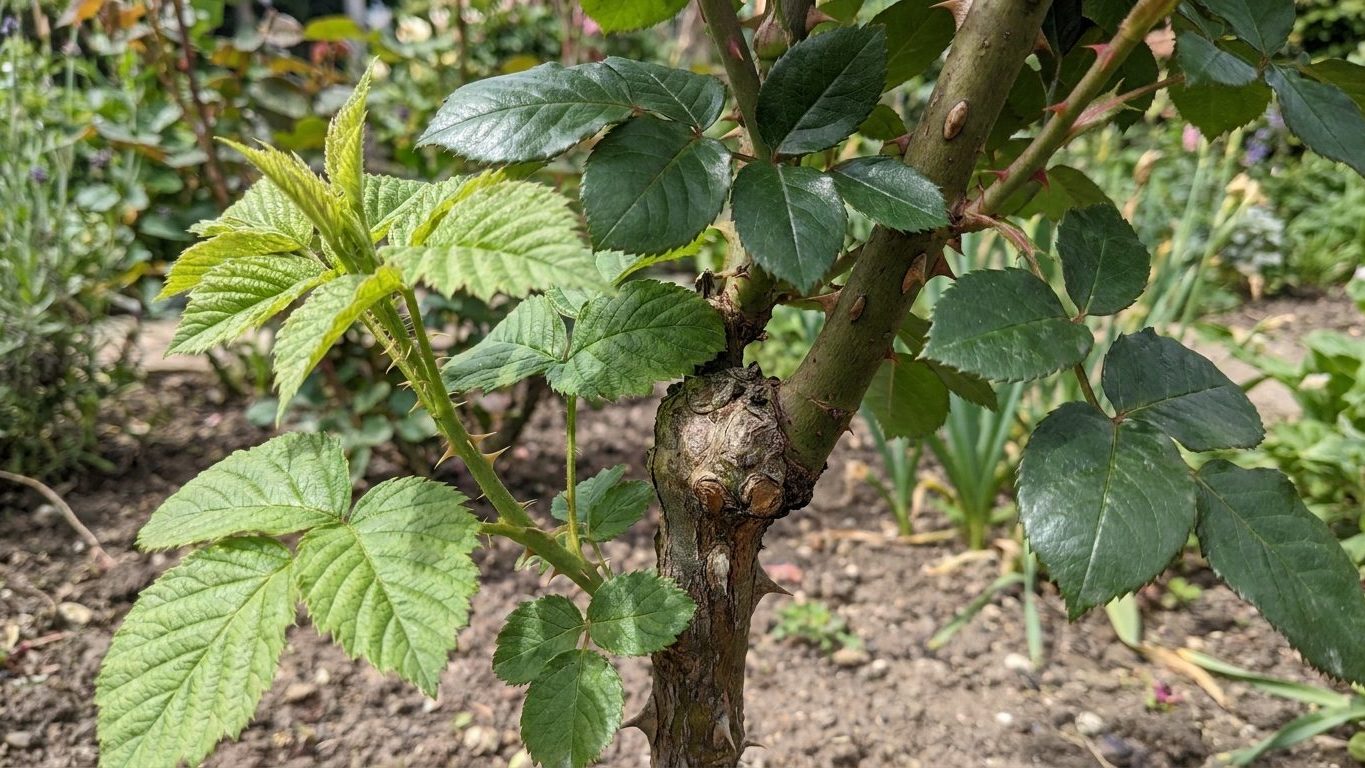

A rose sucker grows from below the graft union, not from the grafted variety itself, and it usually shows leaves, color, or prickle pattern that don’t match the rest of the plant. Once you spot the mismatch, the fix is simple: trace the shoot down to where it leaves the rootstock, and tear it away rather than cut it at the soil line.
Why this matters
A budded rose is really two plants joined at one point: the rootstock below, chosen for vigor and disease tolerance, and the named variety grafted on top, chosen for its flowers. A sucker is the rootstock trying to grow its own top. Left alone, it draws water and nutrients away from the grafted variety, and because rootstock wood is almost always more vigorous than the cultivar budded onto it, the sucker tends to win that competition over time.
Skip removal for a season or two and the visible effect is a rose that looks less full where the named variety should be, with a coarser, often paler-flowered cane taking over one side of the plant. In the worst case, the original variety dies back and the gardener is left tending the rootstock rose, whatever species that happens to be, with none of the traits that made the purchase worthwhile in the first place. This only applies to budded plants. Own-root roses, which include most of the landscape shrub roses sold today, have no union and cannot produce a sucker at all, so if you’re not sure which kind you’re growing, check the plant tag before you start hunting for a problem that may not exist.
When to do it
There’s no calendar date for this task, because a sucker can appear any time the plant is in active growth, and that window shifts with your zone. What matters is watching the plant, not the month. Roses grow in USDA zones 5a through 11b, so a gardener in a warm coastal zone may see suckers emerge months before someone gardening in a colder inland zone even sees new growth start.
The tell is always structural, not seasonal. Look for a shoot rising from below the swollen knob or bend near the base of the plant, the graft union, or coming directly from a root a few inches out from the crown. Compare its leaves to the rest of the bush: different leaflet count, different color, or noticeably different prickle density are all signs you’re looking at rootstock growth rather than a new cane of the variety you bought. If the shoot is close in appearance to the rest of the plant and you’re genuinely unsure, letting it grow long enough to produce a flower or two will settle the question, since rootstock roses almost always bloom differently, if they bloom showy flowers at all, from the grafted variety. Once confirmed, remove it promptly. The longer a sucker stays attached, the more root system it builds for itself at the rootstock’s expense.
For gardeners who prune on a fixed yearly schedule, note that sucker removal is a separate task from the late-winter pruning most roses need. Suckers get removed on sight, whenever you find them, not saved for a single annual session. For the actual pruning calendar for your area, your state page covers the timing specifics that depend on your zone.
How to do it
Start by putting on a pair of thick garden gloves. Roses carry prickles, not true thorns, growing from the outer skin of the stem rather than as woody structures, but they still tear skin easily on both the sucker and the rest of the plant while you work near the base.
Trace the shoot to its actual point of origin before you touch a blade to it. If the sucker emerges above the soil line but below the graft union, that point is usually visible as a slight swelling or bend in the main stem. If it comes from underground, brush soil away from the crown with a hand trowel or your gloved fingers until you can see exactly where the sucker connects to a root, which may be several inches from the plant’s main stem.
Once you’ve found the origin, the method matters more than most gardeners expect. Grip the sucker as close to its base as you can and pull it away with a firm, steady tearing motion rather than cutting it flush with pruners. Tearing removes the dormant buds clustered at the point of attachment, the same buds a clean pruning cut leaves behind intact. Those buds are exactly why cut suckers regrow, often as a cluster of two or three new shoots instead of one. A hand fork can help you expose an underground sucker enough to get a proper grip without disturbing the rest of the root zone.
If a sucker is too thick or too awkwardly placed to tear safely without damaging nearby roots, cutting is the fallback, not the first choice. Use bypass pruners, cut as close to the point of origin as you can reach, and expect to have to repeat the job on that spot at least once more that growing season.
Done correctly, the area where the sucker attached should look torn and slightly rough, not sliced clean, and there should be no visible stub left standing. Backfill any soil you moved to expose an underground sucker, and check that spot again over the following weeks, since a partially removed root fragment can send up a second attempt.
What goes wrong
The most common failure is cutting the sucker off at the soil line instead of tearing it from its point of origin. It looks tidy immediately afterward, but the dormant buds left behind under the bark usually respond by pushing out two or three new shoots where there was one, turning a single sucker into a small thicket over the following months.
A second mistake is misreading a basal break as a sucker and removing it. Vigorous new canes from the crown of a healthy grafted rose can look dramatic and unfamiliar, but if the shoot originates at or above the graft union, it belongs to the named variety, not the rootstock, and cutting it away removes future flowering wood for no reason. Check the point of origin every time, not just the appearance of the leaves.
The mistake that looks like extra care but isn’t: sealing the wound left by a torn or cut sucker with pruning paint or a similar product. It doesn’t stop regrowth, and it doesn’t prevent disease entry any better than leaving the wound open to callus naturally, which is how these plants heal on their own. Time spent sealing sucker wounds is time better spent checking the rest of the plant for the diseases actually documented on roses, among them powdery mildew, black spot, botrytis, and anthracnose, all of which show up as leaf and stem symptoms worth catching early.
Doing it differently
Container-grown roses make sucker removal easier in one specific way: the graft union usually sits close to the surface and stays visible without much digging, so a quick look every few weeks catches new growth early. In-ground plants, especially those mulched heavily for winter protection, hide the union and the surrounding soil, which is exactly why underground suckers on landscape beds often go unnoticed until they’ve built real size.
The most reliable variation isn’t a technique at all, it’s a purchasing choice. Own-root roses, common among modern landscape shrub types including Knock Out and Drift, eliminate the problem entirely because there’s no rootstock underneath to send up competing growth. For anyone tired of chasing suckers, choosing own-root plants for future additions to the bed is the one change that removes the task rather than just simplifying it. Grafting remains the preferred propagation method for many hybrid teas, grandifloras, and climbers, since it produces a strong root system quickly and reliably, so that trade-off between vigor and sucker maintenance is worth weighing at purchase time, not after the fact. Whichever type is already in the ground, the tag or original plant record is the fastest way to know which situation you’re dealing with before you start digging around the crown.
Common questions
Can a sucker ever be left in place on purpose?
Not on a budded rose, since it will eventually outcompete the grafted variety for water and nutrients. The exception is a deliberately own-root rose, where every shoot from the base belongs to the same plant and there’s no rootstock to worry about.
Are rose thorns dangerous when removing suckers?
They are prickles, not true thorns, growing from the stem’s outer skin rather than as a woody structure. They still cause painful scratches near the base of the plant, so gloves are worth wearing even for a quick check.
How do I know if my rose is grafted or own-root?
Check the original plant tag or look for a visible swelling or bend near the base of the main stem, a sign of a graft union. Many modern landscape shrub roses are sold own-root and have no union at all.
Will removing a sucker harm the rest of the plant?
No, as long as you’re tearing or cutting the actual sucker and not a basal cane from the grafted variety. Confirm the point of origin below the graft union before removing anything.