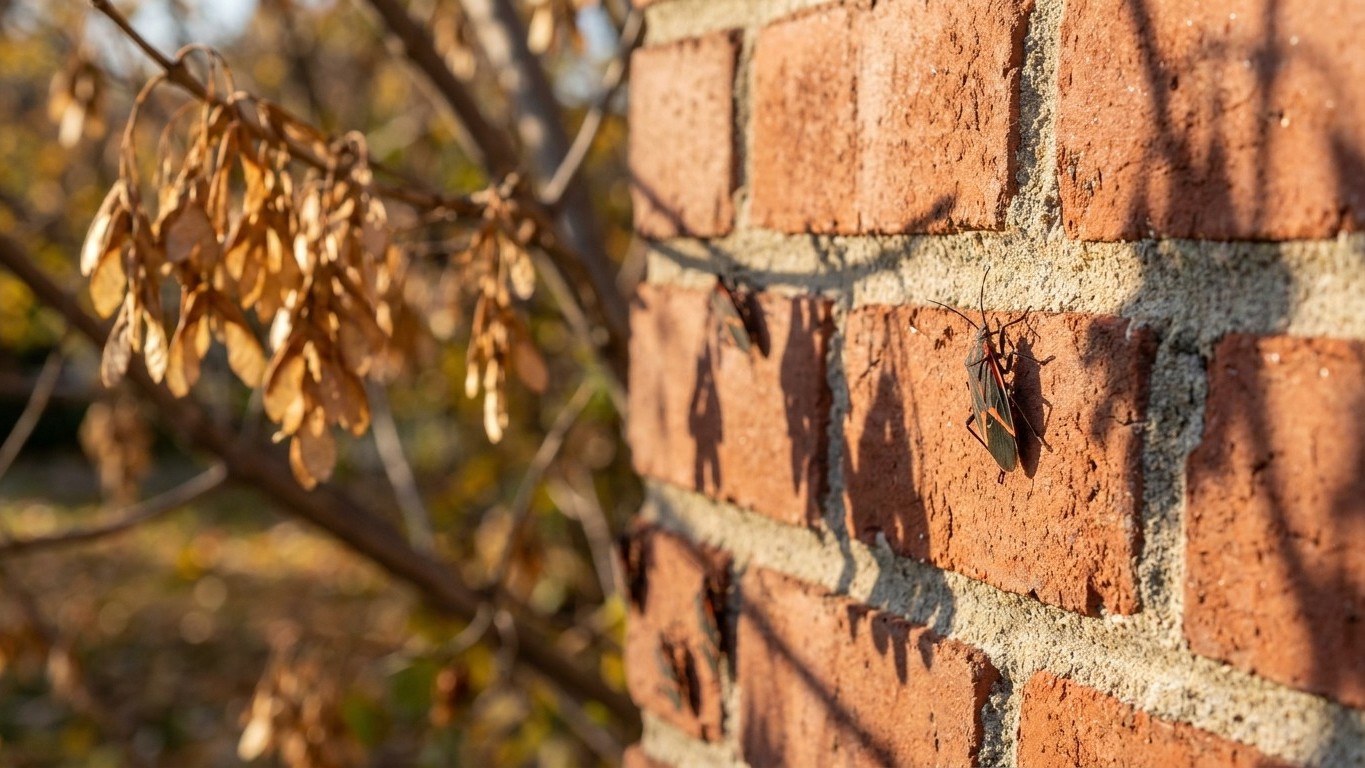

Boxelder bugs show up in Saskatchewan twice a year on a predictable schedule: a modest appearance in spring when overwintering adults wake up and head back outside, then a much bigger show in late summer through fall, when new adults swarm host trees and drift toward buildings looking for a place to spend the winter. Stopping them comes down to two things: cutting off their food source (female boxelder and Manitoba maple trees) and sealing the gaps that let them slip indoors before the first hard frost.
The Saskatchewan Timeline: Spring Wake-Up, Fall Invasion

Boxelder bugs (Boisea trivittata) spend winter tucked into wall cavities, attic insulation, woodpiles, and rock piles. Once temperatures climb into the 60s Fahrenheit, usually by late April or early May across the southern prairies, those overwintering adults stir and make their way back to nearby trees. This spring appearance is usually light. Homeowners might spot a handful of black-and-red bugs sunning themselves on a south-facing wall, but it rarely turns into a real problem.
Fall is a different story. Female boxelder trees produce seed pods through summer, and boxelder bug nymphs feed on those seeds and developing leaves from July onward. By late August and through September, that generation matures into winged adults, right as Saskatchewan days shorten and nighttime temperatures start dropping. The bugs respond by moving en masse off the trees and onto whatever vertical surface is warmest, which in most neighborhoods means the sunny side of a house.
Regina and Saskatoon typically see their first fall frost between mid-September and early October, a bit later in sheltered urban areas thanks to the heat-island effect. That window, roughly three to five weeks before frost, is when boxelder bug clusters on siding, windowsills, and porch columns peak. Once a real cold snap hits, most bugs still outside die off, but a portion has already found cracks and gaps to slip through, and those are the ones that end up as an indoor nuisance through winter.
Why Saskatchewan Yards Are a Good Fit for Them
Manitoba maple (Acer negundo), commonly called boxelder in much of the U.S. and Canada, is one of the most widely planted shelterbelt and urban shade trees on the prairies. It tolerates drought, poor soil, and brutal winters better than most maple species, which is exactly why it got planted so heavily around farmyards, along fence lines, and in older residential neighborhoods across Saskatchewan starting decades ago. That legacy of tree planting is the main reason boxelder bug populations persist here at all. No host tree nearby, no meaningful infestation.
Only female boxelder trees support large boxelder bug populations, since the insects feed primarily on seeds from the trees’ distinctive papery pods. Male trees, silver maple, and most other maple species in Saskatchewan yards don’t host the bugs the same way, though the insects will occasionally feed on ash or fruit trees growing nearby if boxelder seeds run short late in the season.
Urban heat plays a role too. Boxelder bugs are drawn to warm, sun-exposed surfaces, and a stucco or dark-sided house absorbing afternoon sun acts like a magnet compared to a shaded, tree-covered lot. That’s part of why some blocks in a city can have a heavy boxelder bug year while a few streets over stays nearly bug-free, the difference often comes down to one mature female Manitoba maple growing in a nearby yard or boulevard.
What Actually Stops Boxelder Bugs
Boxelder bugs don’t bite, don’t spread disease, and don’t damage wood or wiring the way some other overwintering pests can. The real complaint is volume, dozens or hundreds of bugs clustering on siding, seeping indoors, and leaving reddish-brown stains if crushed. Control works best when it targets both the outdoor source and the indoor entry points, rather than relying on one tactic alone.
Outdoor Measures
Removing a female boxelder tree solves the problem at the root, but that’s a drastic step most homeowners won’t take for a single shade tree. A more practical middle ground is raking up and bagging fallen seed pods through fall, since decomposing pods on the ground continue to feed nymphs into early autumn. For active clusters on siding or trees, a strong spray from a garden hose knocks bugs off surfaces without chemicals, though it has to be repeated as the bugs regroup.
Insecticidal soap sprays, applied directly to visible clusters on warm afternoons when bugs are active and exposed, kill on contact and carry low toxicity to pets and pollinators compared to broader residual insecticides. Timing matters here: spraying works best in early-to-mid fall before the bugs have already dispersed toward the house, and it needs direct contact since these sprays have no lasting residual effect once dry.
Perimeter treatments with a residual insecticide labeled for boxelder bugs, applied to foundation walls, window frames, and soffits in late August or early September, can reduce the number of bugs that make it indoors. This works as a preventive barrier rather than a cure for an existing indoor problem, so timing the application before the fall swarm peaks makes a real difference in effectiveness.
Sealing the House
Exclusion does more long-term work than any spray. Boxelder bugs are flat and thin enough to squeeze through gaps as narrow as a sixteenth of an inch, which means they exploit the same weak points as most other overwintering pests: gaps around window and door frames, unsealed utility penetrations for cable or dryer vents, torn window screens, and loose-fitting attic vents.
A practical fall checklist for Saskatchewan homes includes:
- Caulking gaps around window and door trim, especially on south and west-facing walls that get the most afternoon sun
- Replacing or repairing torn window and door screens before the fall swarm starts in late August
- Installing fine mesh screening over attic, soffit, and foundation vents
- Checking weatherstripping on exterior doors, including garage service doors, which are a common overlooked entry point
- Sealing around where utility lines, cable, and dryer vents penetrate exterior walls
This work goes fastest done in early-to-mid August, ahead of the fall swarm rather than after bugs are already clustering on the siding. Once bugs are visibly massing on a wall, sealing the house helps for next year but does little to stop that particular wave.
Dealing With Bugs That Get Inside
A shop vacuum or household vacuum with a disposable bag is the standard tool for bugs that make it indoors, since crushing them by hand or with a rolled-up newspaper leaves stains on walls, curtains, and carpet. After vacuuming, the bag should go straight into an outdoor trash bin rather than sitting in an indoor canister, since surviving bugs can crawl back out.
Indoor insecticide sprays generally aren’t recommended for boxelder bugs found inside living spaces. They’re a nuisance, not a health threat, and spraying inside a home mostly just adds unnecessary chemical exposure without solving the underlying entry-point problem. Bugs found indoors during winter are typically already dying or dormant, and they’ll show up occasionally on warm sunny days when heating systems trigger them to move around, a pattern that continues until spring, when the survivors head back outside to start the cycle again.
Homes with wood-burning stoves or fireplaces should pay particular attention to firewood storage. Boxelder bugs overwinter readily in stacked firewood, and bringing logs indoors in December can bring dormant bugs with them, which then wake up in the warmth of a heated living room. Storing firewood away from the house through fall, and knocking off any visible bugs before bringing logs inside, cuts down on this specific indoor surprise.