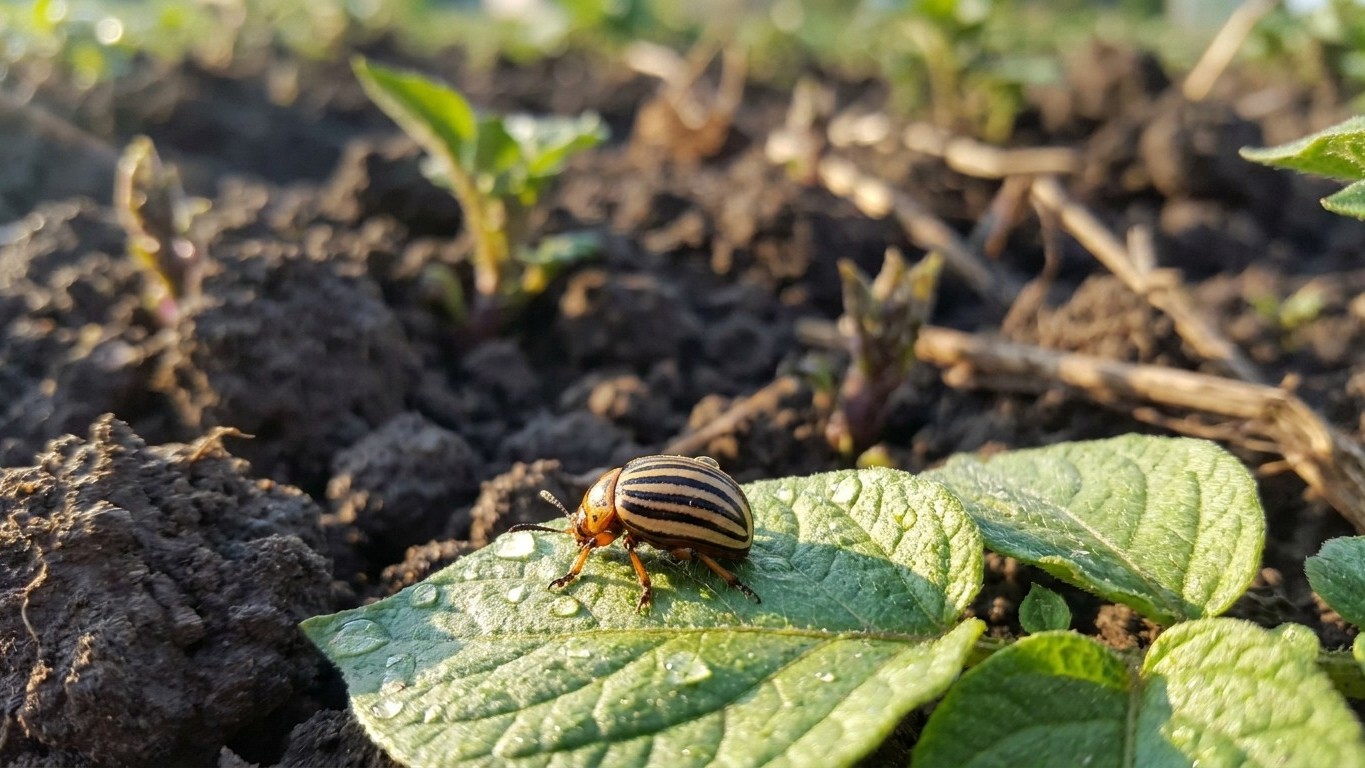

Colorado potato beetles show up in Illinois when soil temperatures climb into the 50-degree range, usually between mid-April and early May in the southern half of the state, and two to three weeks later up north near Rockford or Chicago. Overwintered adults crawl out of the ground first, walk into nearby fields on foot, and start feeding on the earliest potato and tomato leaves they find. That’s your window: catch them at emergence, before egg-laying starts, and you avoid the worst of the season.
The Seasonal Timeline in Illinois

These beetles spend winter as adults buried four to six inches deep in soil, often right at the edge of last year’s potato patch or under nearby fence rows and windbreaks. Once the ground warms, they dig out and walk (they don’t fly much this early) toward the nearest host plants. In central Illinois, that emergence typically lines up with the first potato shoots breaking through the soil, which is no accident. The beetle’s biology has synced with the crop for over a century.
Females start laying eggs within a week or two of emerging, and Illinois growers usually see two full generations per season, sometimes a partial third if August and September stay warm. The first generation peaks in late May through June, doing the heaviest damage to young plants that can least afford defoliation. A second wave of adults appears by mid-to-late summer, feeding on whatever solanaceous crops are still standing, potatoes, tomatoes, eggplant, and peppers among the favorites.
Southern Illinois counties near Cairo and Carbondale see beetles active a good three weeks before northern counties near the Wisconsin border. If you’re scouting, start checking field edges first, not the interior of the planting. Adults that walked in from overwintering sites hit the perimeter rows before spreading inward.
Identifying the Beetle at Every Stage
Adult beetles are hard to mistake once you’ve seen one: a rounded, hard-shelled body about a third of an inch long, cream to orange background color, and ten bold black stripes running down the wing covers. The head has a scattering of black spots. Nothing else on a potato leaf looks quite like it.
Eggs come next, laid in tight clusters of 20 to 40 on the underside of leaves, bright yellow-orange and easy to spot if you flip the foliage over. Larvae hatch within a week to ten days and are the stage that does the real damage, plump and humpbacked, brick-red to orange with two rows of black spots along each side. They molt through four growth stages over about three weeks, growing from barely visible to nearly half an inch long, and a full-grown larva can eat several times its body weight in leaf tissue before pupating in the soil.
Watch for skeletonized leaves first, just the veins left standing, which is a telltale sign of an active infestation rather than general pest nibbling. Potato plants can tolerate some early defoliation, but losing more than 20 percent of leaf area during tuber bulking (roughly the flowering stage) cuts yield hard.
Why This Particular Beetle Is So Tough to Control
This insect has an odd claim to fame in entomology circles: it was the first species documented developing resistance to DDT, back in 1952, and it’s been building resistance to new chemical classes ever since. Populations in parts of the Midwest, Illinois included, have shown reduced susceptibility to certain neonicotinoids and pyrethroids after repeated use. That resistance builds fast because the beetle has a short generation time and huge egg output, giving natural selection plenty of raw material to work with each season.
The species originally fed on wild nightshades in the Rocky Mountain region and only adapted to cultivated potatoes after settlers pushed potato farming westward in the mid-1800s. It picked up the “Colorado” name from early documentation there, then spread east by rail and seed potato shipments, reaching Illinois and Ohio farms by the 1870s. That history matters for one practical reason: a pest with 150-plus years of adaptation to potato cropping systems isn’t going to be solved by a single spray application.
Cultural and Physical Controls Worth Trying First
Crop rotation remains one of the most effective, lowest-cost tools available, and it works specifically because of how the beetle moves. Since overwintered adults walk rather than fly when they first emerge, planting potatoes at least 200 yards from the previous year’s patch forces beetles to cover ground they’re not built for, and many never make it. A rotation of even a few hundred feet reduces early-season colonization noticeably compared to planting in the same spot year after year.
Straw mulch trenches around potato beds create a physical barrier some walking beetles struggle to cross, and floating row covers installed at planting keep the first wave of adults off young plants entirely, as long as they’re removed before flowering so pollinators can reach the blossoms. Handpicking adults and squashing egg clusters sounds tedious, but on a home garden scale it’s genuinely effective, especially if done every few days during the emergence window in April and May.
Straw and vacuum-collection methods used on small commercial plots have shown real reductions in beetle numbers without any pesticide involved. Deep fall tillage that exposes overwintering adults to freezing temperatures and predators also knocks back the population before it even gets a chance to emerge the following spring.
Beneficial Insects and Biological Options
Ladybird beetles, lacewings, and certain stink bug species prey on Colorado potato beetle eggs and small larvae, and maintaining flowering border plants nearby helps keep those predators around. Parasitic wasps in the genus Edovum and the tachinid fly Myiopharus doryphorae target eggs and larvae specifically, though their impact varies field to field and isn’t reliable enough to serve as a sole strategy in Illinois growing conditions.
For gardeners wanting a biological spray option, products based on Bacillus thuringiensis var. tenebrionis (a strain specific to leaf beetles) or spinosad work well against young larvae, breaking down within days and posing minimal risk to bees when applied in early morning or evening.
Chemical Control and Resistance Management
When populations exceed a plant’s tolerance, insecticide treatment becomes necessary, but the resistance history here means product rotation matters more than with most pests. Alternating between different modes of action rather than reaching for the same chemical class season after season slows down resistance development. The Insecticide Resistance Action Committee (IRAC) mode-of-action numbering system, printed on most labels, is the practical tool for tracking this: don’t use the same numbered group two applications in a row.
Extension entomologists across the Corn Belt have documented reduced efficacy of certain neonicotinoid seed treatments against Colorado potato beetle populations that have been exposed to them repeatedly, which is part of why integrated approaches (rotation plus biological controls plus targeted chemical use rather than routine calendar spraying) get recommended over blanket treatment schedules.
Timing chemical applications to target newly hatched larvae, before they reach their third or fourth instar, gives far better results than spraying full-grown larvae that have already done most of their feeding damage. Scouting twice weekly during peak emergence catches that window.
What This Means for Illinois Growers
A backyard gardener with a dozen potato plants and a commercial grower with forty acres are fighting the same insect on very different scales, but the fundamentals hold steady either way: know your local emergence timing, rotate where you plant, check field edges first, and don’t lean on one control method alone. The beetle’s resistance record isn’t a reason to give up on chemical tools entirely, it’s a reason to use them selectively and back them up with the cultural practices that don’t rely on chemistry at all.
One detail that surprises a lot of growers: horsenettle, a common weed in Illinois pastures and roadsides, serves as an alternate host that lets beetle populations persist even in fields with strict potato rotation. Clearing horsenettle from field margins removes a bridge population that would otherwise reinfest a “clean” rotation year.
Related guides
- Colorado potato beetle in Wisconsin: When It Shows Up and What Stops It
- Colorado potato beetle in Indiana: When It Shows Up and What Stops It
- Colorado potato beetle in Kansas: When It Shows Up and What Stops It
- Colorado potato beetle in Maine: When It Shows Up and What Stops It
- Colorado potato beetle in Massachusetts: When It Shows Up and What Stops It
- Colorado potato beetle in Pennsylvania: When It Shows Up and What Stops It