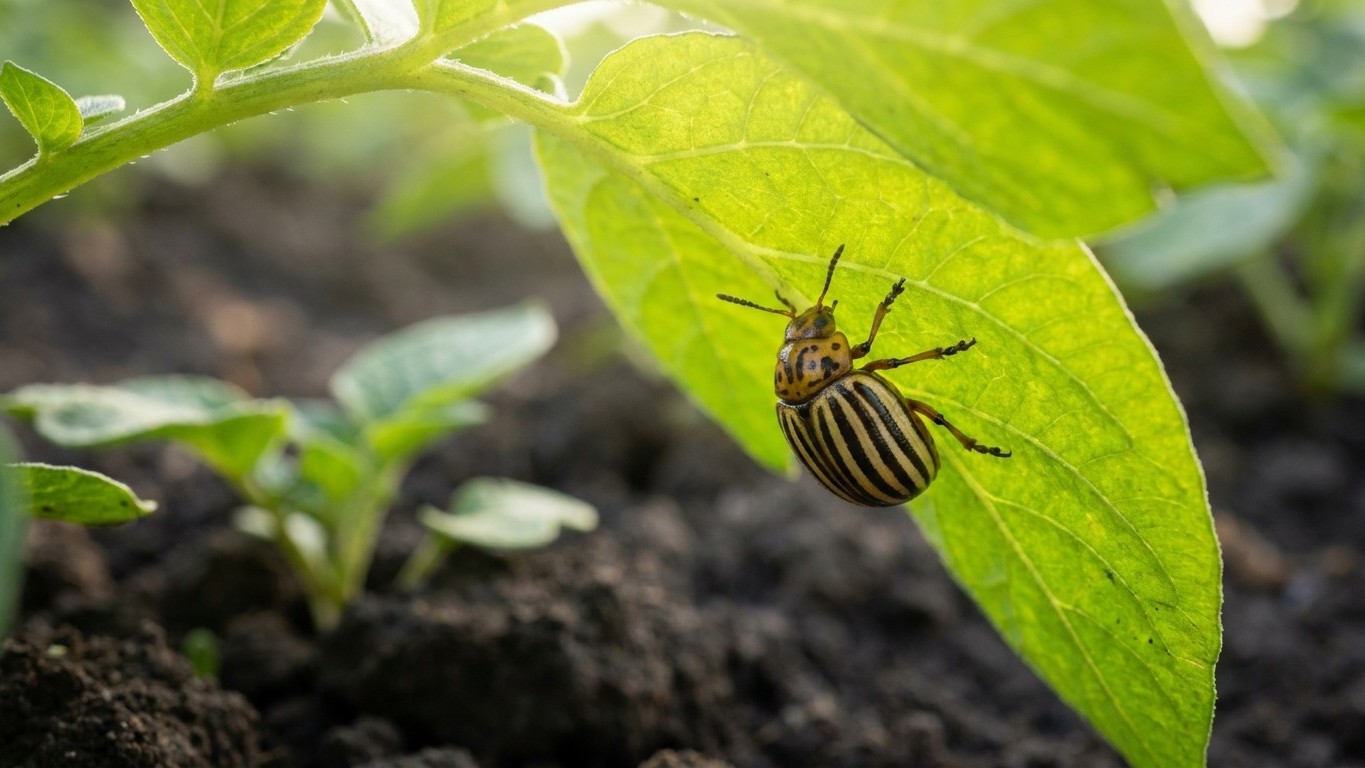

Colorado potato beetles show up in Wisconsin the moment soil temperatures climb into the mid-50s, usually mid-to-late April in the southern part of the state and into May farther north. Overwintering adults crawl out of the soil right around when potato sprouts break ground, and by early June you’ll have a second wave of feeding from freshly hatched larvae. In a typical Wisconsin season, this pest completes one full generation and starts a second, meaning growers deal with adult beetles, eggs, and larvae simultaneously for much of the summer.
Where and When the Beetle Appears in Wisconsin

Timing tracks soil warmth more than the calendar. Wisconsin’s Central Sands region, the sandy, irrigated belt running through Portage, Waushara, and Adams counties, tends to warm faster than heavier clay soils up north, so beetles often emerge there first. Statewide, the general pattern holds: adults that spent winter buried 8 to 10 inches deep start moving once daytime soil temps hit around 50°F, then feed for a week or two before mating and laying eggs on the undersides of potato leaves.
Overwintering and Spring Emergence
These beetles don’t migrate south for winter. They dig into the same field, often within a few hundred feet of last year’s potato patch, and wait out the cold underground. That’s part of what makes them so persistent in Wisconsin’s potato country. A mild winter with decent snow cover for insulation can mean higher survival rates and a bigger spring population, while a winter with deep frost penetration and little snow can knock numbers down noticeably. Growers who track soil temperature at planting depth get a rough early warning: once it’s consistently above 50°F, expect beetles within days.
Life Cycle Through the Growing Season
From egg to adult takes roughly three to four weeks under warm conditions, faster in a hot July, slower in a cool spring. Females lay clusters of bright yellow-orange eggs, often 20 to 30 per cluster, on leaf undersides, and a single female can lay several hundred eggs over her lifetime. The larvae go through four growth stages, ballooning from tiny reddish specks to plump, humpbacked grubs with two rows of black spots along each side. It’s this larval stage that does the real damage, stripping leaf tissue down to the veins in a matter of days when populations run high. By late July or August, a second generation of adults emerges, feeds briefly, and then burrows down to overwinter, restarting the cycle.
Why Wisconsin Fields Are a Hotspot
Wisconsin ranks among the top potato-producing states in the country, and that concentration of host plants is exactly what this beetle needs. Potatoes, along with related crops like tomatoes and eggplant, are the beetle’s primary food source, and continuous potato production in the same region year after year gives the insect a reliable, uninterrupted food supply. The sandy soils that make the Central Sands ideal for growing potatoes also happen to make excellent overwintering habitat, since they drain well and don’t stay waterlogged in ways that would drown burrowed beetles.
There’s also a resistance problem that’s been building for decades. Colorado potato beetle populations in parts of the Midwest, including areas of Wisconsin, have developed resistance to multiple classes of insecticides over the years, a pattern well documented by university entomology programs tracking pest resistance in commercial potato fields. That history shapes how growers approach control today, favoring rotation of chemical modes of action rather than repeated use of a single product.
Recognizing the Beetle and Its Damage
Adults are hard to mistake once you’ve seen one: about 3/8 inch long, oval, with a yellow-orange body and ten black stripes running lengthwise down each wing cover. The head has a rough black pattern that looks almost like a face. Larvae look nothing like the adults, soft-bodied, brick red to orange when young, fading to a dull yellowish-pink as they mature, with two rows of black spots along the sides of the body.
Damage shows up first as small, ragged holes in leaves, then progresses to entire leaflets eaten down to the midrib. A heavy larval infestation can defoliate a potato plant in under a week. Since potato yield depends heavily on leaf area during tuber bulking (the period when the plant is actively building starch in the tubers underground), losing foliage at the wrong time can cut yields substantially even if the plant survives.
What Actually Stops It
No single tactic handles this pest reliably on its own. Growers and gardeners who get consistent results usually stack two or three approaches together, timed to different points in the life cycle.
Crop Rotation and Cultural Controls
Moving potatoes to a field at least a quarter mile from where they grew the previous year forces overwintered beetles to walk farther to find a host plant, and many don’t make it. This single practice, well established in potato pest management guidance from land-grant universities across the Midwest, remains one of the most effective non-chemical tools available. Straw mulch around plants has also shown some benefit in smaller trials, since it seems to interfere with the beetles’ ability to locate host plants and can support populations of ground beetles that prey on CPB eggs and young larvae.
Trench trapping is another old-school tactic still used by some smaller operations: digging a plastic-lined trench along the edge of last year’s potato field intercepts beetles walking in search of new host plants before they ever reach this year’s crop. It’s labor-intensive, but it works as a supplemental measure, not a replacement for other controls.
Biological and Organic Controls
Bacillus thuringiensis var. tenebrionis, a bacterial insecticide often labeled as Bt-tenebrionis, targets young larvae specifically and is approved for organic production. Timing matters here: it needs to be applied when larvae are small, since older larvae are much less susceptible. Spinosad, derived from a soil bacterium, is another option that fits organic standards and has activity against both larvae and adults, though repeated use can accelerate resistance if it’s the only tool in rotation.
Natural predators help too, though rarely enough on their own to prevent damage in a commercial field. Ladybird beetles, lacewings, and certain predatory stink bugs feed on CPB eggs and small larvae, and preserving those populations by limiting broad-spectrum insecticide use gives them a fighting chance to knock down numbers between generations.
Insecticide Resistance Concerns
This is where Wisconsin’s history with the pest gets complicated. Colorado potato beetle has developed resistance to nearly every class of insecticide thrown at it at some point over the past several decades, a trend tracked by entomology researchers monitoring susceptibility in potato-growing regions of the Midwest. Neonicotinoid seed treatments, once a go-to for early-season protection, have shown reduced effectiveness in some populations after years of heavy reliance. The current recommendation from most university extension programs is straightforward: rotate between different insecticide modes of action within a season and across years, rather than leaning on one product because it worked last summer.
For Home Gardeners: Small-Scale Tactics
Backyard potato patches face the same beetle, just at a scale where hand tactics actually work. Checking the undersides of leaves every few days starting in late spring and squashing egg clusters before they hatch cuts the population dramatically before it ever becomes a larval problem. Adults can be hand-picked into a bucket of soapy water, which sounds tedious but takes only a few minutes on a small plot and avoids any pesticide use entirely.
Floating row covers placed over young plants right at emergence block adults from reaching the foliage in the first place, though they need to come off once plants flower if you’re growing a variety that needs pollinators, or if temperatures underneath climb too high on a sunny day. Companion planting with tansy or nasturtium gets mentioned often in home gardening circles as a deterrent, though the evidence for it is mostly anecdotal rather than backed by controlled research.
Rotating where you plant potatoes each year, even in a small backyard garden, still helps. Moving the bed to the opposite corner of the yard forces overwintered beetles to travel farther, and in a small garden that difference in distance can meaningfully cut down on how many actually find their way to your plants.
One detail that surprises a lot of first-time potato growers in Wisconsin: eggplant and tomato plants nearby can serve as a bridge host, letting beetle populations persist even in years when potatoes aren’t planted in that spot. Rotation plans that only account for potatoes while ignoring these related crops in the same garden often see beetle pressure return faster than expected.
Related guides
- Colorado potato beetle in Minnesota: When It Shows Up and What Stops It
- Colorado potato beetle in Illinois: When It Shows Up and What Stops It
- Colorado potato beetle in Wyoming: When It Shows Up and What Stops It
- Colorado potato beetle in British Columbia: When It Shows Up and What Stops It
- Colorado potato beetle in Massachusetts: When It Shows Up and What Stops It
- Colorado potato beetle in Newfoundland and Labrador: When It Shows Up and What Stops It