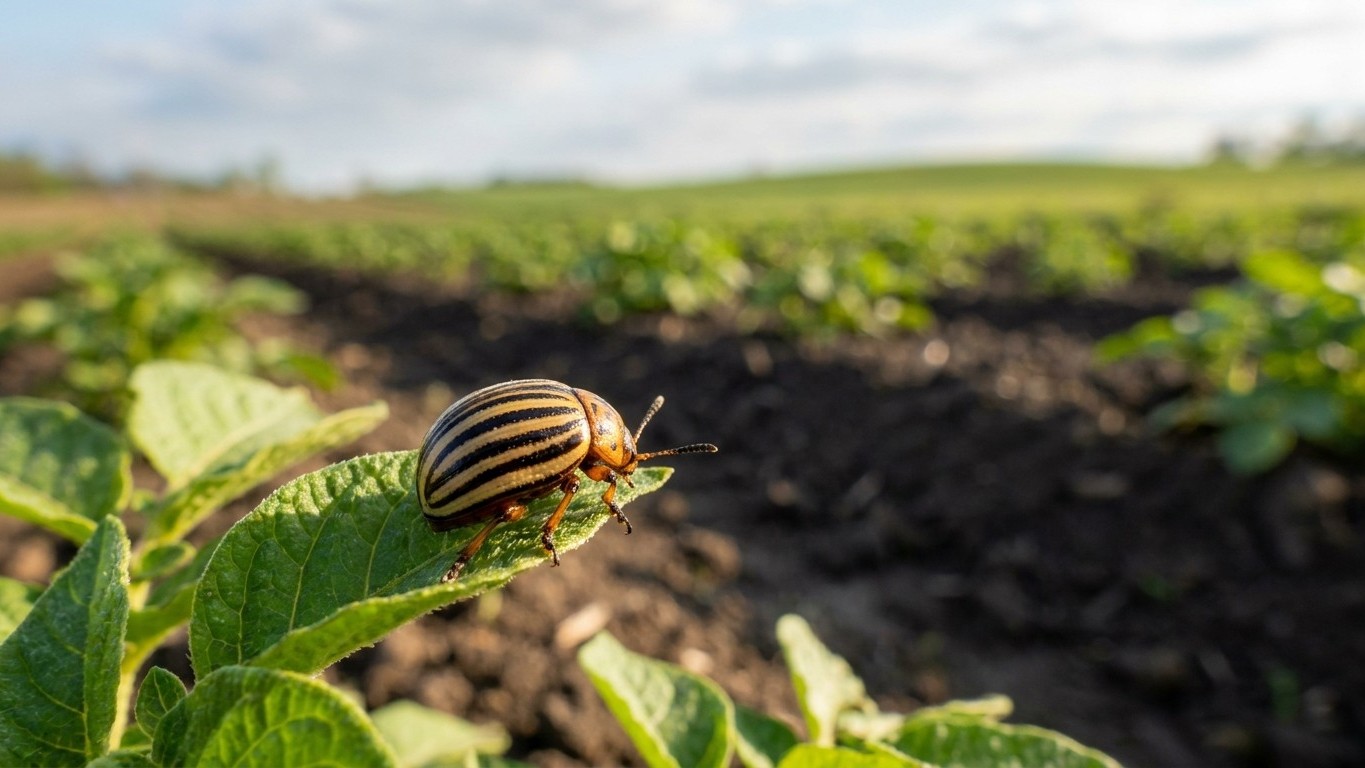

Colorado potato beetles wake up in Indiana soil as early as mid-April in the southern counties, with peak emergence running from late April through May statewide. The insect overwinters as an adult buried four to six inches underground, and it doesn’t wait for perfect weather to start moving. Once soil temperatures climb past roughly 50°F for a few consecutive days, adults dig out and head straight for the nearest potato, tomato, or eggplant patch. Crop rotation, row covers installed before emergence, and targeted insecticides applied at the larval stage remain the three tools that actually knock back populations here. Everything else is a supporting player.
Indiana growers deal with this beetle across two to three generations a year, depending on how far south the garden sits and how warm the summer runs. That’s more generations than northern states like Wisconsin typically see, and fewer than what growers in Kentucky or Tennessee manage. The practical result: Hoosier gardeners get a narrower window to break the cycle before beetle numbers snowball into August.
The weeks to watch

The beetle’s calendar in Indiana tracks closely with degree-day accumulation rather than the calendar date on the wall. Purdue Extension entomologists have long used a base temperature of 52°F to model beetle development, and once accumulated degree days hit around 300, the first wave of overwintered adults is typically active and laying eggs. In an average Indiana spring, that threshold lands somewhere between the last week of April and mid-May in southern counties like Knox or Posey, and one to two weeks later up in the northern tier near South Bend or Fort Wayne.
First-generation larvae, the ones that do the most damage to young potato plants, usually feed heavily from late May through June. A second generation of adults emerges by mid-to-late July, and in warmer years a partial third generation can show up in September before frost shuts everything down. This is why a garden that looked clean in June can suddenly show chewed leaves again in late summer, catching gardeners off guard right when they thought the threat had passed.
Why the Timing Shifts Year to Year
A cold, wet spring pushes emergence back by a week or two. A mild winter with an early warm-up does the opposite, sometimes bringing beetles out before gardeners have even planted their seed potatoes. Soil type matters too: sandy loam warms faster than heavy clay, so beetles overwintering in lighter soils tend to emerge a few days sooner than their neighbors in denser ground. None of this changes the fundamental pattern, but it does mean scouting should start based on soil temperature and degree-day trackers, not a fixed date circled on the calendar.
Identifying the Beetle at Each Stage
Adult Colorado potato beetles are hard to miss once you know what to look for: about 3/8 inch long, with a rounded, hard-shelled body striped in bold black and cream-yellow bands running lengthwise down the wing covers. The head and thorax carry irregular black spots on an orange-yellow background. Eggs are bright orange-yellow, laid in clusters of 10 to 30 on the undersides of leaves, standing on end like tiny grains of rice glued in place.
Larvae go through four growth stages, starting out dark red with a black head and growing into a plump, orange-red hump-backed grub with two rows of black spots along each side. These larvae, not the adults, cause the bulk of defoliation. A single generation of larvae can strip a potato plant to bare stems in a matter of days if left unchecked, and a heavily infested plant loses most of its ability to produce tubers once more than 30 percent of its leaf area disappears.
What Actually Stops Colorado Potato Beetle in Indiana Gardens
Insecticide resistance is the elephant in the room here. Colorado potato beetle has developed resistance to more insecticide classes than almost any other agricultural pest in North America, according to entomology research tracked by land-grant universities across the Midwest. Populations in parts of the Corn Belt, Indiana included, have shown reduced sensitivity to pyrethroids and some neonicotinoids after repeated use. That single fact reshapes the whole control strategy: leaning on one chemical year after year is close to guaranteed to fail within a few seasons.
Crop rotation still works better than almost anything else, and it costs nothing but planning. Overwintered adults emerge from soil near last year’s potato patch and walk toward the first host plant they find. Moving potatoes, tomatoes, or eggplant at least 200 to 300 feet from the previous year’s planting site, ideally with a physical barrier like a lawn or driveway in between, forces beetles to cross more open ground before they find a meal, which cuts colonization rates significantly in home garden settings.
Physical Barriers and Timing Tricks
Floating row covers, installed immediately after planting and before adult emergence, block the beetles from ever reaching the foliage. The catch: covers need to come off before flowering if the crop requires pollination, and they must be sealed tight at the edges, since beetles are persistent walkers that exploit any gap. Growers who dig a small trench around the potato bed and line it with plastic sheeting, angled outward, have had success trapping walking adults before they climb onto plants, a low-tech trick sometimes called a trench barrier.
Mulching heavily with straw disrupts beetle movement too. Research from Midwest agricultural extension programs has shown that deep straw mulch reduces colonization by adult beetles, likely because the loose surface interferes with their ability to locate host plants by scent and sight. It’s not a complete solution on its own, but paired with rotation it meaningfully reduces the number of beetles that ever reach the crop.
Biological and Chemical Options Worth Knowing
Spinosad-based insecticides, derived from a naturally occurring soil bacterium, remain effective against Colorado potato beetle larvae and are approved for organic production. Timing matters more than the product itself: applications work best against young larvae in the first two growth stages, before they’ve done most of their damage and before their exoskeletons toughen up. Waiting until adults show up is largely wasted effort with this class of product.
Products containing Bacillus thuringiensis var. tenebrionis (a strain specific to leaf beetles, distinct from the Bt used against caterpillars) also target young larvae effectively and break down quickly in sunlight, meaning reapplication after rain is often necessary. For gardeners rotating chemical classes to slow resistance, alternating between spinosad, Bt tenebrionis, and, when necessary, a different insecticide class each season is the approach recommended by most university extension entomologists rather than sticking with a single product line year after year.
Natural predators do some of the work for free. Ground beetles, ladybird beetles, and the parasitic wasp Edovum puttleri all feed on Colorado potato beetle eggs or young larvae, though none of them provide complete control on their own in a typical Indiana backyard. Avoiding broad-spectrum insecticide sprays for unrelated pests helps keep these natural predator populations intact, which pays off over a full growing season even if it’s hard to measure week to week.
Regional Differences Across Indiana
Southern Indiana counties, sitting in USDA hardiness zones 6a and 6b, see beetle activity start earlier and often support a fuller third generation compared to the northern part of the state. Growers in counties like Vanderburgh or Dubois should start scouting by mid-April in a typical year. Northern Indiana, largely zone 5b, usually sees the beetle’s activity compressed into a shorter window, with the practical benefit that a well-timed single round of larval control in late May often handles most of the season’s pressure.
Statewide, the beetle shows a clear preference for solanaceous crops. Potatoes top the list, followed by eggplant, then tomatoes, which the beetle will feed on but generally finds less attractive than the other two. Home gardeners growing all three in close proximity often see the potatoes and eggplant hit hardest first, giving an early warning sign before tomato plants show much damage at all.
Hand-picking adults and squashing egg clusters remains one of the most effective free tools available, particularly in small home gardens where a daily five-minute check during peak emergence in May can remove a meaningful share of the breeding population before it multiplies. It’s tedious work, and it won’t scale to a quarter-acre potato patch, but for the average backyard grower it’s often more effective per hour invested than any spray.
Related guides
- Colorado potato beetle in Illinois: When It Shows Up and What Stops It
- Colorado potato beetle in Kansas: When It Shows Up and What Stops It
- Colorado potato beetle in Maine: When It Shows Up and What Stops It
- Colorado potato beetle in Delaware: When It Shows Up and What Stops It
- Colorado potato beetle in Prince Edward Island: When It Shows Up and What Stops It