
If your zucchini plants wilted overnight this summer, the culprit is more likely a stem borne fungus, a bacterial wilt spread by cucumber beetles, or plain heat stress than squash vine borer. This moth-and-larva pest is real in Canada, but in Nova Scotia it stays rare, uneven, and mostly a non-issue for backyard growers. That said, “rare” isn’t “never,” and a handful of Maritime gardeners do report it most seasons, usually in warmer inland pockets of the Annapolis Valley or along the South Shore where summer soil temperatures run a few degrees higher than the coast.
The short version: squash vine borer (Melittia cucurbitae) needs sustained warm soil to complete its life cycle, and Nova Scotia’s short, cool growing season limits how well it establishes. When it does show up, adults are typically active from late June through mid-August, with damage becoming visible in stems by late July. Row covers timed to local emergence, resistant squash types, and quick removal of infested vines stop it more reliably than any pesticide spray.
What Squash Vine Borer Actually Is

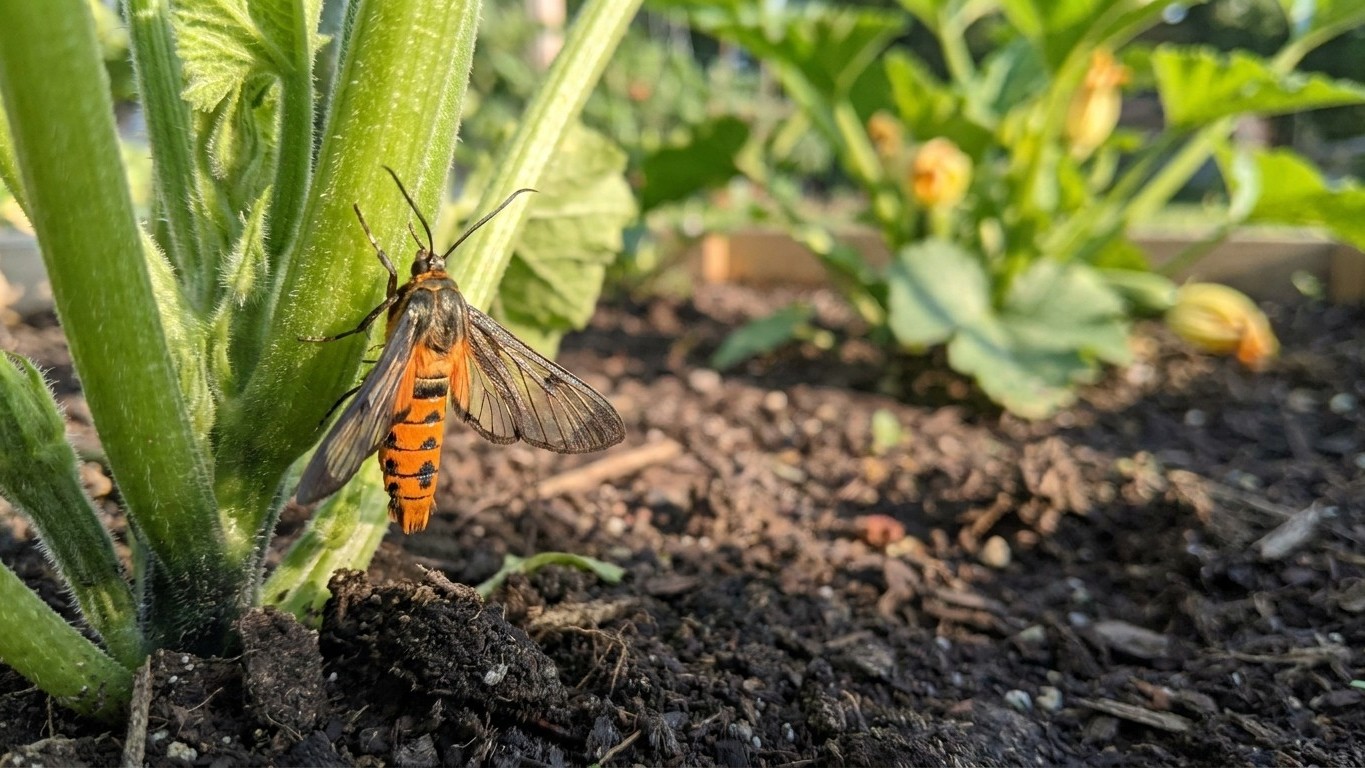
Despite the name, the adult isn’t a worm at all. It’s a day-flying moth with an orange abdomen ringed in black, clear hind wings, and a fast, buzzing flight pattern that makes gardeners mistake it for a wasp. Females lay small, flat, reddish-brown eggs individually at the base of squash stems, near the soil line. Within a week or two, the eggs hatch into cream-colored larvae that immediately tunnel into the stem, where they feed for four to six weeks before dropping into the soil to pupate.
The species is native to eastern North America and feeds almost exclusively on plants in the Cucurbita genus: zucchini, yellow summer squash, pumpkins, and most winter squash varieties. Cucumbers and melons, which belong to different genera, are rarely touched. That distinction matters for crop planning in a home garden, since a bed mixing squash with cucumbers won’t see the same infestation pressure across every plant.
Why Nova Scotia Sees Less Pressure Than Ontario or the US Northeast
Squash vine borer thrives where summer soil temperatures stay consistently warm for weeks at a stretch, the kind of heat common in southern Ontario, Quebec’s St. Lawrence lowlands, or much of the northeastern and midwestern United States. Nova Scotia’s maritime climate, cooled by ocean currents and marked by shorter, milder summers, doesn’t give the insect the same runway. Provincial soil temperatures in most growing regions lag several weeks behind inland Canadian growing areas, which pushes back or shortens the window during which adult moths can successfully lay eggs and larvae can develop before fall cooling sets in.
This doesn’t mean the pest is absent. Isolated populations persist in warmer microclimates, and gardeners who’ve brought in squash transplants or shared seedlings from regions with established borer populations sometimes introduce the insect to areas where it wasn’t previously reported. Climate patterns are also shifting; longer, warmer stretches in July and August over the past several seasons have given some entomologists reason to watch whether the pest’s range creeps further into Atlantic Canada over time.
When It Shows Up: Timing for Nova Scotia Gardens
In regions where squash vine borer is well established, there’s typically one generation per year in northern climates, sometimes a partial second generation further south. Applied to Nova Scotia’s cooler season, that translates to a single generation with adult moths emerging later than their counterparts in Ontario or New England, usually starting in the last week of June and continuing into early August.
Peak egg-laying tends to fall in mid-July, which is also when home gardeners should be checking stem bases most closely. Larvae feeding inside the stem for four to six weeks means visible collapse or wilting often doesn’t appear until late July or August, by which point the damage is already done. That lag between infestation and visible symptoms is exactly why prevention beats treatment with this pest.
A Quick Timeline
- Late June to early July: first adult moths active, most likely in warmer inland gardens
- Mid-July: peak egg-laying at the base of squash stems
- Late July into August: larvae feeding inside stems, wilting symptoms become visible
- Late summer into fall: mature larvae exit stems and burrow into soil to overwinter
Spotting the Damage Before the Plant Collapses
The first sign most gardeners notice is a single vine or the entire plant wilting during the heat of the day, even though the soil is moist. Unlike drought stress, this wilting doesn’t recover overnight. A closer look at the stem near the soil line often reveals small holes surrounded by a moist, greenish-yellow sawdust-like material called frass, which is essentially the larva’s excrement pushed out of the tunnel.
Splitting open a wilting stem lengthwise with a clean knife will usually expose the larva directly, a fat, wrinkled, white grub up to an inch long. Finding it this early still gives you a chance to save the plant, which brings us to what actually works once an infestation is confirmed.
What Stops Squash Vine Borer: Prevention and Control
Chemical sprays aimed at adult moths have a narrow window of usefulness, and most home gardeners miss it entirely because the moths are only vulnerable during the short egg-laying period before larvae tunnel inside the stem, where no spray can reach them. Physical barriers and cultural practices do far more heavy lifting in a Nova Scotia garden than any insecticide.
Row covers remain the most reliable defense. Covering young squash plants with lightweight floating row cover from transplant through early July, before local moth activity peaks, blocks egg-laying entirely. Covers need to come off once flowers appear so pollinators can reach the blossoms, which does create a short window of vulnerability, but by late July in Nova Scotia’s cooler zones, moth activity is already tapering.
Wrapping the base of each stem in aluminum foil or a section of nylon stocking, extending an inch or two below and above the soil line, physically blocks females from reaching the spot where they’d normally lay eggs. This method costs almost nothing and takes a few minutes per plant at transplant time.
Choosing resistant squash types shifts the odds further in your favor. Butternut squash and other varieties in the Cucurbita moschata species have thinner, more fibrous, vining stems that borers struggle to penetrate compared to the thick, hollow stems of zucchini and pattypan squash (Cucurbita pepo). A gardener who’s lost zucchini to borer damage in past seasons but hasn’t touched butternut is seeing that resistance play out directly.
If a stem is already infested, surgery sometimes saves the plant. Slitting the stem lengthwise near the entry hole, removing the larva by hand, then mounding moist soil over the wounded section to encourage new root growth from that point, works often enough to be worth trying before pulling the whole plant. Speed matters here; the earlier you catch it, the more stem tissue survives intact.
At season’s end, pulling and destroying old squash vines rather than composting them removes overwintering larvae and pupae from the garden before they can emerge the following June. Tilling the soil in fall in beds that grew squash also exposes cocoons to freezing temperatures and predators, cutting down the population available to reinfest next year’s plants.
A Note on Trap Crops and Companion Planting
Some gardeners plant a sacrificial squash variety, often a fast-growing summer squash, at the edge of the garden a week or two before the main crop goes in, betting that egg-laying moths will target the earlier, more established plant first. The trap plant is then monitored closely and removed once infested. This approach has more anecdotal support than rigorous field data behind it, but given how low-cost and low-effort it is, it’s a reasonable addition to a Nova Scotia garden where borer pressure is already inconsistent from year to year.
What’s worth remembering heading into next season is that a single wet, cool Maritime summer can suppress squash vine borer activity almost entirely, while a run of unusually warm, dry weeks can bring a noticeable uptick in sightings. Gardeners who track their own results year over year, noting which varieties wilted and which didn’t, end up with a better local forecast than any general guideline can offer.
Related guides
- Squash vine borer in New Brunswick: When It Shows Up and What Stops It
- Squash vine borer in Ohio: When It Shows Up and What Stops It
- Squash vine borer in Ontario: When It Shows Up and What Stops It
- Squash vine borer in Minnesota: When It Shows Up and What Stops It
- Squash vine borer in Indiana: When It Shows Up and What Stops It