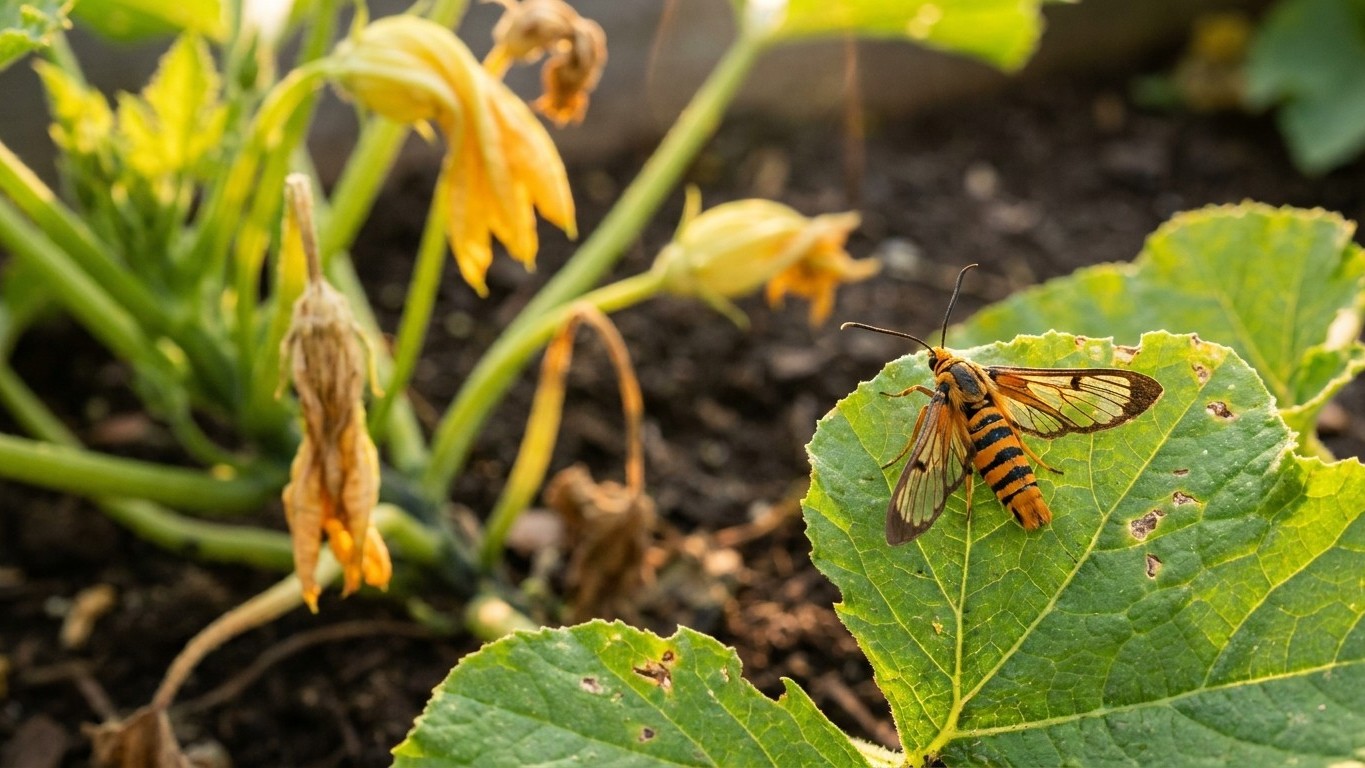

Squash vine borer moths start flying in Minnesota gardens in late June, with the heaviest activity hitting through July and tapering off by mid-August. By the time a vine collapses overnight in August, the damage happened weeks earlier when nobody was looking. Stopping this pest means acting before the wilting starts, not after.
Minnesota gardeners lose entire pumpkin and zucchini plantings to this insect every summer, often without realizing what killed the plant until they slice open the stem and find it hollowed out and packed with frass. The good news: the borer’s biology in Minnesota is predictable enough that a gardener who knows the calendar can beat it most seasons.
The Squash Vine Borer Timeline in Minnesota

Melittia cucurbitae survives Minnesota winters as a pupa buried one to two inches deep in the soil, usually right where last year’s squash plants grew. That’s the first clue for prevention, but more on that later. As soil temperatures warm through late spring, the pupa develops into an adult moth, and emergence typically begins in the last week of June across much of the state, according to University of Minnesota Extension monitoring. Southern counties tend to see activity a few days to a week earlier than the Arrowhead region or far northern counties, simply because the ground warms faster there.
Unlike most moths, the adult squash vine borer flies during the day, and it looks nothing like the fuzzy gray moths people associate with nighttime porch lights. It’s often mistaken for a wasp: orange-and-black body, clear wings with a dark border, and a rapid, darting flight pattern low around the base of plants. That mimicry is deliberate. It fools birds and gardeners alike into leaving it alone.
Minnesota generally sees just one generation per year, which is actually a break compared to warmer states where two generations can overlap and extend the danger window into September. Here, once egg-laying tapers off in late July or early August, the pressure from newly hatched larvae drops sharply. Any larvae already inside a stem, though, keep feeding through August regardless of what the adults are doing outside.
Why the Timing Varies Year to Year
Spring soil temperature drives everything. A cold, wet May followed by a slow warm-up can push emergence into early July, while an early, warm spring can have moths active before summer solstice. Gardeners who want precision over a general calendar guess can hang a yellow sticky trap or a pheromone-baited trap near squash plantings starting in mid-June and check it every few days. Catching the first moths gives a real start date for that year’s egg-laying window, which usually runs about two to three weeks after first emergence.
Spotting Damage Before the Whole Vine Is Gone
The female moth lays her eggs, usually one at a time, at the base of the stem near the soil line, sometimes on leaf stalks close by. Each egg is small, flattened, and reddish-brown, easy to miss unless someone is specifically checking the crown of the plant. Within a week to ten days, the larva hatches and immediately tunnels into the stem, which is the point of no return for that section of vine.
The telltale sign gardeners actually notice is a small pile of moist, sawdust-like frass pushed out through a hole near the base of the stem. It looks like wet coffee grounds. That frass is the single most reliable early warning sign, and it usually shows up before any wilting does. By the time a whole vine wilts suddenly in the middle of a hot afternoon, even though the soil is plenty moist, the larva has already destroyed enough of the stem’s internal tissue to cut off water flow. Squash, pumpkins, and zucchini are the hardest hit. Cucumbers and melons get attacked far less often.
One frustrating detail: a plant can look completely healthy in the morning and be collapsed by evening. That sudden crash is what throws people off, since it seems disconnected from any visible cause. Checking the base of the stems weekly starting in late June, running a thumb along the stem to feel for soft spots or frass, catches the problem while the plant still has a chance.
What Actually Stops Squash Vine Borer
No single tactic fully solves this pest in Minnesota gardens. Combining a few methods, timed to the emergence window, gets far better results than relying on one fix.
Row Covers Timed to the Calendar
Floating row covers physically block the adult moth from reaching the plant to lay eggs, and they’re one of the most effective tools available to home gardeners. The catch is timing: covers need to go on before the moths start flying, generally by mid-June in southern Minnesota and closer to late June farther north, and they need to come off once the plants start flowering so pollinators can reach the blossoms. Leaving covers on too long defeats the purpose of growing squash in the first place, since nothing gets pollinated.
Some gardeners solve the pollination problem by hand-pollinating with a small paintbrush each morning, which lets the row cover stay on through the entire risk window. It’s a bit of extra work, but it closes the gap that trips up a lot of otherwise careful gardeners.
Digging Larvae Out by Hand
Once frass appears at the base of a stem, a gardener can often save the plant with a sharp knife. Slitting the stem lengthwise near the entry hole, finding the larva, and removing it, then mounding moist soil over the wound, allows many plants to root along the buried section and recover. It sounds invasive, and it is, but squash vines root readily at leaf nodes, which is exactly why this rescue works more often than it fails.
Soil Disturbance in Fall and Spring
Since the pupae overwinter shallowly in soil right around where squash grew, tilling that soil in the fall after harvest, and again in early spring before planting, exposes pupae to Minnesota’s hard freezes and to birds looking for an easy meal. This single step, often skipped, cuts down on the following year’s local population more than most gardeners expect. Rotating squash and pumpkin plantings to a different part of the yard each year adds another layer of disruption, since it forces emerging moths to travel farther to find a host plant.
Targeted Sprays During the Egg-Laying Window
Products containing spinosad or Bacillus thuringiensis (Bt) can be applied to the base of stems during the two-to-three-week egg-laying window that follows first moth emergence, generally covering most of July in Minnesota. These treatments work on newly hatched larvae before they tunnel in, which means timing matters more than the product itself. Spraying in May does nothing. Spraying in late July, after larvae are already inside stems, does nothing either. The narrow window in between is where these products earn their keep.
Choosing Varieties That Shrug It Off
Not every squash is equally vulnerable. Butternut squash and other varieties in the Cucurbita moschata species have solid, less hollow stems that resist tunneling far better than the hollow-stemmed varieties in Cucurbita pepo, which includes most zucchini, summer squash, and many pumpkins. Gardeners in Minnesota who’ve struggled year after year with borers in zucchini often find butternut squash sails through the same season with minimal damage, planted in the same soil, same weather, same pest pressure.
That doesn’t mean butternut is bulletproof, only that it’s a meaningfully lower-risk choice for anyone tired of losing a squash patch every August. Mixing a resistant variety in with a favorite, more vulnerable one spreads the risk without giving up on growing zucchini altogether.
Planning Around Minnesota’s Growing Season
Succession planting offers a workaround worth considering for next season. Squash seeded a few weeks later than usual, so that it’s still small and less attractive to egg-laying females during peak flight in July, sometimes escapes the worst of the damage entirely, since the vulnerable stem-base tissue develops after the main egg-laying window has passed. This trades a slightly shorter harvest window for a real reduction in borer pressure, a trade many Minnesota gardeners consider worth making after losing a planting or two.
For gardeners looking back at a rough season by late August, the practical move now is cleanup, not more spraying. Pulling and destroying infested vines, rather than composting them, keeps larvae from completing their life cycle in the pile and emerging as next year’s moths. Combined with a fall tilling pass over the old squash bed, that cleanup does more for next July’s borer population than anything applied to the plants themselves ever could.
Related guides
- Squash vine borer in Wisconsin: When It Shows Up and What Stops It
- Squash vine borer in Iowa: When It Shows Up and What Stops It
- Squash vine borer in Missouri: When It Shows Up and What Stops It
- Squash vine borer in Nebraska: When It Shows Up and What Stops It
- Squash vine borer in Nova Scotia: When It Shows Up and What Stops It