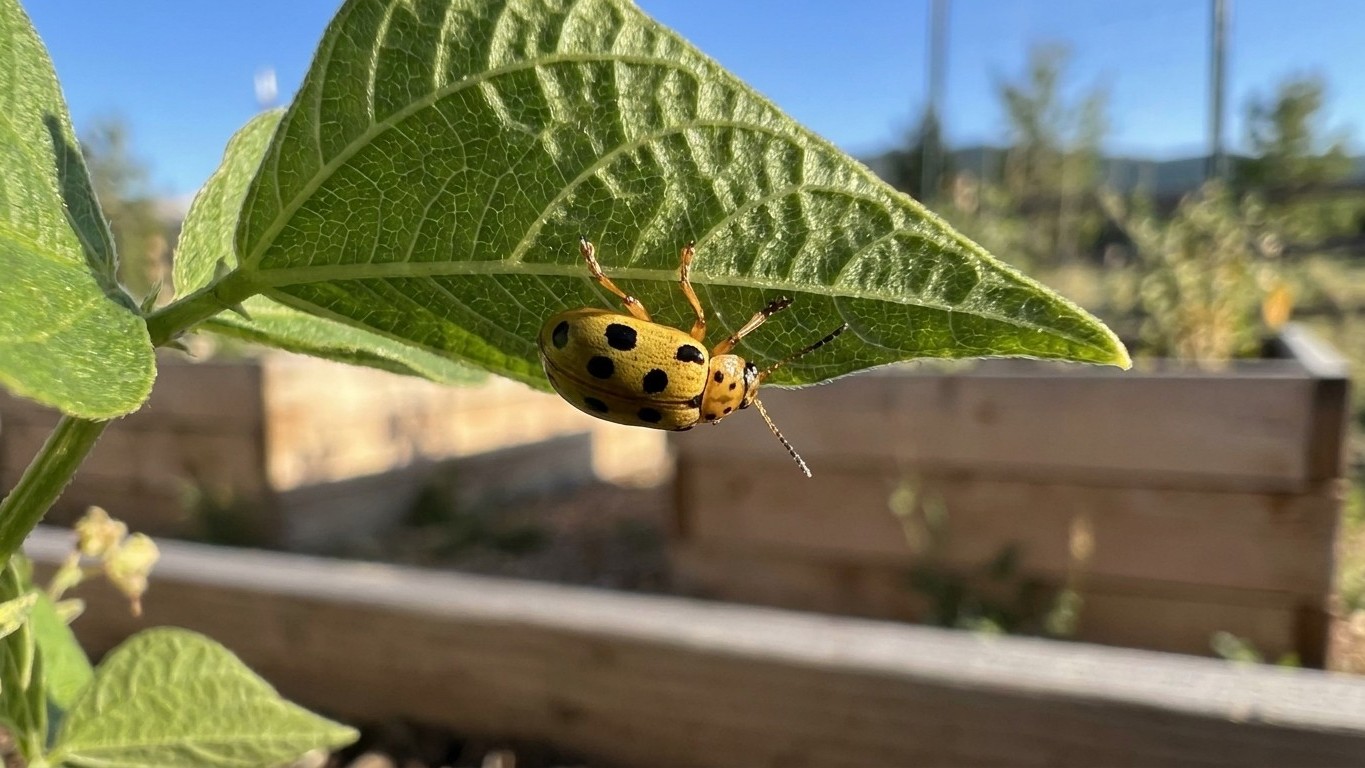

Mexican bean beetle shows up in Wyoming gardens mostly in July and August, and even then it’s rarely the widespread menace it is in states like Nebraska or Kansas. Cooler nights, a short growing season, and elevation above 4,000 feet across most of the state keep populations low and largely confined to a single generation per year. The beetle that does arrive gets stopped fastest with hand removal, row covers timed to egg-laying, and a follow-up spray of insecticidal soap or neem oil on the underside of leaves, where both eggs and larvae hide.
Is the Mexican Bean Beetle Actually a Wyoming Problem?

Not really, and that’s worth saying up front. The Mexican bean beetle (Epilachna varivestis) is native to the highlands of Mexico and spread northeast through the 20th century, becoming a serious pest of snap beans, lima beans, and soybeans across the Midwest and Southeast. Wyoming sits at the edge of its practical range. The insect needs a certain number of warm days to complete even one life cycle, and much of the state simply doesn’t offer that consistently.
Where it does turn up, it’s usually in the southeastern counties, Laramie, Goshen, and Platte, where irrigated bean and soybean acreage borders Nebraska and Colorado, both of which see heavier beetle pressure most years. Home gardeners in Cheyenne, Torrington, or Wheatland who grow snap beans in a sunny raised bed are more likely to spot one than someone gardening at 7,000 feet in Jackson or Lander, where cold snaps in June and September shorten the window even further.
Three cropping factors matter more than the beetle’s biology here. Wyoming’s average frost-free period runs roughly 90 to 130 days depending on elevation, compared to 180-plus days in the beetle’s Midwest strongholds. Bean planting typically waits until late May or early June after last frost risk passes. And most home plantings are small, a few rows or a raised bed, which makes hand control realistic in a way it isn’t on a 40-acre soybean field in Iowa.
Life Cycle and Timing in Wyoming’s Short Season
Adult beetles overwinter in leaf litter, woodpiles, and fence rows, then emerge when soil temperatures climb consistently above 60°F. In Wyoming that’s usually mid to late June, later than the beetle’s emergence in warmer states by three to four weeks. Females lay clusters of 40 to 60 yellow-orange eggs on the undersides of bean leaves, and a single female can produce 400 to 750 eggs over her lifetime under ideal conditions, though Wyoming’s shorter warm season limits how many she actually gets to lay.
Eggs hatch in five to fourteen days depending on temperature. The larval stage, spiny and pale yellow, does the bulk of the leaf damage over the following two to five weeks, feeding from the underside and leaving a lace-like skeleton of veins behind. Pupation happens right on the leaf, and new adults emerge to feed for another few weeks before the season ends.
In most of Wyoming, this whole sequence happens once per growing season. Compare that to Georgia or Missouri, where two to four overlapping generations can build populations to damaging levels by midsummer. One generation means Wyoming gardeners are dealing with a single wave of pressure, typically peaking from mid-July through late August, rather than a rolling infestation that restarts every few weeks.
How to Tell It Apart From a Beneficial Ladybug
This is where a lot of confusion happens, and it costs gardeners real damage. Adult Mexican bean beetles look almost identical to the ladybugs everyone wants in the garden. They’re coppery to yellowish-brown, oval, about a quarter inch long, with 16 black spots arranged in three rows across the wing covers. A native ladybug, by contrast, tends toward brighter red or orange with fewer, larger spots, and it never sits still on a bean leaf eating holes in it.
The larvae are the giveaway if the adult stage has you second-guessing. Mexican bean beetle larvae are yellow and covered in branching black spines, almost bristly looking, and they cluster on leaf undersides in groups. Ladybug larvae, which look like tiny alligators with orange markings, are predators moving actively across the plant hunting aphids, not sitting in one spot chewing.
Damage patterns confirm the identification fast. Mexican bean beetle feeding leaves a distinctive skeletonized, lace-like pattern where only the leaf veins remain intact, concentrated on the underside first before working through. Aphid damage looks like curling and yellowing without the lace pattern, and Japanese beetle feeding, which some Wyoming gardeners have started seeing on beans in recent years, tends to chew from leaf edges inward rather than leaving a net pattern.
What Stops It: Control Methods That Work
Hand-picking remains the single most effective tool for the scale most Wyoming gardeners are dealing with. A daily or every-other-day check of the undersides of bean leaves during late June and July, crushing egg clusters and dropping larvae and adults into soapy water, can keep a small planting essentially damage-free without any spray at all. It sounds tedious. It works, and it takes maybe ten minutes for a typical backyard row.
Floating row covers deployed at planting and removed once flowering begins (beans need pollinator access) block the first wave of adults from finding the plants and laying eggs in the first place. This matters most in years when overwintering adults survive in nearby hedgerows or garden debris and emerge right as young bean plants are at their most vulnerable.
For active infestations, insecticidal soap or neem oil applied directly to the underside of leaves, where eggs and larvae live, gives reliable control with minimal impact on pollinators when applied in early morning or evening. Pyrethrin-based products work faster against adults and larvae but should be used as a last resort since they’re less selective and can affect beneficial insects visiting the same plants.
Crop rotation and fall cleanup reduce the population available to overwinter nearby. Because Wyoming’s beetle populations are typically small and localized, removing bean debris after harvest and rotating bean plantings to a different bed the following year meaningfully cuts the number of adults that survive winter close enough to reinfest.
Biological Controls Worth Knowing About
A parasitic wasp called Pediobius foveolatus has been used successfully against Mexican bean beetle larvae in the eastern and midwestern US, where it’s released commercially each season because it can’t overwinter in most of the country’s climate. It hasn’t seen much use in Wyoming, largely because the pest pressure hasn’t justified the cost, but it’s an option worth knowing about for anyone managing larger bean or soybean acreage near the state’s southern border counties.
The spined soldier bug, a native predatory stink bug relative, feeds on Mexican bean beetle larvae and is already present in much of Wyoming’s insect community. Avoiding broad-spectrum insecticides preserves this predator along with lacewings and ladybugs, all of which help keep beetle numbers low without any intervention from the gardener.
Resistant bean varieties offer another layer of protection with essentially no ongoing effort. Some snap bean cultivars show measurably less feeding damage than standard varieties, largely due to leaf texture and chemical compounds the beetles find less palatable. Checking variety descriptions for beetle tolerance before ordering seed is a five-minute step that pays off over the whole season.
Given how limited the beetle’s foothold actually is across most of Wyoming, the practical takeaway for most home gardeners is that vigilance beats prevention spending. A few minutes checking leaf undersides during the peak window of mid-July through August catches the problem before it becomes one, and that’s true whether you’re gardening at 6,000 feet in Cheyenne or in a river-bottom plot near Torrington where soil warms just a little faster each spring.