
A footing drain set a few inches too high in the trench does almost nothing. Water keeps rising against the wall below the pipe, finds the cold joint at the base of the wall, and the basement floods the same season the drain was supposed to have fixed it. An exterior drain at footing depth relieves the pressure of groundwater against a foundation wall. It does not stop water coming from a leaking gutter, a cracked slab, or condensation, and it does not repair a wall that has already moved. Before anything else, find out where the water is actually coming from, because that decides whether a footing drain is even the right job.
What is actually going on

Water in the soil around a foundation doesn’t just sit there. When soil saturates faster than it can drain, from heavy rain, snowmelt, or a rising water table, that water pushes outward and downward under its own weight. That force is hydrostatic pressure, and it doesn’t care whether the wall holding it back is poured concrete, block, or brick. Given enough saturation and enough time, pressure finds every seam: the cove joint where the wall meets the floor slab, tie holes left from the original pour, hairline cracks that never mattered when the soil was dry.
A footing drain works by intercepting that water before the pressure builds. It sits at the depth of the footing, below the basement floor, in a bed of gravel that lets water move sideways into perforated pipe instead of upward against the wall. Done correctly, it lowers the water table right at the foundation and gives the water an easier path than through your wall. That’s the whole mechanism, and it’s worth being precise about it: this is relief, not repair. The drain doesn’t strengthen the wall, patch anything, or stop water from reaching the soil in the first place. It just gives water that’s already there somewhere else to go.
Of everything used to respond to a wet basement, an exterior footing drain is also the most invasive, since installing pipe at that depth means excavating around the foundation, work that carries real risk and belongs to people who do it for a living. It’s also the only fix here that addresses groundwater at its source rather than managing the symptoms after the fact. An interior drainage system, by comparison, collects water that has already entered the basement and routes it to a sump pump. It manages water. It does nothing to reduce the pressure building against the outside of the wall, and nothing for a rising water table pushing on the footing itself.
Why interior sealing isn’t a substitute
Paint-on or trowel-applied coatings on the inside of a basement wall do have a real job. They cut down on vapor movement through the concrete, which reduces musty smell and surface dampness caused by humidity. What they cannot do is stop water arriving under pressure from outside. Water under pressure doesn’t stop at a coating, it goes around it, usually surfacing at the next weak point, a few inches away or a few feet up the wall. Sealing the inside before dealing with the outside is a common way to spend money and still have a wet basement, just with the wet patch relocated.
What to look at, and in what order
Why order matters
Water needs to be traced back to its actual source before anyone touches the yard around a foundation. That’s a process of elimination, and it runs cheapest and least invasive first, because most wet basements turn out to have a cause simpler than a full footing drain. Skipping straight to the most invasive fix means paying for a footing drain when the real culprit was a downspout dumping water right at the foundation. For the fuller picture of how water moves through a foundation and a basement, see Foundations and Basements: Almost Everything Here Is Water.
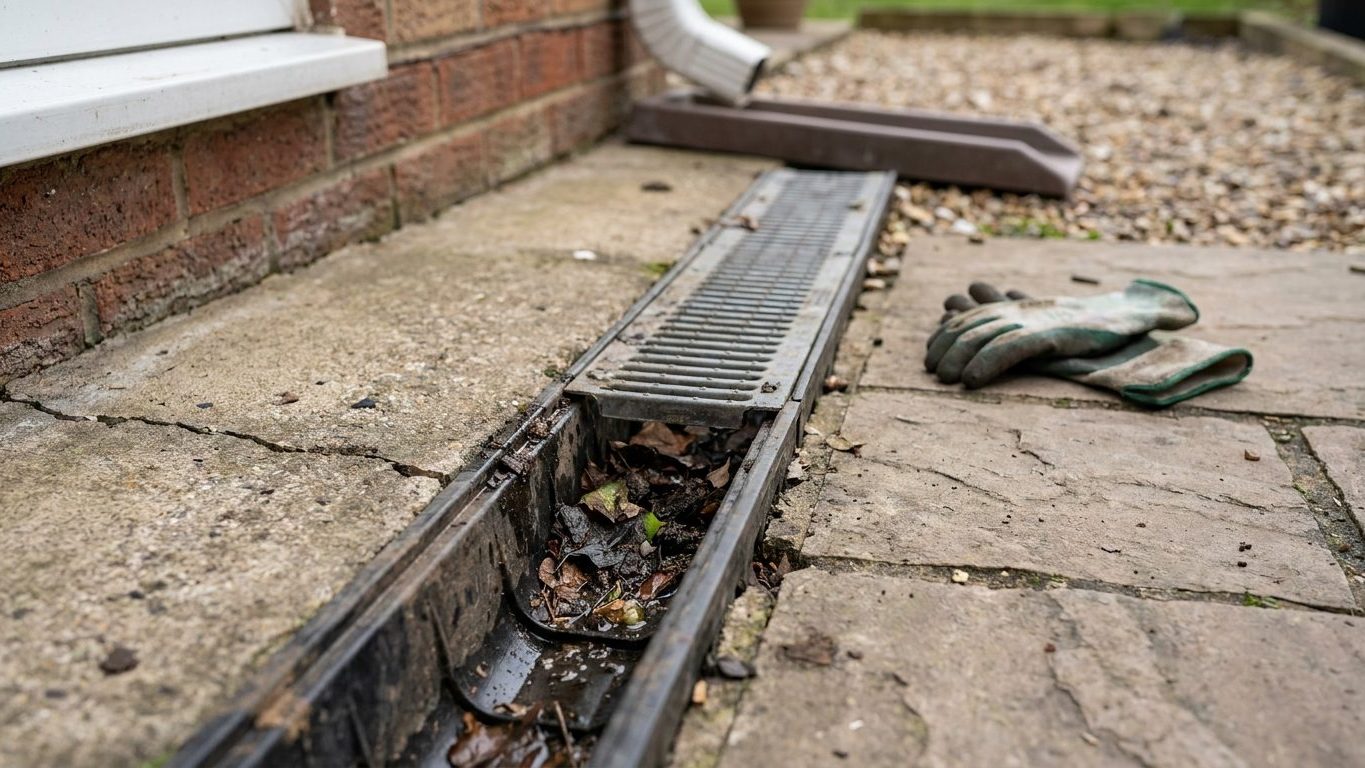
- Downspouts and grading first. Confirm downspouts carry water well away from the foundation rather than dumping it at the wall, and check which way the ground next to the house slopes, away from the wall or toward it. Water reappearing at the same spot every time it rains hard, then drying out within a day or two, points to surface water rather than a rising water table. This step rules out the simplest and cheapest cause before anything else gets blamed.
- Window wells next. Look for a well holding standing water, a clogged gravel bed at its base, or a missing cover during a storm. Seepage that shows up on the wall below a window and nowhere else in the basement usually rules out the rest of the foundation wall as the weak point.
- Test for condensation before assuming intrusion. Tape a small sheet of plastic to the wall and check it after a day: moisture on the room side of the plastic is condensation, moisture trapped against the concrete is the wall itself. Dampness that tracks with humid weather more than with rainfall rules out liquid water entry as the main problem.
- Watch how the sump pump and any existing interior drain behave during and after a heavy rain. A pump that cycles for days after the storm has passed, not just during it, points to groundwater feeding the system rather than surface runoff draining through quickly. That pattern rules out gutters and grading as the whole story.
- Only after the first four steps have been checked, and the wall is still taking on water tied to storms or a persistently high water table, does an exterior footing drain become the answer worth considering. It rules out nothing further on its own. It’s the response to what the earlier steps already ruled in.
Watch it, or get someone in
When to call which professional
A homeowner can reasonably track certain things across a season without any special tools. Note when moisture shows up relative to rainfall, note whether a wall crack is changing shape or simply staining the same way it always has, and keep an eye on efflorescence, that white powdery mineral deposit, to see if it’s spreading or just sitting there. A dated photo taken after each significant storm is more useful than memory. For how to read a crack itself, and which kind changes over time versus which kind has looked the same for years, see Which Foundation Cracks Matter, and Which Do Not.
Some signs move past the point of watching right away. A wall that bows inward, a crack that keeps opening at the same spot season after season, a door or window frame that’s gone noticeably out of square, or water entering even during dry stretches all mean it’s time to call a structural engineer, not schedule another look next spring. An engineer’s job is to assess the wall and say plainly what’s happening structurally. Because the engineer isn’t selling a repair, the assessment isn’t tilted toward recommending a particular fix, which matters more in this trade than in most.
A drainage contractor is a different call for a different problem: standing water in the yard, downspouts and grading that clearly aren’t working, or an exterior footing drain that’s actually warranted once the earlier checks point that way. A waterproofing salesperson is a third, separate conversation, and often the one homeowners reach first because that’s who advertises. Their proposal is worth hearing but shouldn’t be the only opinion in the room, since interior systems and coatings are usually what they’re set up to sell whether or not groundwater pressure is even the real problem.
What has to happen first
The sequence, in plain terms
The single most expensive mistake in this whole subject is doing the steps out of order: finishing a basement before the water problem is solved, or installing an interior system before checking whether gutters and grading could have handled it with far less disruption. Water gets addressed before anything else, no exceptions. That means outside drainage, gutters, grading, window wells, before any interior system, and interior systems before any finish goes back on a wall.
Gutters and downspouts are the cheapest link in this chain and the one skipped most often, because they seem too simple to be the answer. If the roof is shedding water at the foundation instead of away from it, no drain of any kind fixes that at its source, and the roofing side of the house needs its own attention first, a subject the roofing guides on this site cover in more depth.
A sump pump matters just as much on the mechanical side. Whatever water a footing drain or interior system collects has to go somewhere, and getting it well away from the house so it doesn’t soak straight back into the same soil is the pump’s whole job. The plumbing guides here cover pump selection and discharge routing.
Only once the water itself is under control does it make sense to think about what goes back on the walls and floor. Basement wall insulation installed over a wall that’s still taking on moisture just traps that moisture against the concrete, a point the insulation guides address directly. The same logic applies to flooring: a slab that hasn’t been confirmed dry isn’t ready for any finish that can’t tolerate moisture from below, and the flooring guides cover which materials handle that risk and which don’t. Diagnosis, then drainage, then the mechanical systems, then finishes, in that order, is the sequence that avoids paying twice for the same problem.
Common questions
Is a French drain the same thing as an exterior drain?
Usually yes. “French drain” is the common name for a trench of gravel with perforated pipe used to redirect water, either at the footing or elsewhere in the yard. An exterior footing drain is a specific version of it, installed at the depth of the foundation footing rather than just below the surface.
Can I run a drain around just the one corner that’s leaking?
Water in the soil around a foundation moves along the whole perimeter, not just at the spot where it happens to be entering the basement. A partial drain can relieve pressure at one corner while doing nothing for the saturated soil feeding it from the next wall over, so systems like this are usually run continuously around the affected sides rather than patched onto one corner.
Will an exterior drain mean I don’t need a sump pump anymore?
No. If anything it usually means the pump has more work to do, since the footing drain is now delivering water to it that used to sit in the soil or push through the wall instead. The two systems work together: the drain collects, the pump discharges.
My basement just smells musty and there’s no visible water, do I still need a drain?
Probably not right away. A musty smell with no standing water or wall staining usually points to humidity and condensation rather than liquid water intrusion under pressure, and that’s a ventilation and dehumidification problem, not a drainage one. Confirm which one you’re actually dealing with before spending money on either.