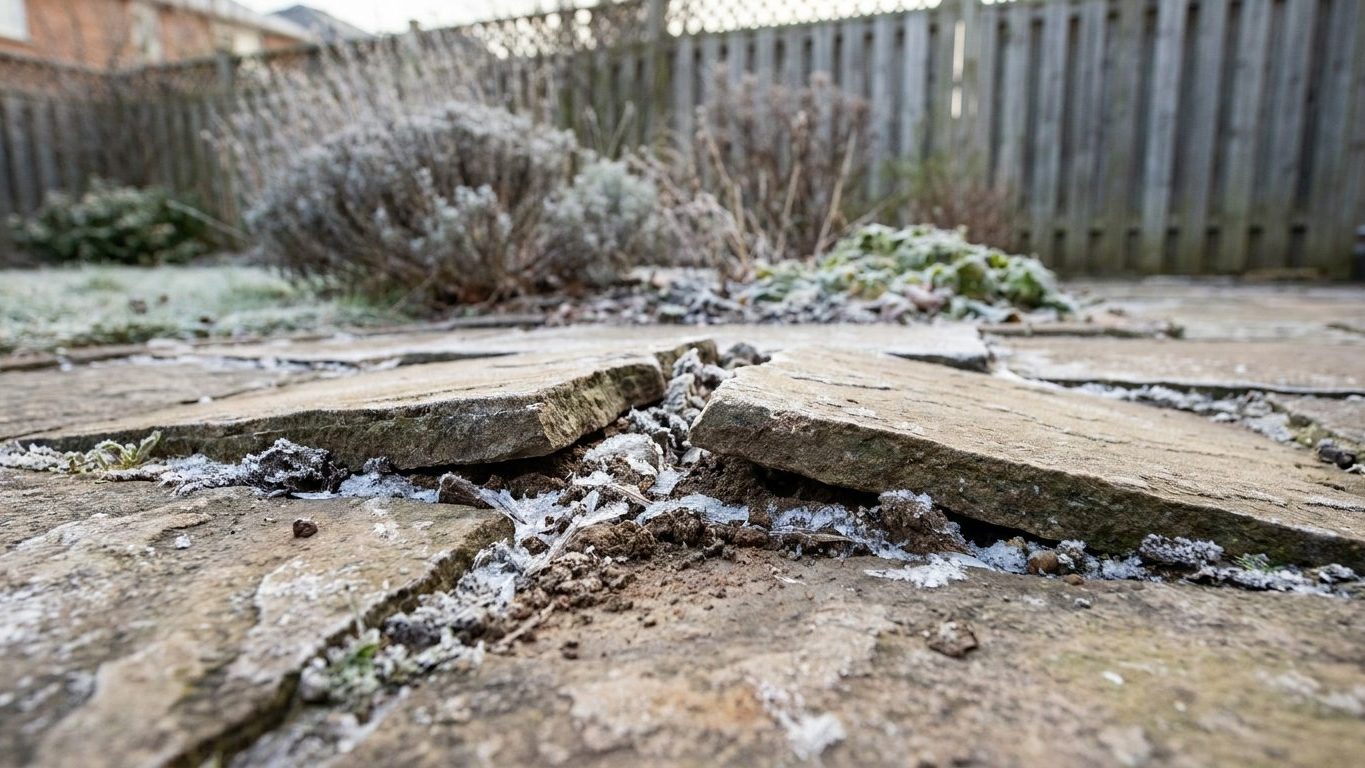

A porch step that rises every January and settles back by June isn’t settling at all, it’s being lifted by ice growing underneath it. That cycle repeats every winter until something below the frost line stops the water that feeds it. Check where your footings actually sit relative to your local frost depth before you touch any crack that opened last winter, because the crack is a symptom, not the cause.
What is actually going on

The mechanism behind frost heave is the ice lens. As the temperature at a given depth in the soil drops below freezing, the water already there turns to ice. That ice doesn’t just sit still. It pulls more moisture toward it from the surrounding soil through capillary action, the same wicking action that lets a paper towel draw water up out of a bowl. The new water freezes onto the existing ice, and the lens grows in layers, like a cake rising from the bottom. Because ice takes up more room than the water that formed it, something has to move, and what moves is whatever sits above the lens: a slab, a footing, a fence post, a porch step.
Not every soil does this equally. Silt and fine sand hold and move water through capillary action far more readily than coarse sand or gravel, which drain too quickly for a lens to build. That’s why two houses on the same street, on different pockets of soil, can have completely different histories with this problem. A house sitting on well-drained gravel might never see a heaved slab. A house forty feet away, on silty clay, might fight it every year.
Why it comes back every winter
Frost heave is seasonal by nature. The lens grows through the cold months as the freeze front pushes deeper, then the ice melts from the surface down as temperatures climb, and whatever it lifted often drops back close to where it started. That rise-and-fall pattern is actually one of the clues that separates frost heave from other kinds of foundation movement, which tend to be one-directional and don’t reverse themselves each spring.
Where this gets serious is when the movement isn’t uniform. A slab or footing that lifts evenly is one thing. A footing that lifts on one corner and not the other twists the structure above it, and that twisting is what produces cracking in block, brick, or drywall. A crack that appears after a winter of uneven heave can be entirely cosmetic, or it can be telling you that a footing has shifted permanently out of level. There is no width or pattern you can safely read yourself and call normal. Only a structural engineer can determine whether a crack reflects surface movement or a real change in how the structure bears its own weight, and this page stops there rather than guess on your behalf.
For the bigger picture of how water moves through and around a foundation before it ever gets cold enough to freeze, see Foundations and Basements: Almost Everything Here Is Water.
What to look at, and in what order
Work from the cheapest, least invasive check to the ones that need a professional. Each step either confirms frost heave or points you toward something else entirely, and each one rules something out before you spend money on the next.
| Check | What it involves | What it suggests | What it rules out |
|---|---|---|---|
| Seasonal pattern | Note whether a gap, a lifted step, or a sticking door shows up only in the cold months and eases off by late spring | A cycle tied to freeze and thaw points toward frost heave | A steady, year-round, one-way movement that never reverses |
| Photo record | Take a dated photo of the same spot from the same angle every few weeks through one winter, without touching anything | Movement that grows then shrinks confirms a seasonal, not a permanent, shift | A crack that keeps widening straight through summer |
| Grading and gutters | Walk the perimeter after rain and see where water is pooling against the foundation instead of running away from it | Standing water next to the footing feeds exactly the kind of wet, frost-susceptible soil that grows ice lenses | A dry perimeter with good slope, which shifts suspicion toward soil type or footing depth instead |
| Soil type | Dig a small handful of soil from a flower bed near the affected area and check whether it’s silty, sandy, or a mix | Fine, silty soil that holds water is the kind most prone to heave | Coarse sand or gravel, which drains too fast to build a lens |
| Footing depth records | Check permit or survey records, or ask a professional to confirm how deep the existing footings actually sit | A footing that sits above the historical frost depth for the area is a strong match for heave | A footing already well below frost depth, which points toward a different cause of movement |
| Engineer inspection | Bring in a structural engineer to assess crack patterns, floor level, and footing bearing directly | Confirms whether movement is cosmetic, seasonal, or structural | Nothing below this step, it’s the final word |
Footing depth exists for exactly this reason. A footing set below the depth to which the ground actually freezes sits on soil that never forms an ice lens under it, because that soil never freezes in the first place. When a footing was poured shallow, or when the ground around it has been disturbed and no longer insulates the way it did, that depth advantage disappears. Your local building department or a structural engineer can tell you the frost depth standard your area was built to, and whether your footings meet it, since that figure changes from one county to the next and isn’t something to guess at from a guide like this one.
Watch it, or get someone in
This is the part homeowners get wrong most often, mixing up what’s safe to track yourself with what needs a professional look right away. The two lists below aren’t interchangeable.
- A step or slab edge that rises in winter and returns close to level by late spring, year after year, in the same amount
- Hairline cracks in an unfinished basement or garage slab that don’t change width across a season, tracked with a dated photo
- A door or window that sticks only during the coldest months and works fine the rest of the year
Those are patterns you can reasonably keep an eye on yourself, with a photo log and a bit of patience across one or two winters.
- A crack that keeps growing across seasons instead of returning to its previous size
- Diagonal, stair-step cracking in a block or brick foundation wall
- A floor or slab that is now visibly out of level and not returning to level as it did in past years
- Doors or windows that no longer close at all, even outside the cold months
Any of those calls for a structural engineer, not a contractor and not a repair crew. An engineer’s job is to assess the movement and tell you what’s actually happening to the structure. They have no repair to sell you, which is exactly why their opinion is worth paying for on its own, separate from whoever ends up doing the work. A waterproofing salesman evaluating a wet basement wall is not the same call as an engineer evaluating a cracked footing, and a drainage contractor regrading your yard is a third call entirely, dealing with the water before it ever reaches the soil near your footings. Keep those three roles separate in your head, because a company that both diagnoses and sells the fix has an obvious incentive built into that diagnosis.
What has to happen first
The order matters more than any single repair, and this is where money gets wasted on this subject more than almost any other. Outside water management comes before anything happens inside. If water is pooling against the foundation because of poor grading or gutters dumping straight down beside the wall, that has to be fixed first. It feeds the same wet soil conditions that grow ice lenses in winter and cause water intrusion the rest of the year, which is covered in more depth in Why a Basement Is Wet: The Four Sources.
Gutters that discharge next to the foundation instead of well away from it are one of the most common contributors, and that’s a roofing question before it’s a foundation one. A sump pump handling groundwater that’s already made it past the footing is a plumbing question, downstream of the drainage fix rather than a replacement for it. Neither should be the first move if water is still landing right beside the wall every time it rains or the snow melts.
Diagnosis comes before repair, always. Cosmetic patching over a crack that hasn’t been assessed hides the exact movement a professional needs to see, which is why no crack should be filled or covered until it’s been looked at by someone qualified to say what caused it. Once diagnosis is done and drainage is under control, interior work like insulating basement walls or choosing what goes over a slab floor can proceed without redoing it in two years because water or ice undid it. Crawl spaces are especially exposed to this cycle since they’re shallow and unheated by design, which is why sealing one properly, as covered in Sealing a Crawl Space: What It Involves, only makes sense once the water and frost issues around it are settled first.
Common questions
Does frost heave only happen to old houses?
No. Age isn’t the deciding factor, footing depth and soil type are. A newer house built on shallow footings over silty soil can heave just as readily as an older one, and an old house with deep footings on gravel may never show it.
Can frost heave damage underground pipes?
Yes, shallow water and sewer lines can be pushed, cracked, or misaligned by the same freezing and expansion that lifts a slab or a footing. Depth below the frost line matters for buried pipe just as much as it does for foundations, and a plumber or engineer can confirm whether a line sits deep enough for your area.
Will adding insulation around the foundation stop frost heave?
Insulation can reduce how deep and how fast the ground freezes near a footing, which is one reason some foundations are built with rigid insulation at the perimeter. It’s not a fix on its own if drainage is poor or the soil is highly frost-susceptible, and it should be planned with a professional rather than added after the fact as a patch.
My slab lifted this winter but looks fine now, do I still need to call anyone?
If it returned close to where it started and the pattern repeats every year without getting worse, that’s the kind of thing you can keep monitoring with photos rather than call someone urgently about. If this is the first time it’s happened, or the return each spring is less complete than the year before, get a structural engineer to look before deciding it’s nothing.