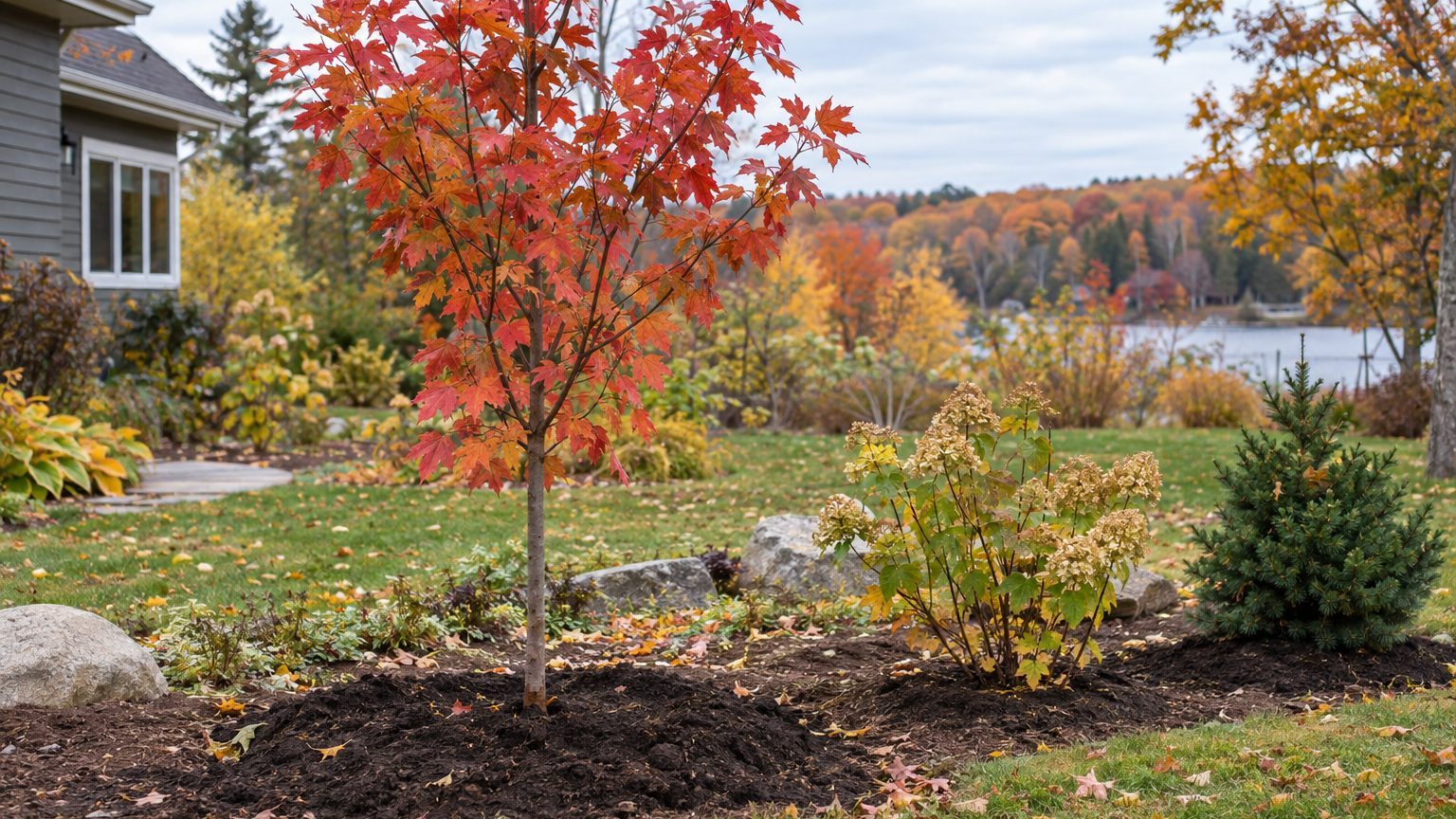

For trees and shrubs in Alabama, the safe fall target is September 21 to October 5, which is six weeks before the first fall frost. NOAA’s 1991-2020 Climate Normals put that frost at November 2 to November 16 at the Huntsville-area airport station. Treat the date as a conservative marker, not a cliff. Where the ground doesn’t freeze, as at Huntsville, roots keep working all winter, and hardy container plants can go in well after the target as long as you keep them watered.
The deadline in Alabama
Roots don’t keep the same calendar as leaves. Top growth shuts down as days shorten and nights cool, but soil gives up its heat slowly, and roots keep pushing outward as long as the ground is workable and above freezing. That gap between cold air and cold soil is the whole reason fall planting works. A tree set out in October spends months building roots, then meets its first Alabama summer with a head start that a spring-planted one has to earn under heat stress.
Cornell Cooperative Extension states the rule this way: “Fall is an excellent time for transplanting, provided you get them to their new home at least 6 weeks before the ground freezes, allowing them time to establish roots before winter dormancy.” Look at what it counts from. Not the first frost, which is a reading of air temperature, but the day the ground freezes, which comes later. Counting back from the first frost instead builds in a cushion.
The numbers for Alabama
The NOAA NCEI 1991-2020 Climate Normals for the Huntsville airport station show the first fall freeze at 32°F arriving between November 2 and November 16 (that is the 30 to 70 percent probability band). Six weeks earlier gives the working dates:
- First fall frost at the reference station: November 2 to November 16
- Conservative planting deadline: September 21 to October 5
- True biological limit: the day the ground freezes, which falls later than the first frost
Write down September 21 to October 5 as the safe target for trees and shrubs, and think of anything planted afterward as a bonus rather than a gamble. In colder gardens the true limit arrives sooner, which is why the target matters more there.
In much of the state that limit may never show up. NOAA’s Climate Normals for Huntsville list a mean daily minimum of 33.1°F for the coldest month, and that sits above freezing. Where that holds, the ground does not freeze, and Cornell’s six-week deadline does not apply. So say it plainly: fall and even winter are the best time to plant in those areas. Cool air keeps leaf water demand low while the soil stays open for roots. (The 33.1°F figure is an average of nightly lows, so individual nights still dip below freezing now and then. It just doesn’t lock the soil.)
Adjusting for your own county
Airport stations run warm. Suburban and rural gardens typically see the first fall frost earlier than the airport does, often by one to two weeks, and more at higher elevation. Farther north and higher up, the first frost comes sooner, so every fall task, planting deadline included, shifts earlier. Treat the Huntsville numbers as one reference point, never a statewide guarantee, and check your own county’s dates in First and Last Frost Dates in Alabama before you pencil in a planting weekend.
What to plant late, and what to wait on
Good candidates for late planting
Container-grown and balled-and-burlapped plants that are fully hardy in your zone are the easy wins. The USDA Plant Hardiness Zone Map (2023 edition, built on 1991-2020 normals) places Alabama in zones 7a to 9a. That is a statewide range, and the zone rests on one variable, the average annual extreme minimum temperature, so look up your own ZIP code instead of assuming. A plant rated comfortably for your zone has cold tolerance to spare, and that margin is what lets it settle in without drama.
Deciduous trees and shrubs lead the list. Once their leaves drop, they need almost no water for foliage, so nearly all their energy goes below ground. Shade trees, flowering trees, and hardy deciduous shrubs planted from October into winter, while the soil is workable, tend to establish well. Dig the hole wide rather than deep, set the plant at the same depth it grew at, and tease apart any roots circling the container. The basics are laid out in Planting and Caring for Trees, Shrubs and Perennials.
| Plant type | Late-fall outlook | Reason |
|---|---|---|
| Hardy deciduous trees and shrubs | Good, through winter while soil is workable | Dormant tops, little water demand, roots keep growing |
| Hardy evergreens | Best inside the September 21 to October 5 target | Leaves keep losing water all winter |
| Balled-and-burlapped stock | Good if hardy in your zone | Root ball is protected, but it still needs watering |
| Plants at the edge of their zone rating | Wait for spring | A cold snap can outrun a small root system |
Better left for spring
Evergreens, both broadleaf and needled, keep their foliage and keep losing water through winter. A newly planted one has a small root system to replace that water, so it rewards early planting. Aim for the September 21 to October 5 target, and if you miss it, plant anyway but commit to watering through every dry spell. Winter rain is unreliable enough that leaving it to chance is a bad bet.
Borderline plants are the real problem. A shrub sold at the edge of its hardiness rating may shrug off a cold night once it has a full root system, but a fall-planted one hasn’t built that system yet. Its coldest-month average may look mild on paper, and the hardiness zone, not the 33.1°F monthly figure, is what predicts survival. Wait until spring for anything rated at the edge of your zone, so it gets a full growing season before it meets its first hard freeze.
Watering and mulch until the ground freezes
Why the first winter is about roots
A fall-planted tree can look like it’s doing nothing for months. Underground, it is busy. Roots grow out from the root ball into the surrounding soil, and that growth is what carries the plant through its first summer. This is why you resist the urge to fertilize or prune for shape in fall. Fertilizer coaxes tender new leaves that the next cold snap will burn, and it pulls the plant’s attention toward the wrong end.
Watering deeply
Water thoroughly at planting, then keep the soil around the root ball damp but never soggy. A slow trickle at the base soaks deep, while a quick spray wets only the surface. Container root balls dry faster than the soil around them, so a plant can sit in damp ground and still be thirsty. Check by feeling the soil at the edge of the root ball, and water when it feels barely damp.
Where the ground freezes, the rule is to keep watering until freeze-up. Where it doesn’t, as at Huntsville, there is no cutoff date: watering simply continues through any dry stretch all winter, easing off when rain does the work for you. Evergreens need the most attention, because they never stop transpiring.
Mulch in a ring, not a volcano
Mulch does two jobs, and NC State Extension’s Gardener Handbook (chapter 11, Woody Ornamentals) gives a depth for each. On weeds: “A 2-inch to 3-inch layer of mulch suppresses most annual weed seeds and makes it easy to hand-pull any that do germinate.” On trees: “Provide a 3-inch layer of mulch to reduce water loss and maintain uniform soil moisture and temperature around roots.” Two purposes, one depth range.
Keep mulch to a 2-inch to 3-inch ring and pull it back from the trunk. Deeper is not better. A mound piled against the bark holds moisture where the bark should stay dry, which invites rot and gives pests a hiding place. The trunk flare, where the trunk widens toward the roots, should stay visible. Spread the ring wide, flat, and thin at the center. Mulching Without Killing the Plant covers the details.
What goes wrong
The first failure is planting too late for your part of the state. In colder, higher-elevation gardens the first frost comes earlier than the airport figures suggest, so the safe target moves earlier too, and a shrub put in after it gets fewer weeks of root growth. Late planting doesn’t guarantee a loss, but it removes the margin. For a comparison with a state that has a different frost calendar, see How Late Can You Plant Trees and Shrubs in Fall in Arkansas?
Winter burn and frost heave belong to places where the soil actually freezes. Frozen roots can’t replace water that evergreen leaves lose, so the foliage browns, and repeated freezing and thawing can push shallow root balls upward. At the Huntsville reference station, with a coldest-month minimum of 33.1°F, the ground does not freeze, so neither is the worry there. In colder pockets where a hard winter does stiffen the soil, water evergreens well before it happens, break the wind if you can, and press any lifted root ball back down after a thaw.
The failure that catches most Alabama gardeners is simpler: a dry fall. Autumn can go weeks without meaningful rain, and a new plant with a small root system depends entirely on you. Container mixes are the worst offenders, because a dried-out root ball sheds water instead of absorbing it. Water through every dry stretch, from planting day until reliable rains return. A hose left on a trickle for a while beats a daily sprinkle.
Common questions
Can I plant trees in Alabama in December or January?
In areas like Huntsville, where the coldest month’s average low stays above 32°F, the ground does not freeze, so hardy container and balled plants can go in through winter whenever the soil is workable. Water them through dry spells, and skip anything rated at the edge of your zone. Colder, higher parts of the state have less room, so check your county’s frost dates.
Does the September 21 to October 5 deadline apply everywhere?
It is a conservative target built from the Huntsville airport station’s first frost of November 2 to November 16. Suburban and rural gardens often see frost one to two weeks earlier, and higher ground earlier still, so shift the target earlier there. In warm areas where the ground doesn’t freeze, the deadline doesn’t apply. More seasonal dates are collected in the Alabama guides.
What hardiness zone is Alabama?
The USDA Plant Hardiness Zone Map (2023) lists zones 7a to 9a for the state. It is based on the average annual extreme minimum temperature, and your garden sits in one specific zone within that range. Look up your ZIP code, then buy plants rated for that zone.
Is fall better than spring for planting trees?
For hardy plants, generally yes. Fall planting gives roots months of workable soil and low leaf water demand before the first summer heat, while a spring planting has to build roots as temperatures climb. The exceptions are borderline plants and evergreens planted late, which usually do better in spring.