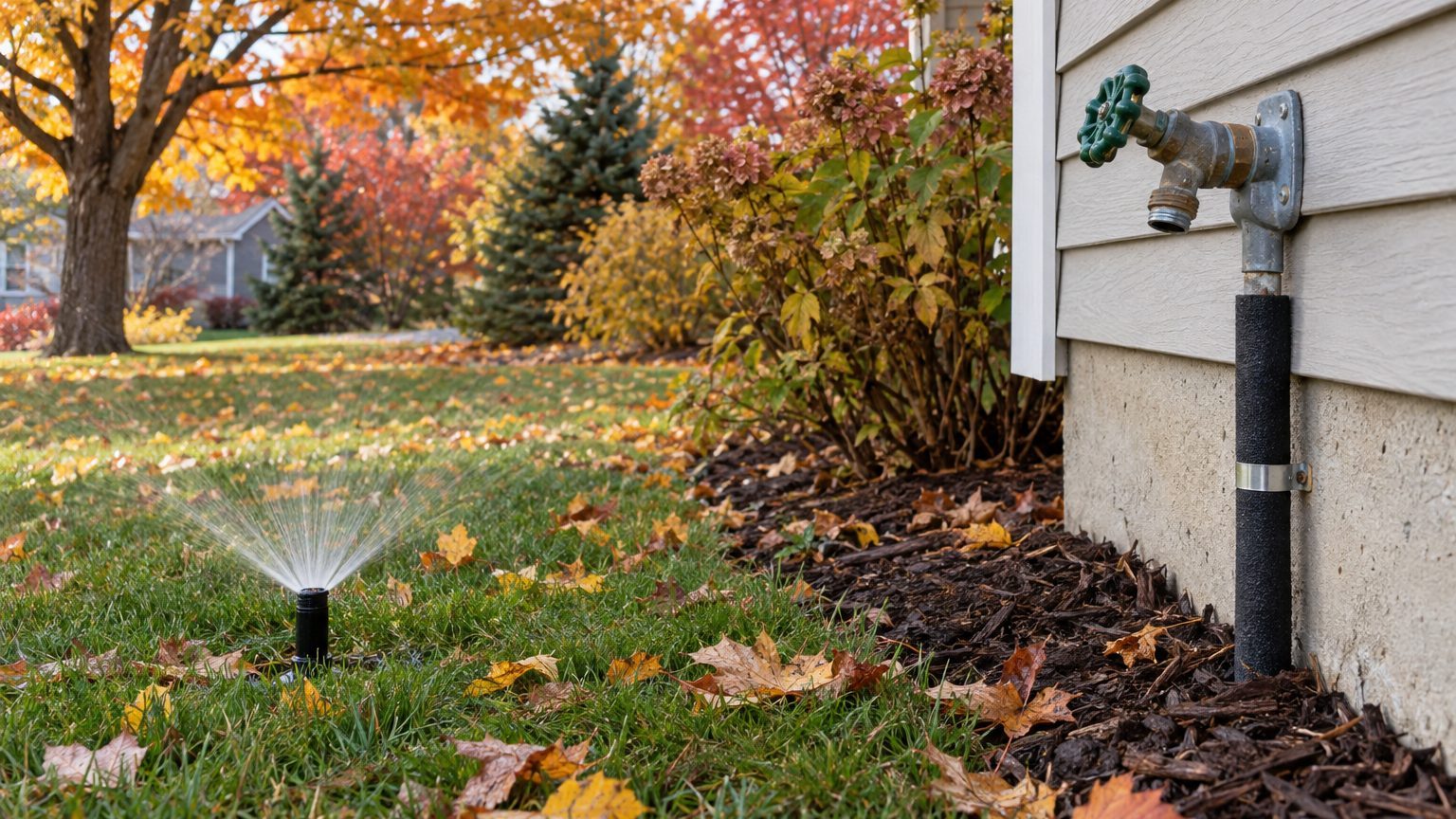

Sprinklers and outdoor spigots in Alaska get shut down in September, not November. Cold arrives fast here, and pipes and soil have little chance to warm back up once it does. A lawn system that goes into winter with water still in it risks coming out with cracked fittings. Below: the timing, the method for each part of the system, and the failures this climate makes most likely.
When to do it in Alaska
In Anchorage, plan to shut down sprinklers and outdoor faucets before the first hard freeze, not after the first light one, which puts the work in the days leading up to a September 22 to October 1 window. That range comes from NOAA NCEI’s 1991-2020 Climate Normals for the Anchorage station (USW00026451), where the probability of a 32°F freeze sits in the 30 to 70 percent band across those dates.
Write this one down: finish the sprinkler blowout and faucet shutdown before the September 22 to October 1 window opens. That gives you a margin on both sides. If a cold night arrives early, you are already done. If autumn drifts warm, you lost nothing but a few weeks of watering a lawn that was slowing down anyway.
A full blowout is not a step you can skip in Alaska. Milder states sometimes get away with a quick spigot check because their winter nights never get close to freezing. Here the mean daily minimum of the coldest month is 11.0°F, according to NOAA NCEI’s 1991-2020 normals for Anchorage. That is the average low, not the record, so plenty of nights run colder. Water trapped anywhere in an outdoor line will freeze solid at some point, and there is no gray area to hope for.
Why the first light frost is a warning, not a deadline
A single frosty morning in September rarely hurts buried pipe. The ground still holds summer heat, and the air warms again by afternoon. What damages plumbing is the stretch after that, when nights stay below freezing, the soil cools, and exposed parts like the backflow assembly, the valve box and the spigot stem have no chance to thaw. The trouble is that nobody can say which frosty morning is the last easy one. Treating the first light frost as the signal to begin, rather than the signal to start thinking about it, keeps you on the right side of that gap.
Anchorage sees about 143 frost-free days, per the same NOAA data, and it is one of the mildest inhabited parts of the state. Long summer daylight makes the short season feel generous, which is exactly why people keep watering into September and let the calendar slip.
Colder parts of the state run earlier
The Interior and the north have far shorter seasons than Anchorage, and higher elevations cool sooner too. In those places the first fall frost comes earlier than the Anchorage window, so the shutdown belongs earlier as well, ahead of the September 22 date rather than inside it. The USDA Plant Hardiness Zone Map (2023 edition, built on 1991-2020 normals) runs from zone 1a to 8a across Alaska, and that spread is a fair reminder that one date does not fit the whole state. Use the Anchorage range as a reference point, then move earlier the colder your location. More regional detail lives in our Alaska guides.
Sprinkler lines: drain or blow out
Water expands as it turns to ice. Inside a pipe, that expansion has nowhere to go, so the pressure builds until the weakest point gives way: a threaded fitting, a valve body, the seam of a plastic pipe, a sprinkler head riser. The break often happens where a pocket of water sits low in the line, and you will not see it until the system runs again in spring. Then water sprays out of the ground or floods a valve box, and finding the crack means digging.
Three ways to clear the lines
Manual drain uses valves at the low points of the system. You open them, water runs out by gravity, and you close them again. Automatic drain valves do the same thing on their own when line pressure drops. Compressed-air blowout forces the water out through the heads, zone by zone, using an air compressor connected to the system.
| Method | How it works | What it can leave behind | Fit for Alaska |
|---|---|---|---|
| Manual drain | Low-point valves opened by hand | Water in heads, risers and sags in the pipe | Weak on its own |
| Automatic drain | Valves open when pressure drops | Water in low spots that never reach a drain valve | Weak on its own |
| Compressed-air blowout | Air pushes water out of each zone | Very little, if every zone is cleared | The reliable choice |
Gravity drains depend on the pipe sloping the right way and every low point having a valve. Real yards, with settled soil, added beds and repairs over the years, seldom match the original plan. In a climate where the coldest month averages 11.0°F at night, a few ounces of leftover water is enough to do damage. So blow out every zone with compressed air, and use the drain valves as a supplement, not a substitute.
Doing the blowout yourself is possible but easy to get wrong. Too much air pressure can split pipe or blow apart heads, and a compressor that is too small will not move the water out of a long zone. The air must go through each zone in turn, cycling until the heads spit mist instead of water, and running air through a dry head or valve for too long wears it. Sprinkler crews carry the right equipment and know the settings for different pipe types.
Hiring a professional is the sensible move if you do not know what your pipe is made of, if you have never seen the compressor connection point on your system, or if the backflow preventer is complicated. The same goes if your system has many zones or drip lines. Paying someone once each fall costs less than digging up a yard in May.
Leave the system’s main shutoff closed after the blowout, and open the controller’s rain mode or turn it off so no zone tries to run. Any water that reaches a cleared line in a warm afternoon can freeze there overnight.
Outdoor faucets and hoses
The rule takes about ten minutes per spigot. Unscrew every hose, splitter and sprayer, then close the interior shutoff valve that feeds the outdoor tap, then open the outdoor tap and leave it open so the line drains. That is the whole job. Anything beyond turning valves, like cutting into a line, replacing a valve, or fixing a leak you find, belongs to a plumber.
Disconnect every hose before the first frost window, and leave the outdoor tap open all winter. A hose left on the spigot holds water against the faucet, and it can hold that water in a freeze even when the hose looks empty, because a small amount always stays in the coil and fitting. A closed spigot cap or a connected hose blocks the drain path, and the water you just tried to remove has nowhere to go.
A frost-free faucet does not save you from this. Its design puts the valve seat well inside the heated wall, and the long stem carries the shut-off point away from the cold. When the tap closes, the water left in the barrel between the seat and the spout runs out the end, provided the faucet tilts slightly downward and nothing is attached. Attach a hose, even a coiled and empty-looking one, and that water stays in the barrel outside the warm zone. It freezes there, splits the pipe, and the failure hides until spring, when the faucet is turned on and water pours inside the wall. Our page on Frost-Free Outdoor Taps covers how these fixtures work in more detail.
Older spigots without the long stem are more exposed. They need the interior shutoff closed and the outside tap drained as described, and if you cannot find or operate the interior valve, that is a call for a plumber before the freeze, not after. For a walk-through of the full sequence, see Winterizing Outdoor Faucets Before the First Freeze. And if a line does freeze despite your work, the steps in Frozen Pipes explain what to do and what to avoid.
What goes wrong here
The early cold snap
Everyone plans to do it “next weekend.” Then a hard freeze arrives in late September, sooner than the middle of the range, and the system is still full. The sign in spring is a zone that will not build pressure, heads that spray sideways or not at all, or a puddle over a buried line. Prevention is boring: start early in the September 22 to October 1 window’s lead-up, not inside it, and treat a forecast cold night as a hard deadline. In colder parts of the state, start earlier still.
The forgotten hose
A hose coiled behind a shed, or left on a tap at the back of the house, is the classic miss. The damage shows up in spring as water spraying inside a wall, a wet ceiling below an outside faucet, or a tap that will not shut off. Walk the whole exterior with a checklist, including the garage and side yard, and look at every spigot, not just the ones you use. Bring hoses inside for the winter so they cannot be reattached by accident.
The flooded valve box
Valve boxes sit in the ground and collect meltwater and groundwater. If standing water covers the valves, then freezes, it can crack the valve bodies or the fittings around them, and the failure is invisible until the system starts. In spring you might see a zone that runs continuously, or a box full of water with a slow leak. Check the box before winter: clear debris, make sure the lid fits, and note any standing water so a pro can look at drainage. Confirm every valve box is dry before the September 22 to October 1 window, because after that, the ground stiffens and the job gets harder.
Before you turn anything back on in spring, walk the yard for wet spots and check inside the wall behind each outdoor tap. Open valves slowly, one at a time. Fall is also the moment to finish the rest of your outdoor list, and Winterizing a Lawn pairs naturally with a sprinkler shutdown.
Common questions
Can I wait until the first snow to winterize my sprinklers?
Waiting for snow is too late in most years. In Anchorage the probability of a 32°F freeze reaches the 30 to 70 percent band between September 22 and October 1, per NOAA’s 1991-2020 normals, and snow tends to follow the freeze, not lead it. Finish before that window opens.
Do I need to blow out the lines if I use only a hose sprinkler?
No. A sprinkler you attach to a hose has no buried lines to clear. Drain the hose, coil it, store it indoors, and follow the outdoor faucet steps: interior shutoff closed, outside tap open. The buried-line blowout applies only to in-ground systems.
Does a frost-free faucet need any winter prep?
Yes, just less of it. Remove every hose and attachment so the barrel can drain, and confirm the faucet is not sitting level or tilted upward. A frost-free tap with a hose left on can freeze and split inside the wall, and you may not find out until spring.
Does the date change in the Interior or the north?
It moves earlier. Colder parts of Alaska, including the Interior and the north, and higher elevations get their first fall frost sooner than Anchorage. The Anchorage window of September 22 to October 1 is a reference for that city, and the shutdown for a colder location should happen ahead of it. Watch local forecasts for the first night that dips near freezing, because the Anchorage station’s 143 frost-free days is a longer season than most of the state gets.